What you’ll learn in this article…
- Most Ohio advanced standing MSW programs finish in roughly one year full time.
- Cleveland State and the University of Akron deliver fully online formats.
- Ohio LSW licensure requires the ASWB exam after earning your CSWE-accredited MSW.
How long does an advanced standing MSW actually take in Ohio? For BSW graduates, the accelerated timeline is the primary draw: most programs range from 9 to 18 months of full-time study, effectively halving the traditional two-year path. Ohio holds eight CSWE-accredited advanced standing options from Cleveland State, the University of Akron, Ohio State, University of Cincinnati, and others, spanning online, campus, and hybrid formats. That geographic and delivery flexibility eliminates the need to relocate for many working professionals. With concentrated coursework and supervised field hours already secured, the state's advanced standing pathway turns a BSW into an MSW faster than almost any other graduate route in social work.
Best Advanced Standing MSW Programs in Ohio: 2026 Rankings
The advanced standing MSW programs below are among Ohio's strongest CSWE-accredited options for BSW graduates. Several offer online or hybrid delivery, so you can earn your degree without relocating. As you compare, remember that graduation rates are institution-wide figures, not program-specific outcomes.
| Rank | School | Location | Net price | Best for | |
|---|---|---|---|---|---|
| #1 | Ohio State University | Columbus, OH | $17,000/yr (net price) | Recent BSW grads seeking flexible online clinical study | |
Ohio State's Advanced Standing Alternative Plan (ASAP) MSW is built for recent BSW graduates from CSWE-accredited programs. The curriculum offers four areas of emphasis: Aging and Health, Mental Health and Substance Misuse, Child and Youth Services, and Community and Social Justice. Students can study on campus in Columbus or online with synchronous and asynchronous options, and Ohio residents and online students pay in-state tuition. Field education draws on more than 1,500 agency partners.
| |||||
| #2 | Case Western Reserve University | Cleveland, OH | $41,000/yr | Working professionals needing weekend or online MSW | |
The Mandel School at Case Western Reserve University delivers an accelerated advanced standing MSW that builds on your BSW foundation. You can complete 39 credits and 500 hours of field education in as little as one year on campus, or choose part-time weekend and online options designed for working professionals. The curriculum emphasizes advanced clinical and community practice within small cohorts, and the program is fully accredited by CSWE.
| |||||
| #3 | Miami University | Oxford, OH | $18,000 – $41,000/yr | Aspiring school and healthcare social workers | |
Miami University's advanced standing MSW is a one-year, 34-credit program for graduates of CSWE-accredited BSW programs. The curriculum focuses on advanced generalist practice and includes a 500-hour field placement across two semesters. Offered in a hybrid format with full-time and part-time pathways, the program prepares graduates for Ohio social work licensure and careers in healthcare, school social work, mental health, and community organizations.
| |||||
| #4 | Ohio University | Athens, OH | $22,000/yr | ||
Ohio University offers advanced standing MSW students two paths: a one-year hybrid campus program that meets one day per week in Athens with a rural practice clinical focus, and a fully online option that can be completed in as few as 24 months. Both formats emphasize clinical social work and interdisciplinary learning, with field placements available at hundreds of agencies. The hybrid track is full-time with a summer start; the online track offers three start dates and part-time pacing.
| |||||
| #5 | University of Toledo | Toledo, OH | $13,000 – $22,000/yr | ||
The University of Toledo's advanced standing MSW is a 33-credit, one-year program that follows an advanced generalist model. Students choose between Mental Health and Child & Family tracks and complete a 525-hour field practicum. Classes meet face-to-face on weekday evenings, making the program convenient for working professionals.
| |||||
| #6 | Bowling Green State University | Bowling Green, OH | $24,000/yr | ||
Bowling Green State University's advanced standing MSW blends online, face-to-face, and evening courses in a cohort-based format. The 35-credit program can be completed in three semesters full time or two years part time, with focus areas in gerontology, health, and children and families. A 500-hour internship prepares graduates for LSW licensure and clinical or macro roles.
| |||||
| #7 | Cleveland State University | Cleveland, OH | $15,000/yr (net price) | ||
Cleveland State University offers a 100% online advanced standing MSW with no campus visits required. The 30-credit program can be completed in as few as seven months, with concentrations in clinical or advanced general practice. Students finish 500 field hours in their own communities and can add certificates in chemical dependency, gerontology, or veterinary social work.
| |||||
| #8 | University of Akron | Akron, OH | $10,000 – $15,000/yr | ||
The University of Akron's advanced standing MSW is available in online, hybrid, and on-campus formats, all capable of completion in as little as 11 months. Students choose micro or macro concentrations and can earn a Cognitive Behavioral Therapy certificate or pursue LICDC credentials. Agency-based internships and expert practitioner faculty support a practice-ready experience.
| |||||
| #9 | Youngstown State University | Youngstown, OH | $13,000/yr | ||
Youngstown State University's advanced standing MSW takes a strengths-based, empowerment approach to prepare students for advanced direct practice. The 39-credit, one-year program covers trauma-informed practice, substance use recovery, and the DSM, with a capstone integration course. Courses meet on Saturdays and weekday evenings, and internships are available on evenings and weekends.
| |||||
| #10 | Miami University-Middletown | Middletown, OH | $11,000/yr (net price) | ||
Miami University's regional campus in Middletown offers an advanced standing MSW for students with a recent BSW. The 33-credit accelerated track emphasizes advanced generalist practice with a focus on urban and rural communities, and includes a 500-hour practicum and capstone. You can specialize in children and families while studying ethics, social justice, and research-informed practice.
| |||||
| #11 | Miami University-Hamilton | Hamilton, OH | $7,000 – $19,000/yr | ||
Miami University-Hamilton delivers the same advanced standing MSW curriculum as its Oxford campus, with a one-year full-time or part-time pathway. The 34-credit program focuses on advanced generalist practice across micro, mezzo, and macro systems, and includes a 500-hour, two-semester field placement. Graduates are eligible for Ohio social work licensure, and 100% of students were rated competent by field instructors in 2021.
| |||||


Accelerated MSW, One-Year MSW, Advanced Standing: The Same Program
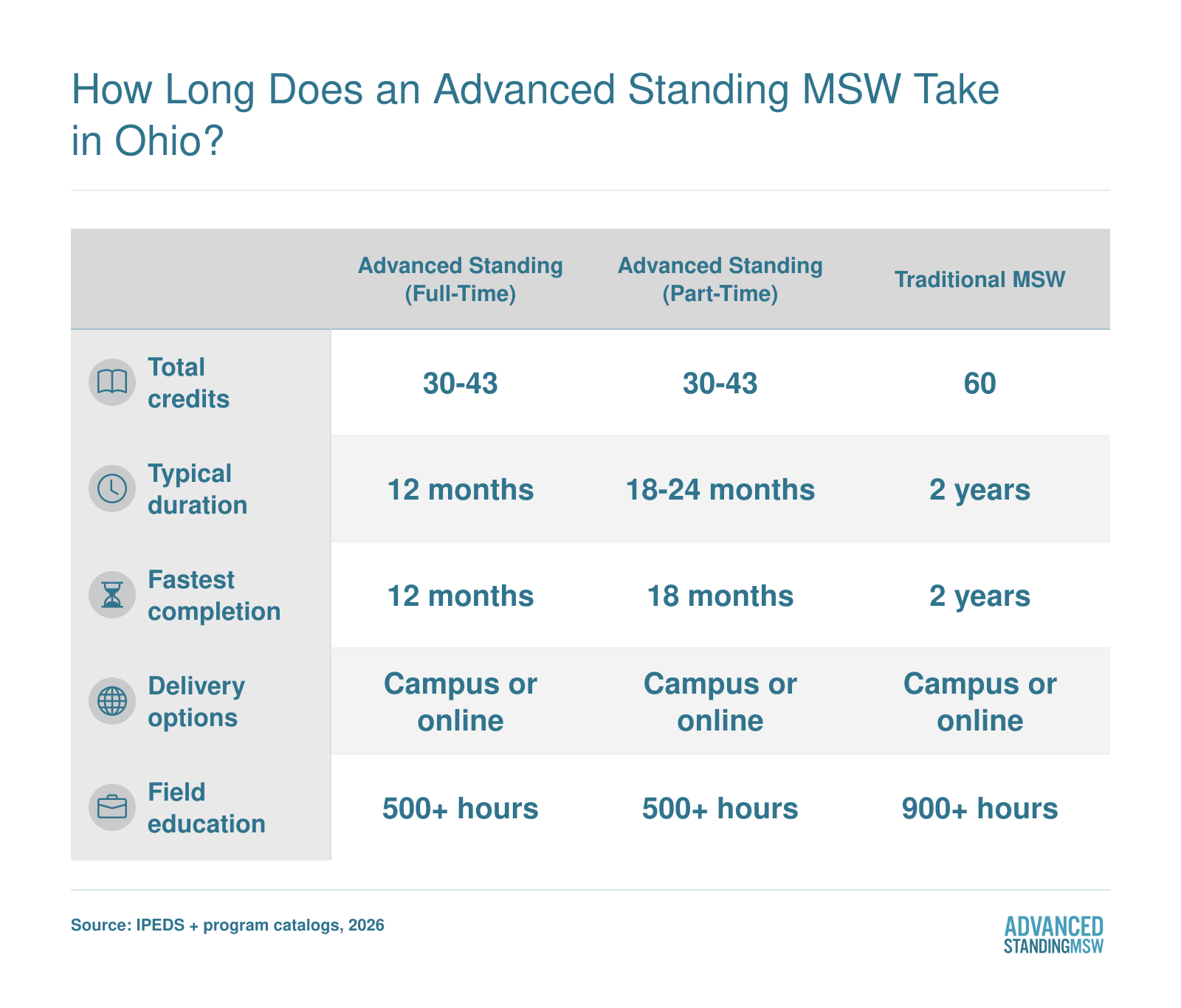
Advanced standing MSW programs in Ohio typically require 30 to 39 credits and take about 12 months to complete, cutting the traditional MSW workload by roughly half. Despite the different labels schools attach to this pathway, the core structure is identical: it is the shortened MSW route built exclusively for applicants who already hold a CSWE-accredited BSW.1
The Many Names for One Pathway
When you browse program listings, you will see a handful of terms used interchangeably. Ohio State University calls its option the "Advanced Standing Program." The University of Cincinnati labels it the "Advanced Standing MSW." Cleveland State University uses the same "Advanced Standing MSW" phrase, while the University of Toledo frames its offering as an "Advanced Standing Cohort." Occasionally a school will market the track as a "One-Year MSW" or "12-Month MSW," but those names always point back to the advanced standing structure. The label "Accelerated MSW" can be trickier because some non-BSW compressed programs also borrow that word; however, when the eligibility requirement is a CSWE-accredited BSW, you are looking at an advanced standing program no matter what the title says.
What Does Not Qualify as Advanced Standing
Not every related bachelor's degree opens this door. A non-CSWE-accredited BSW, a BSW older than a program's recency limit (commonly five to seven years)3, or a bachelor's in psychology, sociology, or human services will not satisfy the prerequisite. Applicants in those situations should explore Ohio's traditional two-year MSW options, which generally require around 60 credits and do not assume prior social work coursework.
The Practical Difference in Credits and Time
A traditional MSW in Ohio typically demands 60 credits over two years of full-time study. Advanced standing reduces that by roughly 20 to 30 credits because the foundational curriculum is waived, recognizing that a CSWE-accredited BSW already covered those competencies. The result is a compact, roughly 12-month timeline.2 While a few Ohio programs extend slightly longer due to part-time pacing or additional specialization requirements, the advanced standing pathway consistently shaves a full year off the standard MSW.
Campus, Online, or Hybrid? Comparing Ohio's Advanced Standing MSW Formats
Ohio's advanced standing MSW programs fall into three delivery formats, each with distinct trade-offs for BSW graduates balancing career goals, geography, and lifestyle. Online options come from Cleveland State University and the University of Akron. Campus programs are offered at Ohio University, the University of Toledo, Bowling Green State University, and Case Western Reserve University. Hybrid formats are available through Miami University (Oxford, Middletown, and Hamilton campuses) and Youngstown State University. One critical point worth emphasizing: every CSWE-accredited program, regardless of format, requires supervised field placement hours. Online programs do not skip fieldwork. Cleveland State, for example, delivers 100% online coursework but still requires 500 hours of field education completed in your local community.
| Dimension | Campus | Online | Hybrid |
|---|---|---|---|
| Ohio programs in this format | Case Western Reserve, Ohio University, University of Toledo, Bowling Green State University | Cleveland State University, University of Akron | Miami University (Oxford, Middletown, Hamilton), Youngstown State University |
| Schedule flexibility | Classes and field hours follow a set weekday schedule during normal business hours | Asynchronous coursework lets you study on your own schedule; field hours are arranged locally in your community | Combines online or evening and weekend coursework with in-person components such as Saturday classes or periodic campus sessions |
| Field placement logistics | Placements coordinated through each university's field office, typically at partner agencies near campus | Field hours completed in your own community. Cleveland State, for instance, offers complimentary placement services for online students. | Field placements may be completed at local agencies, with scheduling options that include evenings and weekends at some programs |
| Field hours required | 500 to 672 hours depending on the program (Ohio University requires 560; Ohio State requires 672) | 500 hours at Cleveland State; check the University of Akron for its specific total | 500 hours at Miami University and Youngstown State University |
| Peer interaction | Daily face-to-face collaboration with cohort members and faculty; strongest in-person networking | Interaction happens through discussion boards, video conferencing, and synchronous sessions; networking requires more intentional effort | A middle ground: periodic in-person meetings build cohort bonds while online components offer independence between sessions |
| Typical completion pace | Roughly 11 to 12 months of full-time study (three semesters at most programs) | As fast as 7 months full-time at Cleveland State or 11 months at the University of Akron; part-time options extend the timeline | Approximately one year full-time; part-time schedules are available at most hybrid programs |
How Long Does an Advanced Standing MSW Take in Ohio?
One of the biggest advantages of the advanced standing pathway is time saved. Because your BSW foundation courses carry forward, you can finish your MSW in roughly half the time of a traditional student. Ohio programs offer full-time, part-time, and accelerated part-time tracks, so you can match your timeline to your life.
Most Affordable Advanced Standing MSW Programs in Ohio
The table below ranks Ohio's advanced standing MSW programs by net price, from lowest to highest. Net price is an institution-wide average that reflects tuition after grants and scholarships have been applied, so your actual cost will depend on your individual financial aid package. Median debt at completion and the estimated monthly payment on a standard 10-year repayment plan are included where federal data is available. All figures draw from U.S. Department of Education data (IPEDS and College Scorecard, 2023).
| Rank | School | City | Format | In-State Tuition | Out-of-State Tuition | Net Price | Median Debt at Completion | Est. Monthly 10-Year Payment |
|---|---|---|---|---|---|---|---|---|
| 1 | Miami University, Middletown | Middletown | Hybrid | $7,491 | $19,407 | $10,809 | $23,000 | N/A |
| 2 | Miami University, Hamilton | Hamilton | Hybrid | $7,491 | $19,407 | $11,286 | $23,000 | N/A |
| 3 | Youngstown State University | Youngstown | Hybrid | $11,113 | $11,473 | $12,767 | $24,000 | N/A |
| 4 | University of Akron | Akron | Online | $13,135 | $20,815 | $13,946 | $23,250 | N/A |
| 5 | Cleveland State University | Cleveland | Online | $12,988 | $18,510 | $14,764 | $21,797 | N/A |
| 6 | University of Toledo | Toledo | Campus | $12,744 | $22,104 | $17,249 | $22,250 | N/A |
| 7 | Ohio State University | Columbus | Online | $13,244 | $40,022 | $17,339 | $19,976 | N/A |
| 8 | Ohio University | Athens | Campus | $14,158 | $24,838 | $21,637 | $21,056 | N/A |
| 9 | Bowling Green State University | Bowling Green | Campus | $14,460 | $22,448 | $24,022 | $25,000 | N/A |
| 10 | Miami University, Oxford | Oxford | Hybrid | $18,161 | $41,221 | $28,384 | $23,000 | N/A |
| 11 | Case Western Reserve University | Cleveland | Campus | $66,608 | $66,608 | $41,190 | $24,000 | N/A |
Related Articles
What You Need to Get In: Admissions Requirements Across Ohio Programs
Every advanced standing MSW program in Ohio requires a BSW from a CSWE-accredited institution, so verify your undergraduate accreditation status before applying. Beyond that baseline, requirements vary in meaningful ways. The table below compares GPA minimums, GRE policies, BSW recency limits, deadlines, and available start terms for 2026 and 2027 enrollment cycles. Where a specific detail has not been published, the cell is marked accordingly.
| School | Min GPA | GRE Policy | BSW Recency Limit | Application Deadline | Start Terms |
|---|---|---|---|---|---|
| The Ohio State University | 3.0 on a 4.0 scale | Not published | Within 5 years | Check program website for posted term deadlines | Not published |
| University of Akron | 3.2 on a 4.0 scale | Not published | Within 5 years | Not published | Advanced standing cohort (confirm with program) |
| Cleveland State University | 3.0 on a 4.0 scale | Not published | Within 7 years | Not published | Not published |
| Ohio University | 3.0 on a 4.0 scale | Not published | Within 7 years | March 1 | Advanced standing cohort |
| Ohio University (Online) | 3.0 on a 4.0 scale | Not published | Within 7 years | Not published | Not published |
| Wright State University | 3.0 on a 4.0 scale | Not published | Within 5 years | Not published | Summer |
| University of Kentucky (available to Ohio residents online) | 3.0 on a 4.0 scale | Not required | Within 7 years | Not published | Not published |
Ohio's LSW and LISW Licensure Path After Your Advanced Standing MSW
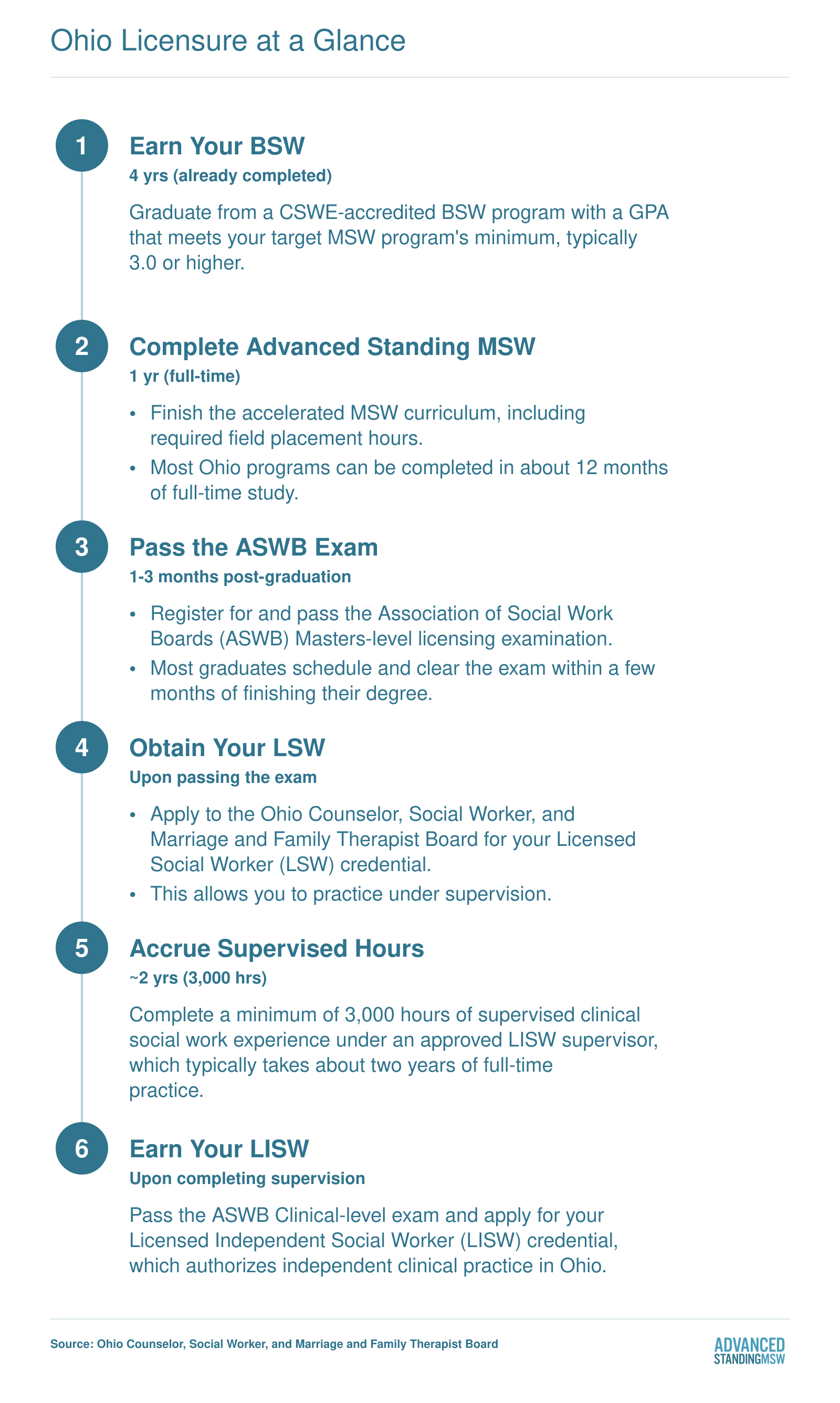
Ohio runs a two-tier licensure system, and your advanced standing MSW puts you on the graduate track for both tiers from day one. The first tier, Licensed Social Worker (LSW), is available the moment you have a CSWE-accredited MSW or DSW in hand and pass the ASWB Masters exam.1 There's no post-degree supervised hours requirement to reach LSW status, which is why so many advanced standing graduates apply for it within weeks of commencement. Note that the LSW credential also has a separate Bachelor's route (CSWE-accredited BSW plus the ASWB Bachelors exam) for those who stop at undergraduate level, but if you're pursuing an advanced standing MSW, the graduate route and the Masters exam are what apply to you.
Moving From LSW to LISW
The second tier, Licensed Independent Social Worker (LISW), is where clinical autonomy actually lives, and it requires more than a diploma. You'll need 3,000 hours of post-degree supervised social work experience completed over at least 24 months2, with 150 total hours of supervision delivered at roughly a 1:20 ratio2, supervision hours to work hours. That supervision has to come from an LISW-S, the supervisory-endorsed version of the credential, not just any licensed independent social worker.1
A Recent Exam Change Worth Knowing
The ASWB Clinical exam becomes the sole qualifying exam for LISW applicants after July 10, 20263, when the Board discontinues the Advanced Generalist exam as a qualifying route (with narrow exceptions for candidates already mid-supervision under that older pathway). If you're timing your MSW graduation and supervision start around this cutoff, plan for the Clinical exam.
Applying Through the State Board
All applications route through the Ohio Counselor, Social Worker, and Marriage and Family Therapist Board's eLicense system.4 Reported fees run $80 for LSW and $100 for LISW, plus a small processing fee, though you should confirm current amounts directly with the Board before submitting.4
One requirement is absolute: your MSW program must carry CSWE accreditation. Ohio's licensing board will not recognize a non-accredited degree at either tier, so accreditation status should be the first thing you verify, not the last.1
Ohio Licensure at a Glance
After completing your advanced standing MSW in Ohio, a clear credentialing ladder leads to independent clinical practice. Here is the typical progression and approximate timeline for each stage.
What MSW Graduates Actually Earn in Ohio
As data-driven decision-making reshapes how students evaluate graduate programs, prospective MSW candidates increasingly expect transparent earnings outcomes. For many advanced standing MSW programs in Ohio, those precise, program-level salary figures are still forthcoming. The most recent federal earnings data for Ohio social work graduates remains blank, meaning the median earnings at one, two, and four years after completion have not yet been published. Until those numbers are released, the strongest wage benchmarks come from the U.S. Bureau of Labor Statistics (BLS), which tracks pay for social workers across the state.
What BLS Data Reveals About Social Work Wages in Ohio
BLS occupational wage data shows what social workers earn across all experience levels and settings, not just new graduates. In Ohio, the mean annual wage varies notably by specialization. Child, family, and school social workers earn an annual mean of $51,2101, while healthcare social workers bring in a higher mean of $64,6501. The broad category of "all other" social workers posts a mean of $62,1902. For context, the national median for all social workers sits at $61,3303. These figures reflect a wage scale where clinically focused roles and those in medical settings tend to land nearer the top of the range. Because BLS does not publish 25th and 75th percentile wages for these Ohio-specific specializations1, readers should treat these means as general guideposts rather than exact entry-level salary promises.
How Student Debt Stacks Up Against Expected Pay
Median federal student debt among Ohio advanced standing MSW graduates paints a relatively consistent picture. Across the programs profiled, median debt at completion ranges from roughly $20,000 to $25,000. For instance, graduates of Ohio State University's program carry a median debt of $19,976, while the figure at Bowling Green State University is $25,000. Most other programs cluster between $21,000 and $24,000. If we pair this debt load with the child and family social worker mean wage of $51,2101, the debt-to-earnings ratio looks manageable. A standard 10-year repayment plan would translate to a modest monthly payment relative to take-home pay, suggesting that early-career social workers in Ohio can handle their loan obligations without excessive strain, especially if they land in the healthcare or clinical sectors where pay is higher.
The Licensure Advantage
Gaining an LISW (Licensed Independent Social Worker) credential markedly shifts earning potential. While the BLS data aggregates all social workers regardless of licensure, practitioners with an LISW and those working in clinical or healthcare settings routinely fall into the higher earnings bracket. The healthcare social worker mean of $64,6501 and the all-other category mean of $62,1902 indicate the kind of salary uplift that comes with advanced clinical responsibilities. Graduates who follow the LISW pathway after their advanced standing MSW can expect not only broader scope of practice but also wages that sit comfortably above the state average for more generalist roles.
Picking the Right Advanced Standing MSW Program in Ohio
With eight CSWE-accredited advanced standing MSW options across Ohio, the decision rarely hinges on a single factor. Format, concentration, cost, field support, and length all interact, and the right fit depends on where you already are in your career and where you want to land.
Match the Concentration to Your Career Goal
Concentration structures vary more across Ohio programs than most applicants expect. Case Western Reserve offers named tracks that include Children, Youth and Families, Community Practice, Mental Health, School Social Work, and Substance Use Disorders. Ohio State’s advanced standing MSW program organizes its curriculum around four areas of emphasis, including Aging and Health. Cleveland State’s online advanced standing MSW program and Ohio University’s online MSW curriculum both center on Clinical Social Work, while Cincinnati’s Direct Practice specialization leans clinical as well. Akron’s online MSW program structures its track around Micro or Macro social work, and Toledo along with the Greater Miami Valley Joint program use an advanced generalist model, the latter with a Children and Families focus. If you already know you want school social work or substance use disorder treatment, that narrows your list fast. If you’re still generalist-minded, the broader programs preserve flexibility.
Check Your BSW’s Age Before You Apply
Advanced standing eligibility typically assumes a recent BSW, and if yours is more than five to seven years old, some programs may require you to complete bridge coursework or demonstrate current practice competency to waive foundation-year credits. Call admissions early rather than assuming your BSW automatically qualifies.
Ask About Field Placement Before You Enroll
Online students in particular should confirm how a program coordinates local placements in your area, since even fully online tracks require in-person field hours. Ask directly about placement lead time, geographic reach, and relocation support before you commit.