What you’ll learn in this article…
- USD's advanced standing MSW cuts roughly one year off the traditional timeline.
- South Dakota MSW graduates report a median salary of $51,926 at ten years.
- Two post-MSW license tiers, CSW-PIP and LCSW, require supervised practice hours.
BSW graduates can earn an advanced standing MSW in roughly one year, cutting the traditional two-year timeline nearly in half. In South Dakota, this accelerated path runs through a narrow set of options: the University of South Dakota holds the state's only full CSWE accreditation, while Augustana University's program remains in candidacy status. This scarcity makes your program choice unusually consequential, because accreditation determines licensure eligibility across the state.
The sections ahead cover ranked programs, tuition breakdowns, online and campus formats, admissions requirements, field placement logistics, and the licensing steps that follow graduation. For BSW holders weighing speed, cost, and flexibility, understanding these details before applying is essential.
Cswe-Accredited Advanced Standing MSW Programs in South Dakota, Ranked
Each program below was weighed on the factors that matter most to BSW graduates: net price after financial aid, graduate earnings, and completion rates. In 2026, that lens reveals a simple landscape: South Dakota is home to exactly one CSWE-accredited advanced standing MSW program. Keep in mind that the net price on each card is an institution-wide average after aid, not a guaranteed MSW-specific quote.
| Rank | School | Location | Net price | Best for | |
|---|---|---|---|---|---|
| #1 | University of South Dakota | Vermillion, SD | $20,000/yr | In-state BSWs needing flexible online study | |
The University of South Dakota is the state's only CSWE-accredited MSW provider, making it the anchor option for BSW graduates who want an accelerated pathway without leaving the state. Its Advanced Standing track compresses 36 credit hours into one year of full-time study, blending advanced clinical practice, policy analysis, and community organization skills with a strong focus on mental health, and it is available both 100% online and on campus, with a Sioux Falls classroom location for students in the eastern part of the state. The institution offering this program has a graduation rate of about 60 percent, and College Scorecard data shows median earnings near $51,900 for former students roughly ten years after first enrollment. The net price shown reflects an institution-wide average after aid, not a guaranteed MSW-specific quote.
| |||||

Accelerated MSW, One-Year MSW, Advanced Standing: The Same Program
Are "accelerated MSW" and "advanced standing MSW" different program types, or just different names for the same thing?
You will encounter those labels, plus "one-year MSW" and "12-month MSW," all over program pages and admissions guides. They refer to the same pathway: a shortened Master of Social Work route designed specifically for applicants who already hold a bachelor's degree in social work from a CSWE-accredited program. The name changes depending on the school's marketing, but the structure is consistent across the state.
One Pathway, Many Names
Every version of this abbreviated MSW track rests on the same assumption: you have already completed the foundational social work curriculum as part of your BSW. Instead of repeating that groundwork, you start directly in the advanced concentration coursework and complete roughly 30 to 39 credits instead of the 60-plus required for a traditional MSW. When a program calls itself an accelerated MSW, a one-year MSW, or a 12-month MSW, it is describing that same streamlined timeline for BSW holders.
How South Dakota Programs Label It
The University of South Dakota, the state's primary public CSWE-accredited MSW provider, uses the term Advanced Standing for its shortened track. Its program page describes the path as a full-time, one-year sequence for qualified BSW graduates. Other South Dakota institutions with online MSW options, such as Augustana University, may use similarly interchangeable wording when discussing the path for BSW holders, though specific terminology varies. Regardless of the label a school chooses, all of these programs function identically: they condense the final year of a traditional two-year MSW into a single intensive year.
Who Qualifies (and Who Does Not)
To enroll in any advanced standing or accelerated MSW in South Dakota, you must have graduated from a CSWE-accredited BSW program. Most schools also enforce a recency requirement, typically that your BSW was earned within the last five to seven years. If your undergraduate degree is in psychology, sociology, human services, or a similarly related field, you do not qualify for advanced standing, even if you have years of work experience; you would instead apply to a traditional two-year MSW track. Likewise, a BSW from a non-CSWE-accredited program does not meet eligibility. Understanding this distinction saves you from applying to the wrong pathway and delays in your graduate timeline.
Advanced Standing Vs. Traditional MSW: What BSW Graduates in South Dakota Should Know
How much faster is an advanced standing MSW than the traditional track in South Dakota, and what do you give up to save that time? At the University of South Dakota, the difference comes down to credits, field hours, and a compressed calendar built specifically for BSW graduates who already have foundation-level coursework behind them.
Credit Hours and Timeline Side by Side
The advanced standing MSW at USD requires 36 total credits, while the traditional MSW track requires 60. That gap of roughly 24 credits translates directly into time saved: advanced standing students typically finish in about 12 months of full-time study, compared with roughly 24 months for traditional-track students. USD structures the accelerated path as three consecutive 12-credit terms (summer, fall, and spring), which is why advanced standing cohorts start in the summer rather than waiting for a fall intake like most traditional programs.
Field Placement Hours Differ Too
Credits are not the only place the two tracks diverge. Advanced standing students complete 500 hours of field education, while traditional-track students complete 1,000 hours. This is not a shortcut so much as a recognition that a CSWE-accredited BSW already includes supervised field experience covering generalist practice. The advanced standing track builds on that foundation rather than repeating it, concentrating field hours on advanced, specialized practice instead.
The Recency Window Matters
Eligibility for advanced standing is not automatic just because you hold a BSW. Most programs, including USD's, require that your BSW or BSSW come from a CSWE-accredited program and that you completed it within a defined recency window, often five to seven years before enrollment. If your degree falls outside that window, expect the admissions committee to ask for additional documentation or coursework showing your practice knowledge is current. This is worth confirming early, since it can affect whether you are eligible for the accelerated timeline at all or need to plan for the traditional two-year path instead.
Questions to Ask Yourself
Was your BSW earned from a CSWE-accredited program within the last five to seven years?
Advanced standing eligibility hinges on this window. If your degree falls outside it, you may be routed into the traditional two-year MSW instead, adding roughly 30 credits and a full year of tuition.
Do you need a fully online format, or can you attend hybrid intensives on campus in Vermillion?
USD's advanced standing track includes on-campus components that rural or working students may struggle to reach. Confirm the residency schedule before assuming the program fits a fully remote lifestyle.
Are you planning to pursue clinical licensure (LCSW) in South Dakota, and do the program's clinical hours satisfy that requirement?
The South Dakota Board of Social Work Examiners requires specific clinical coursework and supervised hours for LCSW eligibility. Verify the curriculum aligns with state rules now, not after you enroll.
South Dakota MSW Tuition and Cost Breakdown
The University of South Dakota is the state's sole provider of a CSWE-accredited MSW program, so understanding its tuition structure is essential before you apply. The figures below reflect published 2025-2026 per-credit rates, which include a $46.90 MSW-specific delivery fee on top of base graduate tuition. Online students pay a single flat rate regardless of where they live, eliminating the out-of-state premium that campus students face.
| Student Category | Base Graduate Tuition (per credit) | MSW Delivery Fee (per credit) | Total MSW Cost (per credit) | Estimated Total (36 credits) |
|---|---|---|---|---|
| In-State / SD Advantage (on campus) | $350.00 | $46.90 | $396.90 | $14,288 |
| Out-of-State (on campus) | $673.00 | $46.90 | $719.90 | $25,916 |
| Online (any residency) | $484.10 | $46.90 | $531.00 | $19,116 |
| Online Graduate Assistant | N/A | N/A | $319.60 | $11,506 |
Financial Aid and Scholarships for South Dakota MSW Students
Paying your full tuition bill with personal funds might seem straightforward, but savvy MSW students in South Dakota build a layered financing plan that taps into federal loans, university-wide awards, and future loan forgiveness programs. The right combination can significantly reduce your net out-of-pocket cost and ease the transition into a social work career.
Federal Direct Loans and Public Service Loan Forgiveness
Graduate students at the University of South Dakota can access federal Direct Unsubsidized Loans (often called Stafford loans) and Grad PLUS Loans by filing the FAFSA. These loans are not based on financial need for the unsubsidized option, but do require you to be enrolled at least half-time. Once you graduate and begin working in a qualifying public service or nonprofit role, the Public Service Loan Forgiveness (PSLF) program becomes a powerful tool. After making 120 monthly payments under an income-driven repayment plan while employed full-time by a government entity or a 501(c)(3) organization, the remaining loan balance can be forgiven tax-free. Most social work positions in schools, hospitals, community mental health centers, and state agencies meet the employer criteria, making PSLF a realistic path for South Dakota MSW graduates.
University-Level Scholarships at USD
While the USD Social Work department does not publish a list of MSW-specific departmental scholarships for the 2026-2027 year, one substantial university-wide award stands out. As detailed on the University of South Dakota scholarships page, the Horatio Alger Denny Sanford Scholarship provides up to $20,000 distributed across a student's collegiate career, with an application deadline of May 15. This scholarship is not exclusive to MSW candidates, but eligible graduate students may apply and compete for the funds. Because named MSW-only awards are not currently advertised on the University of South Dakota MSW program website, prospective students should contact the USD Financial Aid Office and the MSW Program Director, Megan Grode-Wolters, directly at 605-357-1316 or [email protected] to ask about graduate assistantships, tuition remission opportunities, or any field-specific scholarships that become available after admission.
State Programs and Application Timing
South Dakota does not currently advertise a state-specific social work loan repayment or tuition assistance program, but federal and institutional resources remain central. To maximize your aid package, submit the FAFSA as soon as possible after it opens on October 1. Use USD's federal school code to ensure your information reaches the university. Contact the department about assistantship openings early in the admissions process, as many funding decisions are made alongside acceptance offers. Even a small graduate assistantship can offset tuition and provide valuable professional experience.
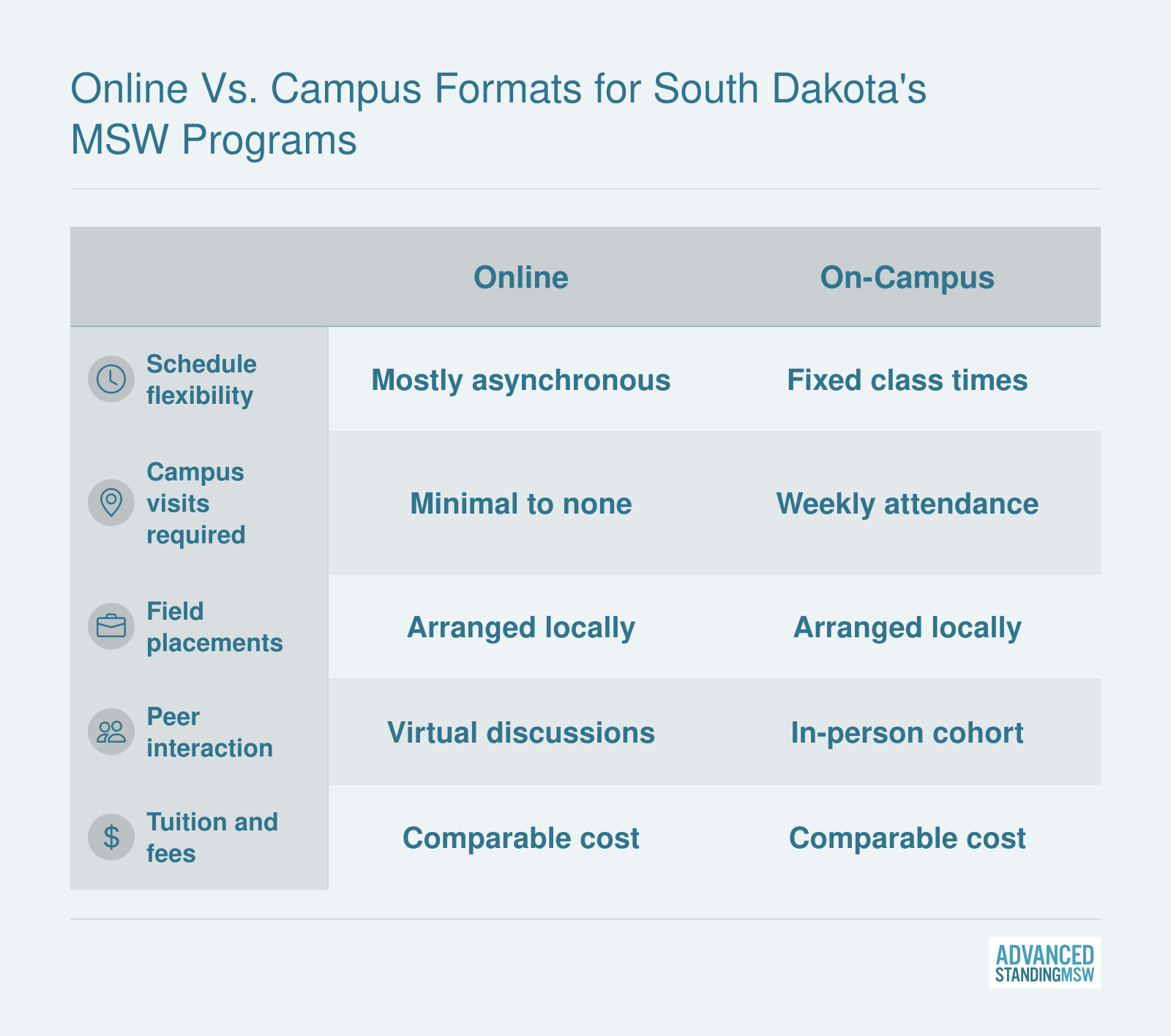
Online Vs. Campus Formats for South Dakota's MSW Programs
The University of South Dakota offers its MSW in both online and on-campus formats, giving BSW graduates real flexibility in how they complete an advanced standing program. USD's online MSW is delivered primarily asynchronously, meaning you can watch lectures and complete coursework on your own schedule, though some synchronous sessions may be required for clinical skills practice. Regardless of format, all students must complete supervised field placements in their communities.
Related Articles
Admissions Requirements and Deadlines for USD's Advanced Standing MSW
The University of South Dakota's CSWE-accredited Advanced Standing MSW is open exclusively to BSW/BSSW graduates. Below is what you need to have ready before you apply.
- Minimum GPAA cumulative GPA of 3.0 or higher from a CSWE-accredited BSW or BSSW program is required. There is no published option to petition below this threshold, so treat it as a firm cutoff.
- GRE PolicyUSD does not list the GRE as a required component of the Advanced Standing MSW application. If this changes, the program's admissions page will reflect it, so verify before you submit.
- BSW RecencyThe program does not publicly specify a recency window (e.g., degree earned within a certain number of years). Contact the MSW admissions office directly to confirm whether your graduation date affects eligibility.
- Required Application MaterialsYou will need a completed application with a $35 fee, official transcripts from every institution attended, letters of recommendation, a statement of purpose explaining your goals in advanced clinical or macro practice, and a current resume or CV.
- Cohort Start and DeadlineAdvanced Standing students begin coursework in the summer term. A specific application deadline for the 2026–2027 cohort has not been published at the time of writing; contact USD's Department of Social Work early in the spring to confirm the cutoff date, as advanced standing cohorts are smaller and seats fill quickly.
- Prerequisite Coursework and ExperienceYour BSW/BSSW from a CSWE-accredited program satisfies the foundational curriculum requirement, which is why the program is only 36 credit hours. While no additional prerequisite courses are listed, a strong application typically reflects supervised field experience completed during your undergraduate program.
How Field Placements Work for Advanced Standing and Online MSW Students
The appeal of an online MSW is clear: the flexibility to study from anywhere. Yet field placements are the in-person cornerstone that can make or break your ability to stay in your community. For BSW graduates considering the University of South Dakota (USD) advanced standing track, the practical question is whether you can complete your clinical hours without moving to Vermillion. The answer is yes, but it requires understanding USD's placement model and timeline.
Field Hour Requirements: Advanced Standing vs. Traditional
As of 2026, USD's advanced standing MSW students generally complete 500 hours of practicum, while traditional two-year students accumulate 1,000 hours1. That 500-hour threshold is standard for CSWE-accredited advanced standing programs and recognizes the foundational field experience you already earned through your BSW. Traditional students spread 1,000 hours across four semesters, 250 hours per term, which equates to roughly 16 to 24 hours per week1 for 15 to 16 weeks. Advanced standing students often distribute their reduced hours over two semesters, though final scheduling depends on your individual plan of study and the start term.
How Online Students Secure a Local Placement
USD does not require you to find your own agency cold. A dedicated placement coordinator works with you to identify approved field sites near your home community. The process usually begins several months before your placement semester: you share your geographic preferences and clinical interests, and the coordinator reaches out to agencies with established USD affiliation agreements or assists in developing new partnerships. In more rural parts of South Dakota, you may need to be flexible, considering a neighboring town or a site that can offer telehealth-supervised tasks, but the goal is always to keep you local. Most advanced standing students secure a placement within a reasonable commute.
A Typical Semester Schedule for Field Work
Field semesters align with USD's academic calendar, starting in late August or early January. Placements run concurrently with your online coursework, so you are never asked to pause classes to focus solely on the field. For each placement semester you will spend 16 to 24 hours1 on site over two or three weekdays, integrating direct practice with your digital class discussions. Advanced standing students typically begin their first field experience the semester after admission; depending on when you start, you could complete all hours within a single academic year while remaining enrolled in online courses.
Staying Put While Earning Your MSW
You do not need to move to Vermillion, or even visit campus, to graduate from USD's MSW program. The entire curriculum is delivered asynchronously online, and field placements are arranged in or near your community. BSW holders living in Sioux Falls, Rapid City, Pierre, or anywhere else in South Dakota and in bordering states with approved agencies can finish the advanced standing track without relocating. Early communication with the placement coordinator is key to securing your site before the semester begins.
What MSW Graduates Earn in South Dakota
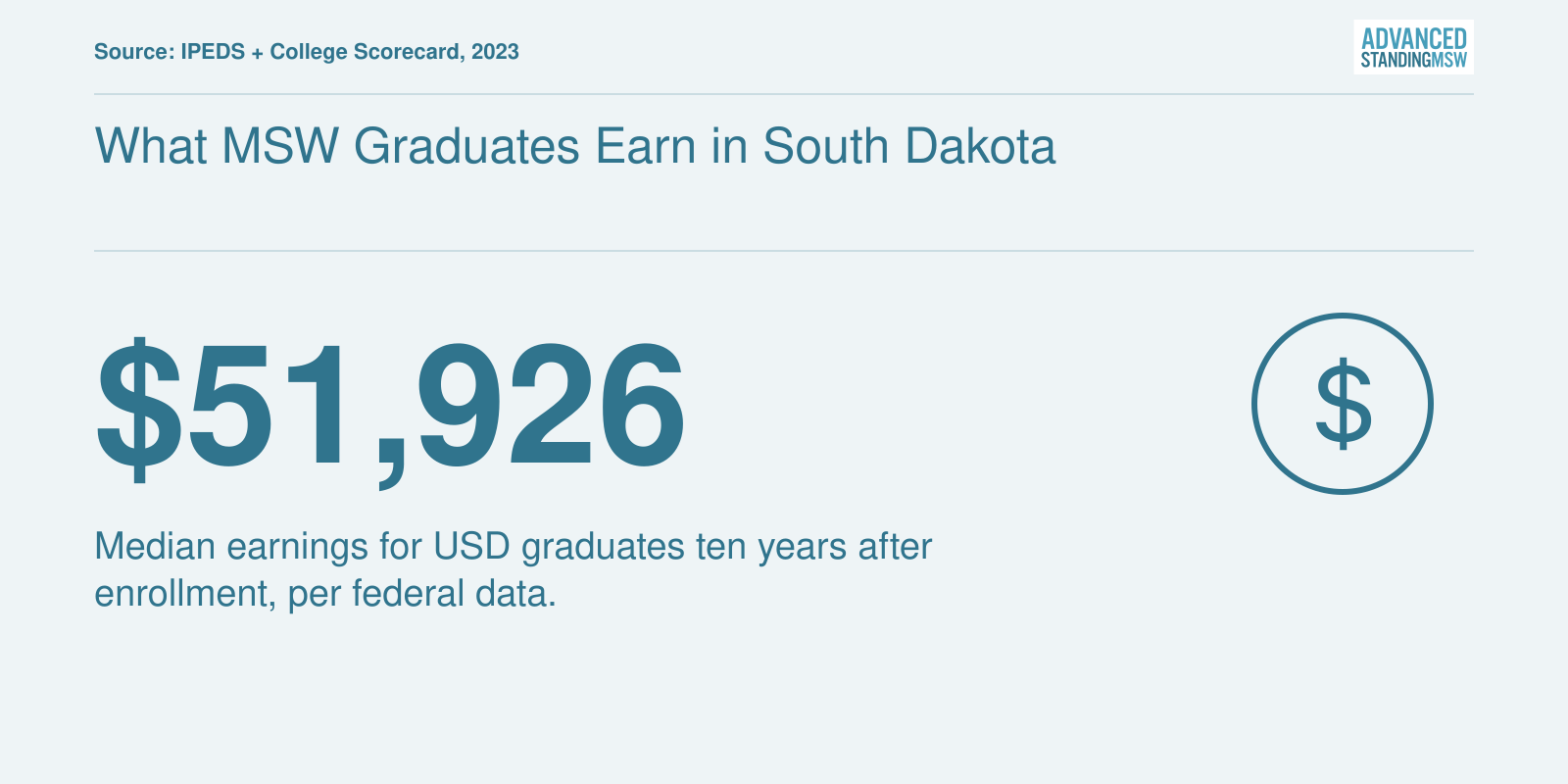
Program-level earnings data for the University of South Dakota's advanced standing MSW are not yet published in the federal outcomes database. However, institution-wide figures offer useful context. USD graduates report a median salary of $51,926 at ten years after enrollment, against a median student debt of $23,592, yielding roughly $2.20 earned for every $1.00 borrowed. For BSW holders weighing the cost of an accelerated MSW, that return on investment signals strong long-term value.
South Dakota Social Work Licensure: From MSW to Licensed Practice
Two licenses define advanced social work practice in South Dakota: the Certified Social Worker in Private Independent Practice (CSW-PIP) and the Licensed Clinical Social Worker (LCSW). While both require a master’s degree from a CSWE-accredited program, the pathways diverge sharply in terms of supervision, examination, and scope of practice.
Choosing Between CSW-PIP and LCSW
The CSW-PIP is the gateway to autonomous private practice. It lets you operate independently as a clinical or macro social worker without another practitioner’s oversight. The LCSW, by contrast, is a clinical license designed for those delivering psychotherapy and diagnostic services, typically within agencies or group practices, though it can also lead to independent practice once all requirements are fulfilled. South Dakota law makes clear that both licenses rest on the same educational foundation: a master’s or doctoral degree from a program accredited by the Council on Social Work Education (CSWE).1
How Advanced Standing MSW Programs Meet the Degree Requirement
An advanced standing MSW earned from a CSWE-accredited program fully satisfies the state’s educational prerequisite. The Board of Social Work Examiners does not differentiate between a traditional two-year MSW and an accelerated advanced standing track; what matters is that your degree is conferred by a CSWE-accredited institution. If you are considering a newer program (Augustana University’s MSW, for example), be aware that its current CSWE candidacy status is not yet full accreditation. Licensure eligibility hinges on the program’s accreditation at the time you graduate, so verifying that status before you commit is essential.
Supervised Experience: The Two-Year Standard
Both licenses require two years of post-master’s supervised work. For the CSW-PIP, the statute broadly demands two years “under appropriate supervision in the field of specialization” before you can practice privately and independently. The LCSW pathway tightens this into a quantified 3,000 hours of post-master’s supervised clinical experience,2 as outlined in licensing guides. Your supervisor must be a CSW-PIP, a licensed psychologist, or a psychiatrist who has been in good standing in South Dakota for at least two years. Before the supervision agreement becomes active, that supervisor must complete 6 hours of continuing education covering supervision, and then 3 hours every two years as the relationship continues.3 The Board must approve the supervision contract, so early planning is non-negotiable.
Exams, Fees, and the Application Process
Exam requirements differ. The CSW-PIP candidate sits for the ASWB Clinical or Advanced Generalist exam, while the LCSW candidate must pass the ASWB Clinical exam.2 Board approval is required before you schedule a test date, so you cannot simply register on your own. As of 2026, third-party sources report a $170 application fee for the master’s-level license (CSW-PIP initially) and $210 for the clinical license upgrade. Exam registration runs $230 for the ASWB Masters-level test and $260 for the Clinical test.2 These figures are not published directly on the Board’s website, so check the current fee schedule with the South Dakota Board of Social Work Examiners as you prepare your application. Expect to submit official transcripts, supervision paperwork, and professional references alongside the fee.