What you’ll learn in this article…
- Seven CSWE-accredited NC schools offer advanced standing MSW tracks in 2026.
- Field hour requirements range from 500 to 672 across programs.
- Most schools require a minimum 3.0 GPA and a recent BSW.
Two years and 60 credits of graduate study versus a single year and about 30 credits: that’s the fork BSW graduates face when choosing between a traditional MSW and advanced standing in North Carolina. The accelerated route slashes tuition costs and puts licensure-track graduates into supervised practice 12 months sooner than their peers in the full-length program.
Online, hybrid, and on-campus formats span the state: UNC Chapel Hill, NC State, UNC Charlotte, and East Carolina all offer advanced standing cohorts, so geography is rarely a barrier. But the sharper calculus is specialization. North Carolina’s LCSW credential requires 3,000 supervised post-master’s hours, so every dollar and credit saved upfront compresses the timeline to independent clinical practice.
Understanding the Advanced Standing MSW Pathway
Advanced standing is a shortened Master of Social Work track reserved for applicants who already hold a Bachelor of Social Work from a program accredited by the Council on Social Work Education (CSWE). Instead of the full 60-credit, two-year MSW, advanced standing students complete roughly 30 to 39 credits, and most finish in a single calendar year.
Why the BSW Foundation Gets Waived
A CSWE-accredited BSW curriculum already covers the generalist practice content that fills the first year of a traditional MSW: human behavior and the social environment, social welfare policy, research methods, and a supervised foundation-year practicum. Because those competencies have been verified through CSWE accreditation, advanced standing programs waive the foundation year outright and place you directly into specialized (concentration-year) coursework. This is why the accreditation status of your undergraduate program is non-negotiable. A social work bachelor's from a non-accredited institution, or a related degree in psychology or sociology, will not qualify you, no matter how strong the transcript.
Typical Timeline in North Carolina
NC programs generally structure advanced standing across two to four semesters. Full-time students often begin in a summer bridge term and finish the following spring, roughly 12 months. Part-time options stretch the same credits across four to six semesters, useful for students who plan to keep working during the program.
Not the Same as Transfer Credit
Advanced standing is a distinct admissions track, not a transfer arrangement. You apply to it specifically, you are admitted into a designated cohort, and your schedule, orientation, and practicum sequence run on a separate timeline from traditional MSW students. Transferring credits between MSW programs is a different process with its own limits.
NC Advanced Standing MSW Programs, Ranked for 2026
If you already hold a BSW, an advanced standing MSW in North Carolina can shorten your path to licensure by a year or more. These seven programs are the strongest accelerated options in the state, each offering different formats, costs, and specialization tracks. Use this ranking as a starting point, then dig into the details that matter for your career.
| Rank | School | Location | Net price | Best for | |
|---|---|---|---|---|---|
| #1 | University of North Carolina at Chapel Hill | Chapel Hill, NC | $12,000/yr | BSW graduates aiming for clinical or macro leadership | |
UNC-Chapel Hill is the state's flagship for social work education, pairing a nationally ranked School of Social Work with a 12-month advanced standing track that runs May to May. Students choose between direct practice and community, management, and policy concentrations, with practicum options at more than 850 sites. The program's 95% first-time licensure pass rate and the 25% average salary boost reported by graduates make it a compelling choice for BSW holders seeking clinical or macro leadership.
| |||||
| #2 | North Carolina State University at Raleigh | Raleigh, NC | $9,000 – $33,000/yr | Students targeting child welfare or addiction care | |
NC State delivers a full-time, 12-month advanced standing MSW anchored by a summer bridge curriculum and a 24-hour-per-week field internship. Students can tailor the degree through electives in child welfare, addiction recovery, veterans' services, and trauma-informed care. The program's emphasis on evidence-based practice and social justice prepares graduates for clinical and leadership roles in healthcare, schools, and government.
| |||||
| #3 | Appalachian State University | Boone, NC | $8,000 – $25,000/yr | Online learners who need part-time flexibility | |
Appalachian State makes advanced standing social work education accessible through online and on-campus delivery, with full-time and part-time pacing that fits different life situations. Two concentrations, Individuals and Families or Community and Organizational Practice, let students shape the degree around their career goals. Graduate assistantships and the school's innovation-focused culture add practical support for working students.
| |||||
| #4 | University of North Carolina at Charlotte | Charlotte, NC | $15,000 – $20,000/yr | ||
UNC Charlotte offers advanced standing MSW pathways in both on-campus and online formats, giving BSW graduates flexibility in how they complete a shortened master's degree. The curriculum emphasizes leadership, social justice, and community engagement, with a competitive admissions process that requires a 3.0 GPA and strong endorsements. Graduates are prepared for licensure and for clinical or macro roles across diverse settings.
| |||||
| #5 | University of North Carolina Wilmington | Wilmington, NC | $7,000 – $24,000/yr | ||
UNC Wilmington's advanced standing MSW is a one-year, May to May accelerated program with summer bridge courses and two specializations: Direct Practice and Macro. Students can add credentials in substance use disorders, school social work, or child welfare, and take advantage of study abroad opportunities in London, Ireland, and India. The program's mix of field placements and global options makes it stand out for clinically minded BSW graduates.
| |||||
| #6 | East Carolina University | Greenville, NC | $16,000/yr | ||
East Carolina University provides an advanced standing MSW for BSW graduates within seven years, offering a one-year full-time campus track or a three-year part-time online track. The clinical-community practice curriculum blends direct practice skills with community advocacy and social justice, supported by 672 hours of field education. Graduates are prepared for licensure in all continental U.S. states, a useful advantage for those planning to move after graduation.
| |||||
| #7 | Western Carolina University | Cullowhee, NC | ~$13,000/yr (est.) | ||
Western Carolina University's advanced standing MSW can be completed in as few as 10 months, with a 33-credit curriculum and a 600-hour field placement across more than 200 agency partnerships. Students can choose the Cullowhee campus or the Asheville Biltmore Park location, and a part-time option is also available. The program prepares graduates for LCSW, LCAS, and school social work licensure with a strong emphasis on social justice and evidence-based practice.
| |||||


Accelerated MSW, One-Year MSW, Advanced Standing: The Same Program
Every CSWE-accredited advanced standing MSW program in the country follows the same structural logic, but schools brand that pathway under different names, and the variation can confuse applicants scanning program listings across North Carolina.
One Pathway, Multiple Labels
Whether a university calls its shortened track an "Advanced Standing MSW," a "One-Year MSW," a "12-Month MSW," or an "Accelerated MSW," the underlying design is identical: the program waives the foundational (generalist) year of coursework that traditional MSW students must complete, because your CSWE-accredited BSW already covered that content. You enter at the advanced curriculum level, complete roughly 30 to 39 credit hours of concentration coursework and field education, and finish in approximately 12 months of full-time study instead of the 60 credits and two academic years a traditional MSW requires.
In North Carolina, you will see schools use slightly different phrasing on their program pages. Some list the option under "Advanced Standing," while others emphasize the accelerated timeline. Regardless of the label, confirm that the program is housed within a CSWE-accredited social work department and that it explicitly requires a BSW for admission. If both conditions are met, you are looking at the same pathway.
When "Accelerated" Means Something Else Entirely
One important caveat: the word "accelerated" does not always refer to the advanced standing route. Some schools use "accelerated" to describe a compressed, year-round schedule designed for applicants who do not hold a BSW. These programs still cover the full 60-credit curriculum; they simply run through summers and breaks so students finish in less calendar time. That is a fundamentally different track, not a waiver of foundational coursework. If a program admits applicants with any bachelor's degree (psychology, sociology, criminal justice) into a fast timeline, it is not advanced standing.
Who Does Not Qualify
Advanced standing eligibility hinges on three non-negotiable factors:
- CSWE accreditation: Your BSW must come from a CSWE-accredited BSW program. A bachelor's in social work from a non-accredited institution, or a related degree like psychology or sociology, does not satisfy this requirement.
- Recency of the BSW: Most programs require that your BSW was conferred within the last five to seven years. If your degree falls outside the school's recency window, you will typically need to enter the traditional two-year MSW track.
- Minimum GPA: Schools generally set a GPA floor for the BSW, often 3.0 or higher, though thresholds vary.
If you hold a bachelor's in a related field rather than a BSW, or if your BSW is from a program that lacks CSWE accreditation, the advanced standing door is closed. The two-year traditional MSW remains your path, and North Carolina has several strong options for that route as well.
Why the Distinction Matters on This Page
The program listing above includes only CSWE-accredited MSW programs in North Carolina that offer a genuine advanced standing option for BSW holders. When you see terms like "one-year" or "accelerated" in those listings, they all point to the same shortened pathway. Understanding this keeps you from accidentally applying to a compressed full-curriculum program or overlooking a program simply because it uses different branding for the identical track.
Frequently Asked Questions About Advanced Standing MSW Programs in NC
North Carolina’s advanced standing MSW programs vary widely in their requirements for GPA, BSW recency, field hours, and delivery format. Below, you’ll find answers to the questions BSW graduates ask most often when evaluating their options.
How long does an advanced standing MSW take in North Carolina?
What GPA do you need for an advanced standing MSW program in NC?
Which NC schools offer online advanced standing MSW programs?
What is the cheapest advanced standing MSW program in NC?
How many field hours are required for an advanced standing MSW in North Carolina?
Can I use an advanced standing MSW to qualify for LCSW licensure in North Carolina?
Do NC advanced standing programs accept BSW degrees earned more than 5 years ago?
Is Fayetteville State University's MSW program available in an advanced standing format?
Online, Hybrid, and Campus-Based Advanced Standing MSW Formats in NC
Fully Online vs. Campus-Based Programs
North Carolina offers advanced standing MSW students a spectrum of delivery methods. Several universities offer traditional on-campus cohorts: UNC Chapel Hill, NC State, UNC Charlotte, UNC Wilmington, and Western Carolina. These programs meet primarily in person, often in weekday or evening formats. In contrast, Appalachian State and East Carolina University provide fully online advanced standing tracks, though East Carolina also offers in-person and online delivery options for greater flexibility. Hybrid models, blending occasional campus residencies with online coursework, exist at other schools not highlighted in our main ranking, such as UNC Pembroke; BSW graduates should check individual program pages for the latest format details.
Synchronous, Asynchronous, and Cohort Models
Online delivery isn't monolithic. East Carolina's online courses mix synchronous (live) and asynchronous (self-paced) elements, letting you balance real-time discussion with independent study. Appalachian State offers online delivery with full-time and part-time tracks that start in summer or fall. Many campus programs, like UNC Wilmington's one-year accelerated path, run on a fixed cohort schedule that builds strong peer networks. Weekend cohorts are less common at the advanced standing level because the accelerated timeline often relies on weekday classes and intensive field hours, so always verify with the coordinator.
Field Placements for Online Students
A major practical difference is field placement logistics. Campus-based students typically work with a program's local agency network, whereas online advanced standing students usually complete practicum hours in their home community. This arrangement lets you keep your job and family ties while gaining local experience, but it also shifts the burden of finding a CSWE-approved site onto you or a field liaison. Availability of qualified supervisors varies by region, so secure your placement early.
Out-of-State Online Applicants: Tuition Differences
If you're applying from outside North Carolina, don't assume you'll pay in-state rates simply because courses are online. Compare published total program costs across North Carolina MSW programs: Appalachian State and East Carolina, for instance, show a clear resident/nonresident split, roughly $8,000, $8,500 for in-state and $20,800, $25,200 for out-of-state. That gap means out-of-state online learners often pay two to three times as much. Some public universities may offer a flat online rate, but the common pattern among these programs is that residency still matters. Always check the university's bursar page for the most current online tuition schedule before budgeting.
Related Articles
What Advanced Standing MSW Programs in NC Actually Cost
Tuition for advanced standing MSW programs in North Carolina varies significantly depending on the institution and whether you qualify for in-state rates. The figures below reflect published graduate tuition and fees alongside institution-wide average net price after financial aid, drawn from 2023 U.S. Department of Education data. Net price is an institutional average across all students and aid types, not a guaranteed MSW-specific figure; your actual cost will depend on your individual aid package, residency status, and enrollment intensity. The spread between the least and most expensive options is substantial: in-state tuition ranges from roughly $3,648 at UNC Pembroke to $12,751 at UNC Chapel Hill, a difference of more than $9,000 per year.
| School | In-State Tuition | Out-of-State Tuition | Avg. Net Price (Institution-Wide) |
|---|---|---|---|
| Fayetteville State University | $4,353 | $8,353 | $7,892 |
| UNC Pembroke | $3,648 | $7,648 | $10,260 |
| UNC Greensboro | $7,661 | $24,012 | $10,965 |
| UNC Chapel Hill | $8,994 | $41,203 | $11,655 |
| Western Carolina University | $4,630 | $8,630 | $13,315 |
| NC Central University | $6,699 | $19,735 | $15,359 |
| UNC Charlotte | $7,239 | $22,492 | $15,435 |
Field Hours and Practicum Requirements at Each NC Program
Field hour totals for the advanced standing track vary meaningfully across North Carolina programs, ranging from 500 to 672 hours. Some schools assign placements through a central field office, while others let you complete supervised practice in your home community. Before committing, pay close attention to weekly hour expectations and any geographic restrictions that could affect your schedule or commute.
| School | Advanced Standing Field Hours | Placement Notes |
|---|---|---|
| UNC Chapel Hill | 500 | All field placements must be completed in North Carolina. Students should plan accordingly if they live outside the state. |
| North Carolina Central University | 560 | Students complete 16 hours per week during the foundation year and 24 hours per week in the concentration year. The Director of Field Education cannot guarantee evening or weekend placements. |
| NC State University | 600 | Advanced standing internship courses require 24 hours per week in the field, arranged through the program. |
| North Carolina A&T State University | 600 | The advanced standing curriculum (39 credit hours total) includes an advanced internship requiring 24 hours per week in the field. |
| UNC Charlotte | 600 | The one year advanced standing plan includes 6 practicum credits at an approved agency. Students are on site 16 hours per week under MSW supervision. |
| UNC School of Social Work (Online MSW) | 600 | Students complete their practicum in their home community at an approved agency setting, making this a flexible option for those outside the Triangle area. |
| East Carolina University | 672 | The highest field hour requirement among NC advanced standing programs. Contact the field education office for details on placement logistics and scheduling. |
GPA Thresholds, BSW Recency Rules, and Other Admissions Requirements
Advanced standing admissions in North Carolina are not one-size-fits-all. GPA floors, recency windows, and supplemental materials vary meaningfully from school to school. Use the checklist below to gauge where you stand before you start assembling applications.
- UNC Chapel Hill, GPA and Coursework StandardsApplicants need a grade of B or higher across the last 60 credit hours and a B or higher in every required social work course. You must also have completed at least 400 hours of direct-service field placement with a grade of B or higher. A faculty recommendation is required. No specific BSW recency window is published, so contact the admissions office directly to confirm whether your degree's age matters.
- NC State, Highest GPA Bar in the StateNC State sets the steepest GPA threshold among North Carolina programs: a 3.5 cumulative GPA plus a B or higher in all social work courses. The program also requires prerequisite coursework in biology and statistics (specifically Statistics 311 and one approved biology course) completed before classes begin. No published BSW recency rule has been confirmed; verify with the program. Plan to submit a personal statement and professional references as part of a competitive application package.
- UNC Charlotte, Broadest Degree AcceptanceA 3.0 cumulative GPA is the baseline. Notably, UNC Charlotte accepts BSW degrees evaluated through CSWE, CASWE, or ISWDRES, making it a viable option for internationally educated social workers. The BSW recency requirement is listed as up to seven to ten years depending on the source, so confirm the current policy before applying. Expect to provide letters of recommendation and a personal statement.
- UNC Pembroke, Most Flexible for Lower GPAsThe standard GPA requirement is 3.2, and your BSW must have been earned within the last five years, the shortest recency window in the state. However, applicants whose GPA falls below 2.75 may still qualify through alternative criteria, such as a 3.0 in the last 60 credit hours, a 3.0 in a completed graduate degree, a 3.0 in nine or more hours of graduate coursework, or qualifying GRE scores (148 verbal, 145 quantitative, 3.5 analytical writing). This makes UNC Pembroke's hybrid program one of the most accessible entry points for BSW holders who struggled academically early in college but have since demonstrated graduate-level readiness.
- North Carolina Central University, Dual GPA RequirementNCCU requires both a 3.0 cumulative GPA and a 3.25 GPA in your social work major courses. Additional admissions details, including BSW recency limits and prerequisite coursework, are not currently published, so reach out to the NCCU School of Social Work for the latest guidance.
- Common Supplemental Materials Across ProgramsRegardless of which school you target, expect to prepare a personal statement articulating your practice goals, two to three professional or academic letters of recommendation, and a fieldwork evaluation from your BSW program. Some programs also request a current résumé and a writing sample. Gathering these materials early gives recommenders ample lead time and lets you refine your statement through multiple drafts.
- Application Deadlines for the 2026–2027 CycleAs of mid-2026, none of the five CSWE-accredited advanced standing programs in North Carolina have publicly confirmed application deadlines for the 2026–2027 admissions cycle. Most advanced standing cohorts historically begin in the summer term, with applications due the preceding winter or early spring. Check each program's admissions page frequently starting in the fall, and contact admissions offices directly to avoid missing a rolling or priority deadline.
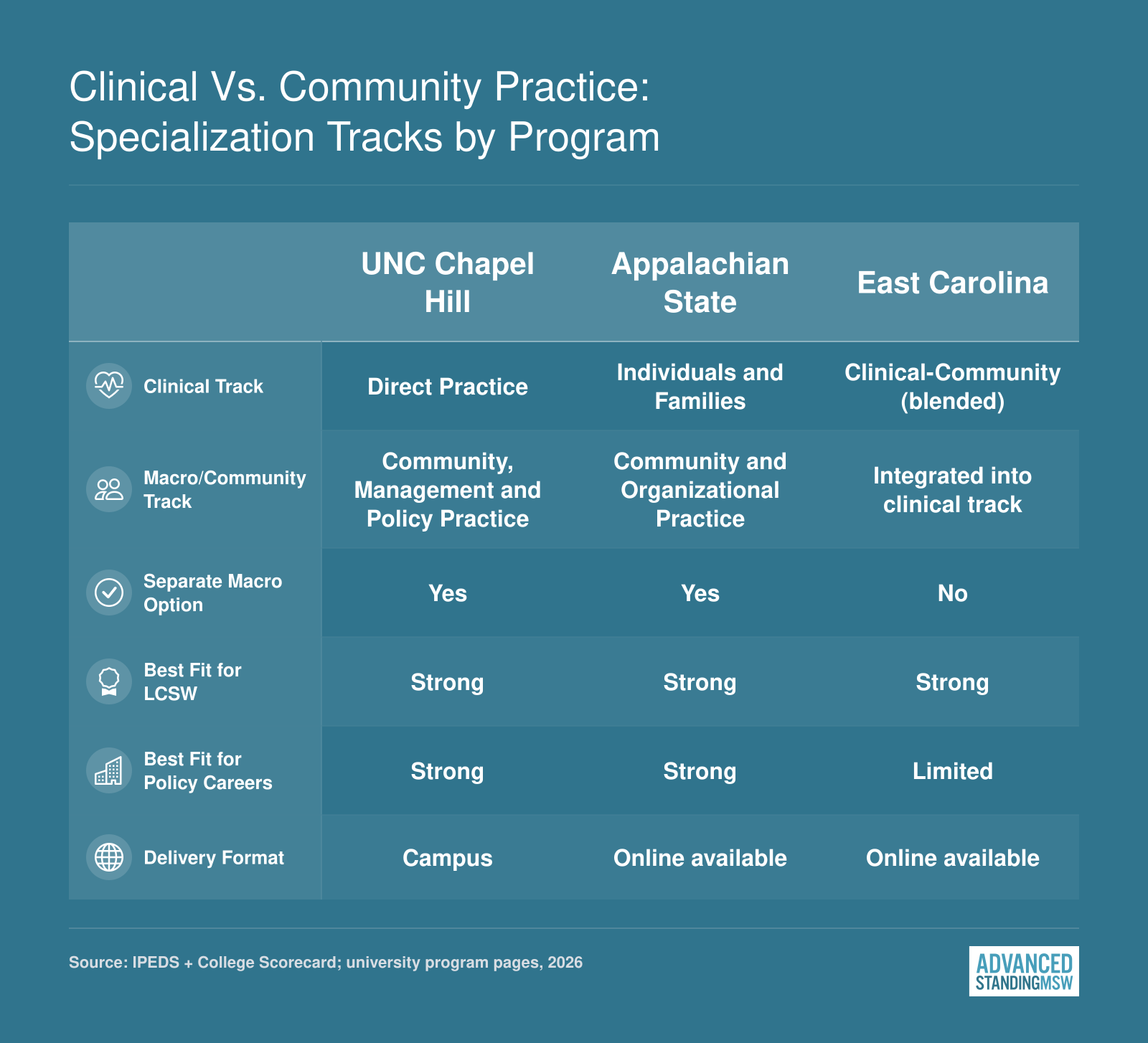
Clinical Vs. Community Practice: Specialization Tracks by Program
Not every advanced standing MSW program in North Carolina offers both a clinical and a macro track. The comparison below maps three representative programs so you can quickly identify which one matches your career direction, whether that is direct clinical practice toward LCSW licensure or community-level policy and organizational work.
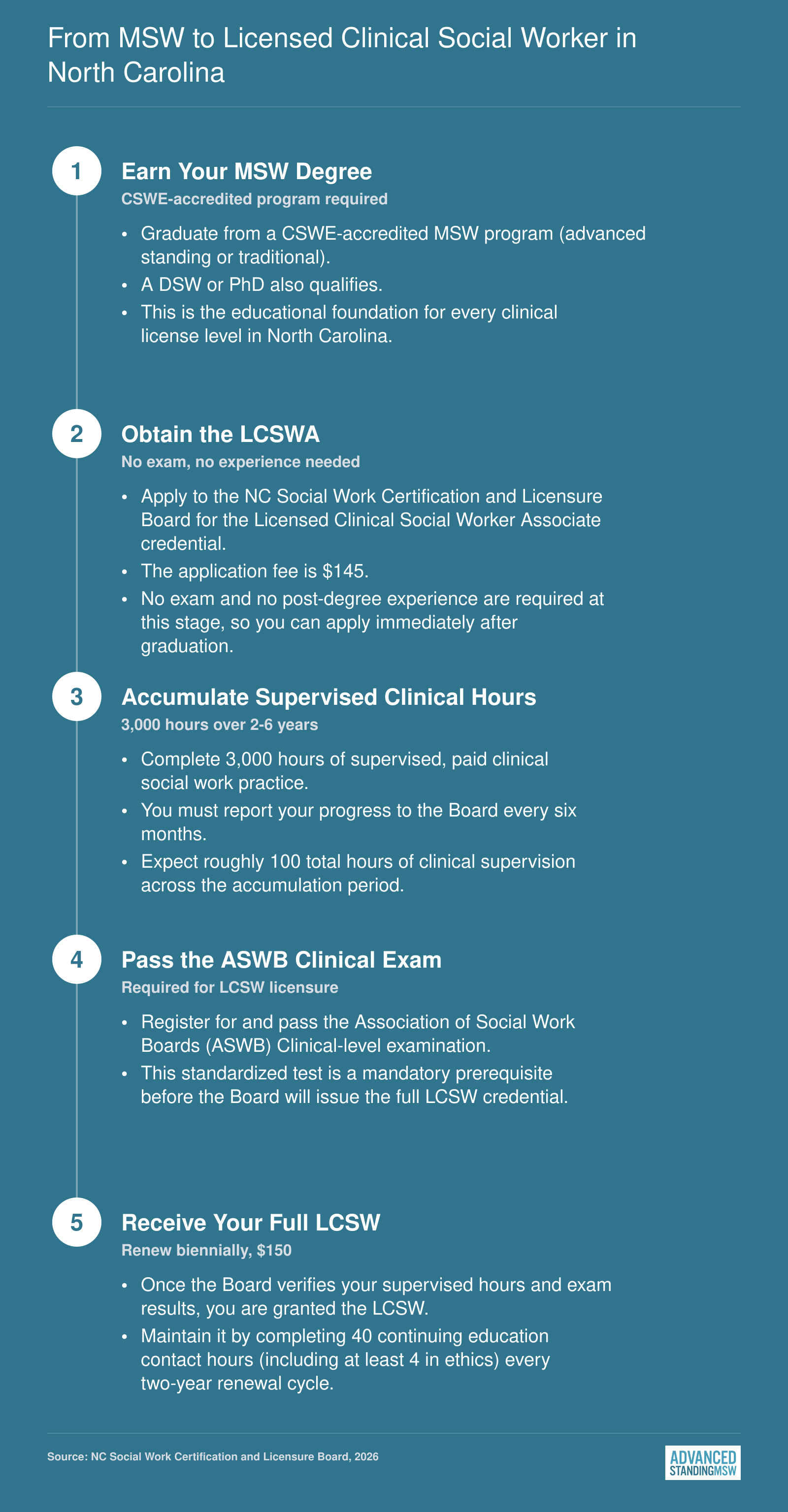
From MSW to Licensed Clinical Social Worker in North Carolina
Whether you complete an advanced standing or traditional MSW, the path to full clinical licensure in North Carolina is identical. The NC Social Work Certification and Licensure Board oversees every step, from your associate credential through the final LCSW designation.
What NC Advanced Standing MSW Graduates Earn After the Degree
What can you realistically expect to earn after finishing an advanced standing MSW at a North Carolina school? Salary data specific to social work graduates isn’t published at the detail level needed for reliable program-specific figures. That gap is common for MSW programs nationwide, and glossy brochure numbers often mix in salaries from other disciplines.
What the Institution-Wide Numbers Suggest
Across the seven NC schools with advanced standing tracks, the broader alumni earnings picture (measured a decade after enrollment, across all majors) ranges from roughly $49,000 at Western Carolina and Appalachian State to $72,000 at UNC Chapel Hill. Treat those figures as context for the school’s overall graduate outcomes, not as a promise of what an MSW holder will make. A UNC Chapel Hill accountant pulls up that average; a Western Carolina school social worker pulls it down.
Clinical Licensure Changes the Math
Earnings for MSW graduates in North Carolina hinge heavily on the license you pursue after graduation. Clinicians who complete supervised hours and sit for the LCSW exam typically out-earn peers in macro or community roles, sometimes by $15,000 to $25,000 annually once fully licensed. Programs like Western Carolina and ECU explicitly prepare graduates for LCSW, LCAS, and CSSW credentials, which positions those alumni for the higher end of the salary band.
Debt vs. Earnings
Median graduate debt across these NC programs sits between $14,000 (UNC Chapel Hill) and $22,750 (ECU), which is modest relative to national MSW debt loads. Even at entry-level social work wages, that debt is manageable, and the ROI improves sharply once clinical licensure is in hand.
Weighing Your Options: How to Pick the Right Advanced Standing MSW in NC
Choosing among advanced standing MSW programs in North Carolina means weighing your personal circumstances against what each school offers. The right program balances cost, format, specialization, and location in a way that fits your career timeline and budget.
Prioritize What Matters Most
- Cost: Look beyond sticker price. Calculate total out-of-pocket expense after financial aid, estimated living costs, and potential salary during the program. In-state public options like Fayetteville State University often yield the lowest debt load.
- Format: Online programs offer geographic flexibility for working professionals but demand self-discipline. Campus-based programs in Raleigh, Charlotte, or Greensboro strengthen local networks and provide easier access to on-site resources and faculty mentorship.
- Specialization: If you aim to become a Licensed Clinical Social Worker, confirm the curriculum includes the clinical coursework and field placements required by the North Carolina Social Work Certification and Licensure Board. Macro-focused students should verify that concentrations in policy, administration, or community practice are available and supported by fieldwork.
- Location: Even partially online programs require local practicum sites. Proximity to agencies aligned with your interests, such as hospitals, schools, or behavioral health centers, can simplify placement logistics and post-MSW job hunting.
Accreditation Is Non-Negotiable
Your BSW must be from a program accredited by the Council on Social Work Education (CSWE). Without this, you cannot qualify for advanced standing. If you earned your BSW outside the US or from a non-CSWE-accredited program, you will need to apply to a traditional MSW track instead.
Verify Practicum Availability Early
Before committing, contact the field placement coordinator at your top-choice schools. Ask how many current students are placed in your geographic area and what types of agencies typically host advanced standing interns. Some programs have formal relationships with providers that fill quickly; others rely on students to self-secure sites, which can delay graduation.
Consider Your BSW Recency
If you earned your BSW more than 5-7 years ago, many advanced standing programs will not consider you competitive, because they require recent academic foundations. In that case, explore programs with longer recency windows or prepare to enter a traditional MSW program, where your experience may still strengthen your application.