What you’ll learn in this article…
- Illinois field placement hours range from 480 to 900 across programs.
- Net costs span roughly $10,974 to $19,398 per year.
- Illinois projects 357 new social worker positions opening by 2026.
Can a BSW actually cut an MSW timeline in half? In Illinois, it can. CSWE-accredited advanced standing programs let BSW holders skip foundational coursework and finish in roughly 12 months, often at significantly lower total cost than the traditional two-year track.
Illinois offers multiple accredited options across online, campus, and hybrid formats, with net annual costs ranging from about $10,974 to $19,398 depending on the institution. Field placement requirements vary from 480 to 900 hours, and that variation has real consequences for how quickly you reach LCSW licensure after graduation.
The accelerated timeline is the draw, but the differences between programs in cost, format, and clinical preparation are where the real decision lives.
Illinois Advanced Standing MSW Programs Worth Considering
Every program on this list is CSWE-accredited, which is the baseline for social work licensure in Illinois. For BSW graduates, the advanced standing route cuts the traditional MSW down to roughly one year, but the programs differ widely in concentration offerings, field hour requirements, and cost. Use the cards below to weigh those trade-offs against your career goals.
- CSWE accreditation status
- Graduate earnings and debt
- Net price for students
- Graduation and retention rates
- Program flexibility and format
- NCES-IPEDS federal institutional data — nces.ed.gov
- Independent program research
- Internal program database
- College Scorecard graduate earnings — collegescorecard.ed.gov
| Rank | School | Location | Net price | Best for | |
|---|---|---|---|---|---|
| #1 | University of Illinois Chicago | Chicago, IL | ~$11,000/yr (est.) | Urban practitioners seeking multiple specializations | |
This advanced standing MSW brings BSW graduates into one academic year of specialized study, with five concentrations spanning child and family, mental health, school social work, justice systems, and organization and community practice. Field instruction totals 630 hours, placing students in urban settings with at-risk populations. The program adds interdepartmental concentrations, a joint MSW/MPH option, and a trauma-informed, strengths-based lens.
| |||||
| #2 | Aurora University | Aurora, IL | $19,000/yr (net price) | Working professionals wanting employment-based internships | |
This advanced standing MSW can be completed in as few as 12 months and leans heavily on employment-based internships across more than 50 partner organizations. Specialized tracks including addictions, child welfare, school social work, forensics, and trauma-informed practice align with professional credentials such as CADC and school social work endorsement. The curriculum advances clinical skills through human behavior, research, and policy coursework.
| |||||
| #3 | Illinois State University | Normal, IL | $19,000/yr | Aspiring school social workers in K-12 settings | |
This advanced standing MSW is built around school social work, with coursework approved by the Illinois State Board of Education and preparation for the School Social Work Content Exam 238. The cohort model pairs close faculty mentorship with a full academic year of school-based practicum. Graduates leave ready for careers in K-12 districts, counseling, and advocacy.
| |||||
| #4 | Dominican University | River Forest, IL | $12,000/yr | ||
This advanced standing MSW can be finished in nine months of full-time study, with six specialized tracks including aging, children and family, and health and well-being. The curriculum centers on human behavior, community analysis, social welfare policy, family systems, and mental health, with 600 clock hours of fieldwork. Small cohorts and dedicated faculty support students headed into aging services, healthcare, and community organizations.
| |||||
| #5 | Southern Illinois University-Edwardsville | Edwardsville, IL | $15,000/yr | ||
This advanced standing MSW emphasizes advanced generalist practice, preparing graduates for micro and macro roles, policy analysis, and applied research. Field instruction runs each semester, and a capstone project anchors the curriculum. The program positions graduates for LSW and LCSW licensure.
| |||||
| #6 | Governors State University | University Park, IL | ~$12,000/yr (est.) | ||
This advanced standing MSW is a 32-credit, one-year full-time pathway with afternoon and evening classes designed for working professionals. Specializations include school social work and children and family practice, with subspecialties in child welfare and mental health. The program's social justice focus and small class sizes prepare graduates for LSW and eventual LCSW licensure.
| |||||


Choosing Between Online and Campus Advanced Standing MSW Programs in Illinois
One of the first decisions you will face is whether to pursue your advanced standing MSW online, on campus, or through a hybrid format. The answer depends on your work schedule, where you live in the state, and how much you value face-to-face collaboration. Here is how the Illinois programs break down across the dimensions that matter most to BSW graduates ready to accelerate their careers.
| Dimension | Online | Campus | Hybrid |
|---|---|---|---|
| Illinois programs in this format | Aurora University is the standout option, offering a fully online advanced standing MSW with flexible start dates in fall, spring, and summer. | UIC (Chicago), Illinois State (Normal), Dominican University (River Forest), Governors State (University Park), and SIUE (Edwardsville) all deliver their advanced standing tracks primarily on campus. | SIUE blends online and on-campus coursework, making it the closest hybrid model among Illinois programs. |
| Schedule flexibility | Highest flexibility. Aurora offers daytime, evening, and asynchronous online courses, letting you maintain employment while finishing in one or two years. | Less flexible overall. Most campus programs hold classes during set daytime or afternoon and evening blocks. Governors State, for example, schedules afternoon and evening sessions to accommodate working students. | Moderate flexibility. SIUE pairs some online coursework with required in-person sessions, offering a middle ground for students who can travel to Edwardsville periodically. |
| Field placement logistics | You arrange placements locally, which is ideal if you live far from a campus. Aurora partners with over 50 organizations statewide for fieldwork, and employment-based internships may be available. | Placements are typically coordinated through the university's regional network. UIC places students in urban Chicago settings, while Illinois State focuses on school social work placements across central Illinois. | SIUE coordinates field instruction each semester through its own network, though some online components reduce how often you must be on campus between placement days. |
| Peer networking and faculty interaction | Interaction happens through discussion boards, video conferencing, and virtual office hours. You can build connections, but spontaneous hallway conversations are limited. | Strongest networking environment. Small class sizes at programs like Governors State and Dominican (with a 12 to 1 student-faculty ratio) foster close mentoring relationships and cohort bonding. | A blend of both. You get some face-to-face cohort time along with online collaboration tools. |
| Tuition (advanced standing program) | Aurora charges approximately $16,463 for the full advanced standing program, the same rate for in-state and out-of-state students. | Ranges widely. In-state tuition runs from roughly $10,218 at Illinois State to $18,500 at Dominican. UIC lists approximately $17,550 in-state and $27,748 out-of-state for the advanced standing track. Public universities like Governors State ($10,666) and SIUE ($10,488) offer some of the most affordable options. | SIUE's hybrid tuition matches its campus rate of approximately $10,488, making it one of the most affordable paths in the state. |
| Can you complete the degree entirely online from Illinois? | Yes. Aurora University's CSWE-accredited online advanced standing MSW can be completed fully online, with local field placements arranged wherever you live in Illinois. | No. These programs require regular on-campus attendance for coursework. | Not entirely. SIUE requires some on-campus sessions alongside its online components. |
Questions to Ask Yourself
What Does an Advanced Standing MSW Cost in Illinois?
Based on institutional net price data, advanced standing MSW students at ranked Illinois programs face net costs ranging from roughly $10,974 to $19,398 per year. Public universities consistently land below private options on effective price, but the sticker price alone rarely tells the whole story. The advanced standing track cuts required credits nearly in half compared to a traditional MSW, which directly shrinks the tuition bill before aid enters the equation.
The Public-Private Price Gap
The cost spread between public and private programs is significant but not absolute. At the public University of Illinois Chicago, the advanced standing program carries an in-state tuition of $17,550 and an out-of-state rate of $27,748, yet the institution-wide average net price for all graduate students sits at $10,974 once grants and scholarships are applied. Governors State University, also public, charges a flat $10,666 in tuition for the entire advanced standing sequence, regardless of residency, and posts a net price of $12,329. On the private side, Dominican University lists a uniform tuition of $18,500 and shows a net price of $11,745, meaning its aid packages effectively close the gap. Aurora University and Illinois State University both report higher net prices, at $18,838 and $19,398 respectively, reflecting tuition rates of $16,463 and $10,218 (in-state) plus fees.
The takeaway: do not dismiss a private school solely on sticker price. Generous institutional aid or targeted scholarships can narrow or even reverse the public-school advantage, especially for students who bring strong academic profiles or commit to high-need fields.
Credit-Hour Savings
Every advanced standing MSW in Illinois leverages the foundational coursework you already completed in a BSW program. That truncation typically means you need only 30 to 32 credit hours, compared to 60 or more in a traditional track. Dominican University, Southern Illinois University Edwardsville, and Aurora University each structure their advanced standing program at 30 credits. Governors State requires 32. Since most programs charge by the credit hour, those 30 fewer credits translate directly into savings of $10,000 to $20,000 before you factor in living expenses or opportunity costs. Verify the exact per-credit rate and any mandatory fees with the program, because a low per-credit charge can be offset by high semester fees.
Debt After Graduation
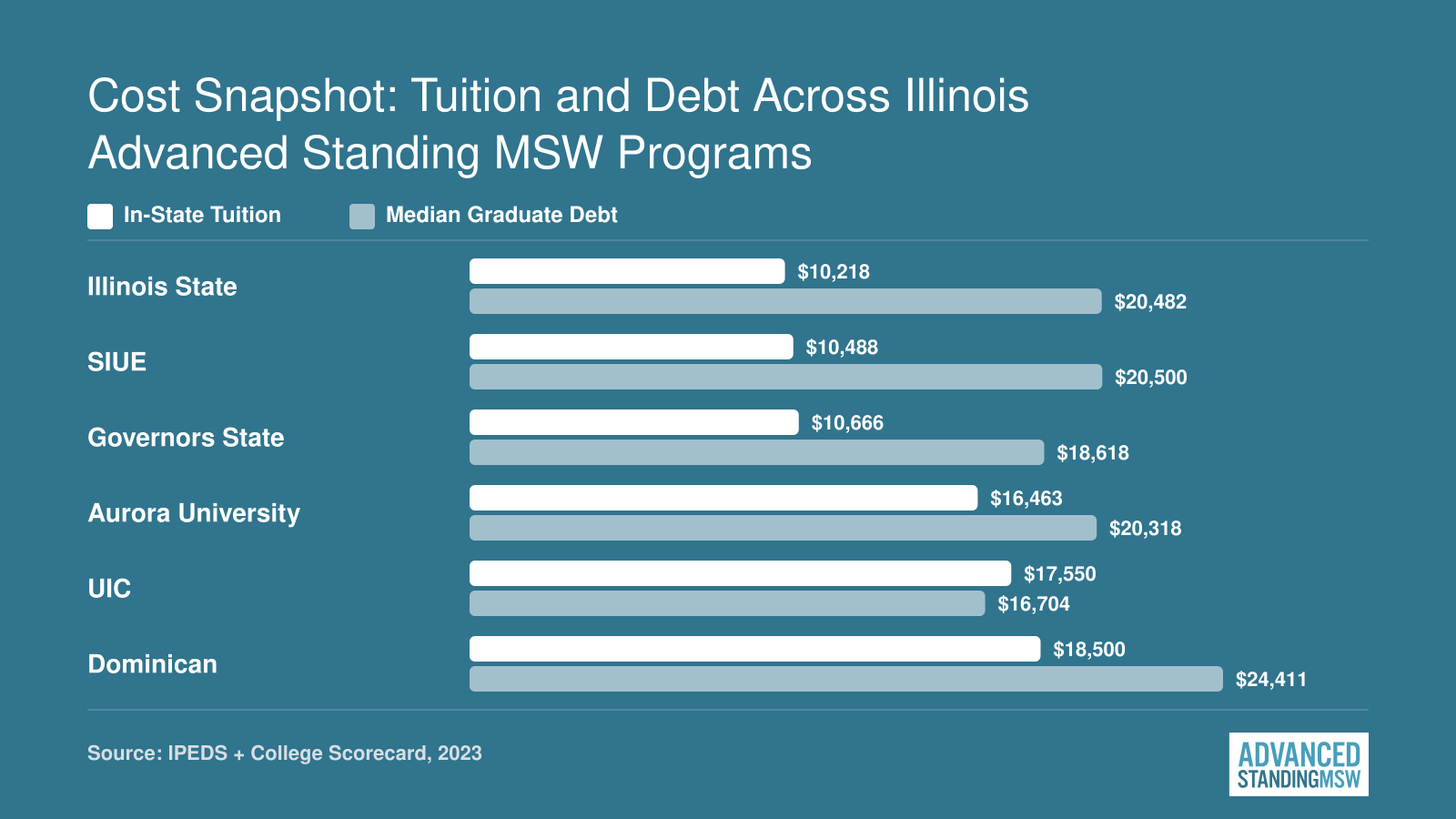
Median federal loan debt among graduates offers a clearer picture of what students actually borrow. At UIC, the median debt stands at $16,704, the lowest in the group. Governors State follows at $18,618. Aurora University, a private institution, reports median debt of $20,318, nearly identical to Southern Illinois University Edwardsville at $20,500 and Illinois State University at $20,482. Dominican University posts the highest median debt at $24,411. These figures suggest that lower sticker prices do not always produce the lightest debt loads; living costs, program length, and financial aid strategy all shape the final number. If minimizing debt is your priority, UIC’s combination of a competitive net price and below-average borrowing makes it a standout.
How to Pin Down Your Real Cost
Because net price data is institution-wide, not program-specific, your actual cost as an advanced standing social work student may differ. Request a financial aid estimate directly from each program, specifying that you are an advanced standing applicant and providing your FAFSA information. Ask whether assistantships, stipends, or field-placement-related aid is available specifically for MSW students. Public universities often extend in-state tuition to residents of neighboring states through reciprocity agreements, which can cut the out-of-state premium for border-county applicants. Finally, compare the total program cost, not the annual rate: a program that takes nine months full-time may carry a higher per-semester price but lower overall expense than a two-year part-time option.
Cost Snapshot: Tuition and Debt Across Illinois Advanced Standing MSW Programs
Tuition for advanced standing MSW programs in Illinois varies widely depending on whether you attend a public or private institution. The chart below pairs each school's in-state tuition with its median graduate debt so you can weigh sticker price against how much graduates actually borrow.
Admissions Requirements for Illinois Advanced Standing MSW Programs
Understanding what Illinois advanced standing MSW programs ask for upfront saves you time and helps you assemble a competitive application. While each school has its own flavor, the core ingredients are remarkably consistent, and a few subtle differences can make or break your eligibility.
Universal Advanced Standing Requirements
Every CSWE-accredited advanced standing MSW in Illinois shares three non-negotiable prerequisites. First, you need a Bachelor of Social Work from a CSWE-accredited program: no exceptions.1 This credential signals you have already mastered foundational social work knowledge. Second, your BSW must include a documented field practicum, proving you have supervised direct-practice experience. Third, most programs set a minimum undergraduate GPA, typically around 3.0, though some use holistic review that considers upward grade trends or relevant work history. For example, Governors State University explicitly lists a 3.0 GPA floor,3 while other schools may weigh professional background more heavily if your GPA falls slightly below.
How Recent Must Your BSW Be?
This is the question we hear most often, and the answer is not one-size-fits-all. Illinois programs vary in their BSW recency windows, the maximum number of years since your degree was conferred. University of Illinois Urbana-Champaign and University of Illinois Chicago both use a 7-year window.12 Illinois State University allows up to 8 years.4 Not all schools publish a recency policy publicly; we could not verify windows for Loyola University Chicago or Aurora University at the time of writing. Broader directory summaries suggest a 5-to-10-year range across the state, but individual program rules matter most. If your BSW is older than a program's window, don't assume you are disqualified. Some schools consider exceptions based on continued social work practice, post-BSW coursework, or passing a qualifying exam.
Application Materials: What You'll Need
- Official transcripts: From every college you attended, showing your CSWE-accredited BSW and GPA.
- Personal statement: A focused essay detailing why advanced standing fits your career goals, often with prompts about social justice or practice values.
- Letters of recommendation: Typically two or three, from academic references or professional supervisors who can speak to your readiness for accelerated graduate work.
- Resume or CV: Highlight social work, related experience, including internships, volunteer roles, and employment.
- Writing sample or supplemental essays: Some programs ask for an additional piece on a specified topic; check each program's admissions page for unique requirements.
Deadlines and Admissions Cycles
Most advanced standing MSW programs in Illinois admit one cohort per year, usually starting in summer or fall. Illinois State University has a firm February 1 deadline for fall entry.4 and school social work advanced standing applicants must apply for the summer term by the same date. Governors State University listed summer and fall 2026 deadlines in published materials,3 though the exact cutoff dates were not specified in the source we reviewed. University of Illinois Chicago's deadline was not publicly available in our research. Fixed deadlines are the norm because advanced standing cohorts are intentionally small; missing a cycle often means waiting a full year. Rolling admissions, if offered, are rare for these tracks. With so much riding on a single application window, mark your calendar and submit early.
Related Articles
How Long Does an Advanced Standing MSW Take in Illinois?
Some Illinois advanced standing MSW students finish in a single focused year; others spread the degree across two or more years to balance work and family obligations. The path you choose shapes your daily rhythm, your finances, and how soon you step into licensed practice.
Full-Time: The One-Year Fast Track
Most full-time advanced standing programs in Illinois are designed to be completed in one calendar year1, roughly two to three semesters, compared to the two years a traditional MSW demands. This accelerated pace is possible because advanced standing students have already covered foundational social work content in their BSW program, so the curriculum jumps straight to advanced coursework and specialized field experiences.
At the University of Illinois Urbana-Champaign, for instance, a full-time advanced standing student can earn the degree in one year2. DePaul University also offers a full-time track that rounds up to roughly one year1 for advanced standing candidates. In both cases, the compressed schedule means you move through course material quickly and need to be ready for a demanding weekly commitment.
Part-Time Tracks: Slower but Sustainable
Three Illinois schools with advanced standing MSW programs offer part-time study: UIUC, Loyola University Chicago, and DePaul. Part-time timelines vary widely, typically ranging from two to four years1 depending on course load and program architecture.
UIUC's part-time advanced standing path generally takes two years2. Loyola's online MSW is structured as a part-time-only program, yet it still wraps up in one year3 because it runs four continuous semesters with no summer break, a distinctive model that blends the lighter weekly load of part-time study with the speed of a full-time schedule. DePaul offers both speed options, but its part-time advanced standing track can extend up to four years1, giving students maximum flexibility to pace coursework around employment.
Start Terms and Cohort Cycles
Your start date affects not just when you begin but the total length of your degree because some Illinois programs admit advanced standing students only once or twice a year. Loyola's program admits only in the spring3, so if you miss that window, you wait a full year. UIUC normally offers summer or fall starts, but the Fall 2026 advanced standing cohort is part-time only and launches in Spring 20272, a departure from the usual cycle that underscores the need to verify entry terms directly with each school before applying.
Factors That Can Extend Your Timeline
Even within a program's stated length, individual circumstances can add time. If your BSW coursework does not fully align with the program's prerequisites, you may need bridge courses before starting advanced-level classes. Similarly, students who require additional field hours to meet Illinois licensure requirements or who change a placement mid-program may see their graduation date shift by a semester. When you plan, assume the shortest timeline is for a student who enters with no gaps in their preparation and moves through field placements without interruption.
Field Placement Hours Required by Each Illinois Program
Field placement is one of the most time-intensive components of any MSW program, and the hours required in an advanced standing track vary significantly across Illinois schools. The range spans from roughly 480 hours to 900 hours depending on the institution and specialization. Importantly, these are new practicum hours completed during your MSW program. Your BSW field placement hours are not double-counted here; CSWE accreditation standards treat advanced standing field education as a separate requirement building on your undergraduate foundation. The table below is the only side-by-side comparison of advanced standing field hours across Illinois programs available online.
| School | Advanced Standing Field Hours | Notes |
|---|---|---|
| University of Illinois Chicago | Up to 900 hours | The advanced clinical practice option requires a minimum of 900 hours across one to two semesters of field placement. The broader advanced standing pathway lists 12 to 24 credits of field education, with total program credits ranging from 44 to 56. Exact hours may differ depending on the chosen concentration. |
| University of Illinois Urbana-Champaign | Approximately 480 to 560 hours (one semester) | Advanced standing students complete a single semester internship, typically a 14-week extended summer placement. The internship accounts for 12 to 24 of the 44 total credit hours required. Actual clock hours depend on weekly scheduling and the specific track selected. |
| Loyola University Chicago | 600 hours | The online MSW advanced standing program requires one internship totaling 600 hours. The program is 23 credit hours, making it one of the more streamlined options in the state. |
| Aurora University | 600 hours (minimum) | Aurora requires a minimum of 600 hours for advanced standing internships regardless of track. Students pursuing the school social work specialization in Illinois also meet the 600-hour standard. The generalist internship at the BSW level, by contrast, is 450 hours. |
| Illinois State University | 350 hours per semester | The school social work advanced standing plan lists 350 practicum hours per semester at 22 to 25 hours per week. Students completing two semesters of specialized practicum would accumulate approximately 700 total hours, though the published plan does not specify a single combined total. |
From Advanced Standing MSW to Illinois LCSW: The Licensure Path
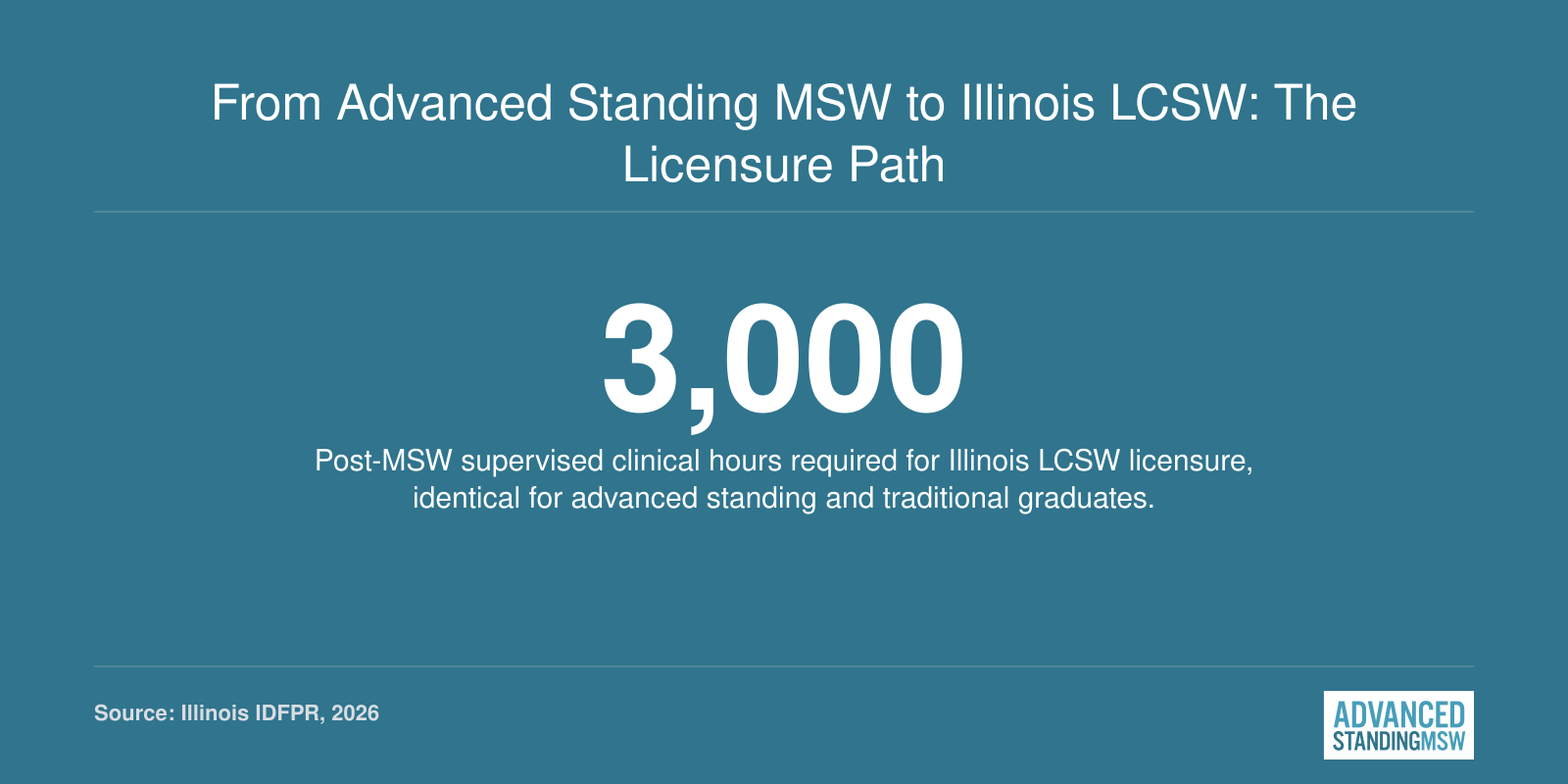
Advanced standing compresses your MSW into roughly one year, but the post-degree licensure journey remains the same as it is for traditional MSW graduates. After earning your degree from a CSWE-accredited program, you must pass the ASWB Clinical exam, accumulate 3,000 supervised clinical hours (with at least four hours of supervision per month under an Illinois-licensed LCSW), and then apply to IDFPR for your LCSW. Working full time at 30 to 40 hours per week, most graduates complete those hours in approximately 17 to 23 months. The advanced standing pathway saves you a year on the front end of your career, but it does not shorten or alter the supervised practice requirement on the back end.
Illinois is projected to add 357 new Child, Family, and School Social Worker jobs by 2026, a 2.02% increase in just two years. Advanced standing MSW graduates can meet this demand sooner, entering the workforce with a BSW already in hand.
Common Questions About Advanced Standing MSW Programs in Illinois
Below are answers to the questions BSW graduates ask most often when exploring accelerated MSW options in Illinois. Each response draws on published admissions data and program details from CSWE-accredited schools across the state.
- What GPA do I need for advanced standing MSW admission in Illinois?
- Most Illinois programs require a minimum 3.0 GPA, though the calculation basis varies. Illinois State University looks at your last 60 credit hours1, while the University of Illinois Urbana-Champaign applies the 3.0 threshold more broadly2. Governors State University is somewhat more flexible, requiring a 2.50 cumulative GPA overall paired with a 3.0 in your BSW coursework3. Always confirm calculation methods with your target school.
- Can I complete an advanced standing MSW entirely online in Illinois?
- Some Illinois programs do offer a fully online advanced standing track, but availability is program‑specific rather than a statewide standard. Not every CSWE-accredited school in Illinois offers an online option, and even fully online programs may require in‑person field placement hours in your local community. Check directly with each program to verify its current delivery format before applying.
- Does an advanced standing MSW qualify me for LCSW licensure in Illinois?
- An advanced standing MSW from a CSWE-accredited program satisfies the degree requirement for Illinois LCSW licensure, just as a traditional MSW does. However, the degree alone is not the credential. You must also accumulate the required supervised clinical hours and pass the clinical licensing examination. The advanced standing pathway does not create any disadvantage in the licensure process.
- What happens if my BSW is older than the recency window allows?
- Each school sets its own recency limit. Illinois State University requires your BSW to have been earned within 8 years1, while the University of Illinois Urbana-Champaign sets a 7‑year window2. If your degree falls outside that range, you will not qualify for advanced standing, but you can still apply to the program’s regular or extended track. An older BSW does not disqualify you from earning an MSW altogether.
- Which Illinois advanced standing MSW program is the most affordable?
- Among programs with publicly listed tuition, Governors State University stands out at $231 per credit hour for in‑state students3, making it one of the most clearly documented affordable options. Several other Illinois schools do not publish per‑credit rates in an easily comparable format, so a definitive statewide ranking is difficult to compile. Contact financial aid offices directly for the most current figures and fee schedules.