What you’ll learn in this article…
- University of Memphis offers the lowest in-state advanced standing tuition at $11,628.
- Most Tennessee programs require 500 to 600 field placement hours.
- Graduates typically recoup their MSW investment within five to seven years.
For BSW holders in Tennessee, the most efficient path to an MSW cuts required credits by roughly half, compressing what is normally a two-year degree into about 12 months of full-time study. That speed brings a real tradeoff: fewer classroom seats and a narrower list of programs built to accept advanced standing transfer credits.
Six CSWE-accredited schools currently offer the accelerated track across online, campus, and hybrid formats. Each sets its own rules for BSW recency, field placement geography, and specialization alignment with Tennessee's LMSW and LCSW licensing sequence.
In a state where social worker demand runs high in both urban and rural counties, picking the right program means matching format and cost to the clinical or macro path your credential requires.
Tennessee's Top-Ranked Advanced Standing MSW Programs for 2026
Choosing among Tennessee's advanced standing MSW programs starts with fit: delivery format, cost, and the specific strengths each school brings to clinical practice. The six programs below stand out for BSW graduates in 2026. Graduation rates in the cards are institution-wide figures, and net prices are averages, so treat them as context alongside each program's specific structure.
- Net price after aid
- Institutional graduation rates
- Post-graduation earnings outcomes
- Program flexibility and delivery
- Independent program research
- NCES-IPEDS federal institutional data — nces.ed.gov
- College Scorecard graduate earnings — collegescorecard.ed.gov
- Internal program database
| Rank | School | Location | Net price | Best for | |
|---|---|---|---|---|---|
| #1 | The University of Tennessee-Knoxville | Knoxville, TN | ~$19,000/yr (est.) | Flagship campus learners pursuing clinical roles | |
UT Knoxville anchors this list as Tennessee's flagship research university. Its advanced standing MSSW compresses graduate study into 36 credit hours with a 12-month full-time or 24-month part-time option, and students begin in the summer while completing one 600-hour field placement. The Knoxville and Nashville campuses widen access across the state, and graduates leave prepared for advanced clinical, community, or organizational roles.
| |||||
| #2 | Union University | Jackson, TN | ~$27,000/yr (est.) | Online professionals wanting Christian worldview integration | |
Union University builds its advanced standing MSW on a Christian worldview and offers it fully online or at face-to-face locations in Jackson and Germantown. With a per-credit rate of $679, rolling admissions, and spring and fall start dates, it is one of the most accessible programs on this list. The optional Trauma Studies Graduate Certificate makes it a strong match for students planning to work with survivors of trauma.
| |||||
| #3 | East Tennessee State University | Johnson City, TN | ~$16,000/yr (est.) | Rural students needing flexible online clinical training | |
East Tennessee State University has offered a CSWE-accredited MSW since 2003 and is a particularly strong option for students across East Tennessee and rural parts of the state. The clinical concentration emphasizes evidence-based practice for mental health and healthcare settings, and the 100% online delivery with synchronous and asynchronous classes accommodates working professionals. Advanced standing students can finish in about 12 months full-time, and the program requires a CSWE-accredited BSW earned after 1984.
| |||||
| #4 | University of Memphis | Memphis, TN | $10,000 – $15,000/yr | ||
The University of Memphis offers an accelerated advanced standing MSW that can be completed in as few as three semesters, or 37 credits, with both full-time and extended two-year tracks. Its Advanced Practice Across Systems specialization develops skills in evidence-based assessment, intervention, and evaluation across clinical, community, and policy settings. Distance learning options and a spring start for some tracks broaden flexibility for working students.
| |||||
| #5 | The University of Tennessee-Chattanooga | Chattanooga, TN | ~$14,000/yr (est.) | ||
The University of Tennessee at Chattanooga runs a cohort-based advanced standing MSW built around evening classes and daytime field placements, making it practical for professionals in the Chattanooga region. The 32-credit curriculum starts in May, requires a BSW earned within the past seven years, and asks applicants to verify a 400-hour BSW field internship. Graduates commonly move into clinical social work, school social work, healthcare, and nonprofit leadership.
| |||||
| #6 | King University | Bristol, TN | $22,000/yr | ||
King University's online advanced standing MSW is designed for working professionals and carries the lowest barrier to entry on this list, with no application fee and guaranteed admission for King BSW graduates. The curriculum focuses on clinical advocacy, applied learning, and program development, and the Yellow Ribbon Program makes it a standout for military veterans. Applicants with a BSW earned within five years qualify, and those with earlier degrees plus continued field experience are encouraged to apply.
| |||||


Accelerated MSW, One-Year MSW, Advanced Standing: The Same Program
If you have been comparing Tennessee programs and noticed the labels keep shifting, you are not imagining it. "Advanced Standing MSW," "Accelerated MSW," "One-Year MSW," and "12-Month MSW" all describe the same shortened graduate pathway for applicants who already hold a CSWE-accredited BSW.1 The label is marketing; the eligibility rule is what matters.
What the Different Names Actually Mean
Schools tend to pick a name that emphasizes either the applicant's status or the program's length. Tennessee examples:
- University of Tennessee, Knoxville: calls it the "Advanced Standing MSW," completed in one calendar year of full-time study.
- Middle Tennessee State University (MTSU): uses "Advanced Standing" for BSW holders and awards up to 30 credits of foundation-year waiver.
- University of Memphis: offers an "Advanced Standing" track that begins each summer and finishes the following spring.
- Union University: frames its accelerated route as an "Advanced Standing" option within its MSW.
Whether a school says "12-month," "one-year," or "advanced standing," the underlying Advanced Standing MSW programs are structurally the same: they replace the foundation year of a traditional MSW with waived credit, and you enter directly into the concentration (specialization) year.1
Who Does Not Qualify
Advanced standing is a narrow door. You will not be eligible if:
- Your bachelor's degree is in a related field like psychology, sociology, or human services rather than social work.
- Your BSW came from a program that is not CSWE-accredited.1
- Your BSW is older than the school's recency window, commonly five to seven years, though Tennessee programs vary.
If any of those apply, the traditional two-year, 60-credit MSW is your route. The practical trade-off is straightforward: advanced standing runs roughly 30 to 39 credits and about one year, while the traditional MSW is 60 credits across two years.
Online, Campus, or Hybrid: Which Tennessee Format Fits Your Life?
Tennessee's CSWE-accredited advanced standing MSW programs come in three distinct delivery formats, but the labels can be misleading. A program marketed as "online" may still require synchronous evening sessions at a physical campus, while a "hybrid" option might let you complete every course from home. The comparison below breaks down what each format actually demands so you can match it to your schedule, location, and caregiving or work obligations.
| Feature | Fully Online | Hybrid | Campus Only |
|---|---|---|---|
| What it means | All coursework is delivered remotely, typically through a mix of synchronous and asynchronous sessions. Field placements are arranged locally. | Most coursework is online, but periodic in-person sessions, evening classes, or campus intensives are required. | All classes and most learning activities take place on a physical campus. Field placements are also arranged in the surrounding region. |
| Tennessee programs in this category | East Tennessee State University, King University, Austin Peay State University (online track), University of Memphis (distance option), Southern Adventist University | UT Knoxville (synchronous evening classes at the Nashville campus every other week), MTSU, Union University (face-to-face sessions in Jackson and Germantown), Austin Peay (hybrid track) | UT Chattanooga (evening classes with daytime field internships, no online option listed) |
| Best fit for | Working professionals logging full-time hours, rural students far from a campus, and caregivers who need maximum scheduling flexibility. | Students who value some face-to-face interaction but cannot commit to a traditional full-time campus schedule. Often ideal for those living within driving distance of a program site. | Students who thrive in a structured classroom environment and live near Chattanooga or another campus hub. Cohort-based models can strengthen peer connections. |
| Typical campus visits required | None for coursework. Field placement is completed in your local community. | Varies. UT Knoxville, for example, requires in-person evening classes in Nashville every other week. Union University holds face-to-face sessions at its Jackson and Germantown locations. | Attendance expected for every class session on campus. |
| Out-of-state access | Several programs accept out-of-state applicants. Note that tuition rates may differ: public universities such as ETSU and University of Memphis charge higher out-of-state tuition, while private institutions like King University charge a single rate regardless of residency. | Possible, but recurring campus visits can make it impractical for students who live far from Tennessee. | Generally limited to students who can relocate to or already reside near the campus. |
| Field placement logistics | You typically arrange placements in your home community with program approval, making this format practical even if you live outside Tennessee. | Placements may be local or tied to the program's regional network, depending on the school's requirements. | Placements are usually coordinated within the campus region. UT Chattanooga, for instance, expects daytime field internships near the Chattanooga area. |
| Key trade-off to consider | You gain flexibility but may miss spontaneous peer collaboration and in-person mentoring from faculty. | You get a blend of convenience and face-to-face learning, but travel to campus adds time and cost. | You benefit from deep immersion and cohort bonding, but the rigid schedule is difficult to balance with full-time employment or family responsibilities. |
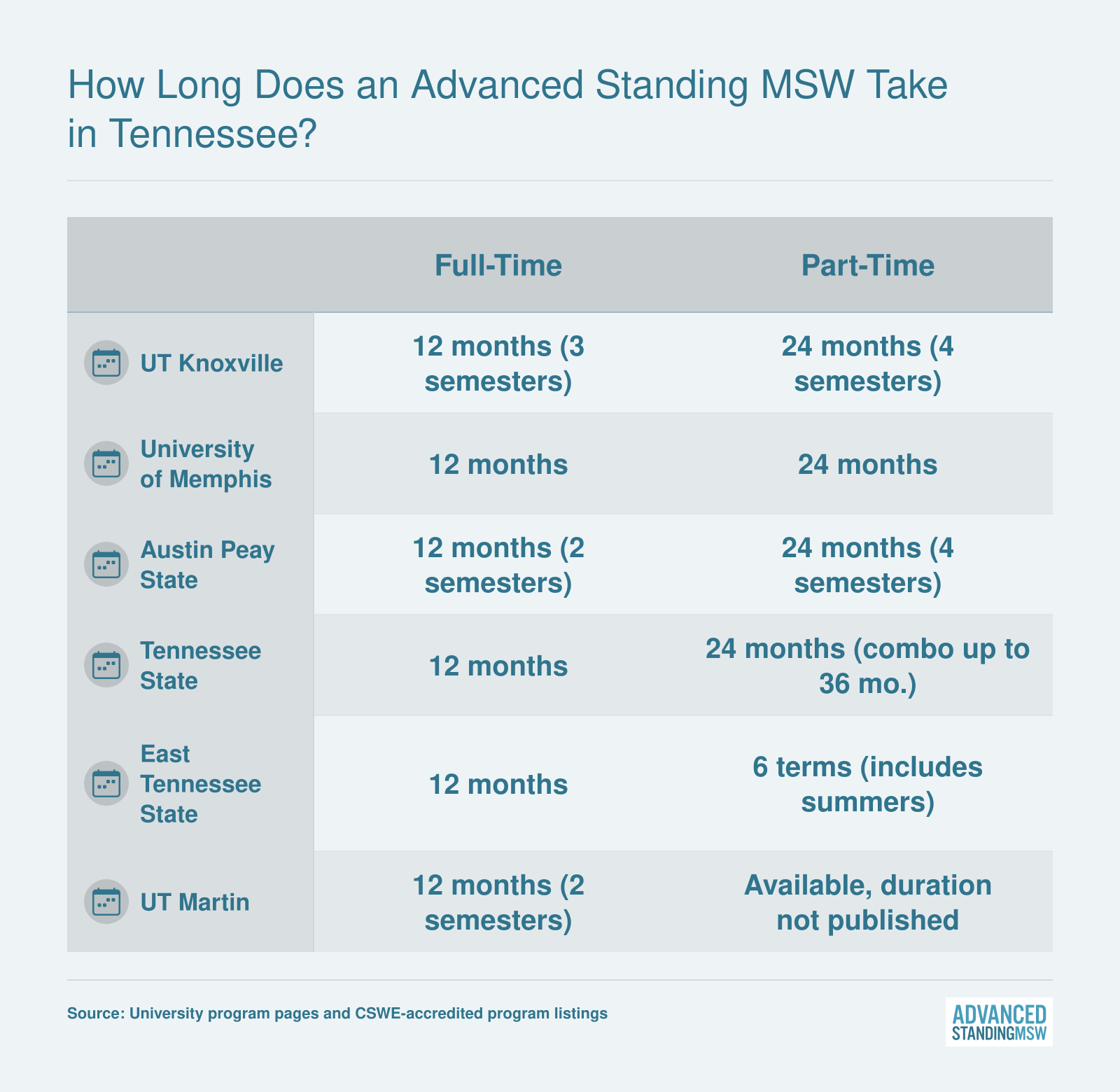
How Long Does an Advanced Standing MSW Take in Tennessee?
Full-time advanced standing MSW programs across Tennessee converge on a roughly 12-month timeline, typically spanning two or three semesters. If you need to keep working or manage family obligations, several schools stretch the same curriculum across four semesters (about 24 months). East Tennessee State University structures its part-time track across six terms, incorporating summers. The table below breaks down confirmed timelines so you can compare at a glance.
Questions to Ask Yourself
Field Placement Hours: What Each Tennessee Program Requires
Field placement is the engine of your MSW education, and in Tennessee, advanced standing students complete a streamlined but rigorous practicum designed around their BSW foundation. The hours required vary by institution, but every school anchors its advanced standing field experience in competency-based learning rather than simply logging clock time.
Required Hours by School
While exact figures shift slightly year to year, here is what current program policies show for the 2026-2027 academic cycle.
- UT Knoxville (Advanced Standing, full-time): 600 hours across one semester.1 The extended-study option spreads the same 600 hours over two semesters for students balancing work or family.3
- East Tennessee State University: 600 hours, typically split across two semesters of consecutive practicum courses.2
- Other Tennessee programs: Programs at MTSU, University of Memphis, UT Chattanooga, and Austin Peay generally follow a similar range of 500-600 hours for advanced standing students. Because each school publishes its field manual on its own cycle, verify the exact total with the field office before you enroll.
How Advanced Standing Differs from the Traditional Track
A traditional MSW student without a BSW must complete a generalist placement (often 400-500 hours) plus a specialist placement (500-600 hours), totaling 900-1,200 field hours. Advanced standing waives the generalist requirement, so you jump directly into the specialist-level practicum. That is why advanced standing hours typically range from 500 to 600, not 900-plus.
Where Can You Complete Your Placement?
- Online and out-of-area students: Most programs actively support placements in your home community. UT Knoxville and other schools work with students to identify qualifying agencies near them, provided the site meets CSWE accreditation standards.
- Employment-based placements: Some programs, including UT Knoxville, allow you to count your current employer as your practicum site, if the learning activities are clearly distinct from your regular job duties and supervised by someone other than your direct supervisor.1 Restrictions are strict: you typically must submit a proposal showing a separate learning plan, and the field office reserves final approval. ETSU and other schools may have similar policies but often require that the placement not be at your primary place of employment unless a documented hardship exists.2
Before assuming you can use your job, talk to the field coordinator early. Every program prioritizes the educational integrity of the placement over convenience.
Tuition and Net Price: Finding the Most Affordable Option
University of Memphis posts the lowest in-state tuition among Tennessee advanced standing MSW programs at $11,628 for the full program, while Union University lists the highest sticker price at $14,419 for its online track. Those figures, however, tell only part of the story. Net price, which factors in grants and scholarships, shifts the landscape considerably for students who pursue institutional aid.
Published Tuition Across Tennessee Programs
In-state students will find public universities offer the clearest savings. The University of Memphis charges $11,628 in-state and $15,840 out-of-state for its 37-credit hybrid program. UT Chattanooga requires $11,110 in-state and $19,174 out-of-state for a 32-credit on-campus track. East Tennessee State University lists $11,366 in-state, though out-of-state students face $26,486. UT Knoxville's 36-credit advanced standing MSSW runs $15,972 in-state and $34,760 out-of-state, reflecting the flagship campus premium.7
Among private institutions, King University charges a flat $16,073 regardless of residency for its online program, removing the in-state versus out-of-state distinction entirely. Union University follows a similar model at $14,419 across the board.
Average Net Price: Institutional Context
Net price figures published by the U.S. Department of Education reflect institution-wide averages for undergraduates receiving aid, not MSW-specific costs. Still, they offer a rough sense of how aggressively each school deploys financial assistance. University of Memphis reports an average net price of $12,397, while UT Chattanooga comes in at $14,265. East Tennessee State University averages $15,983, and UT Knoxville sits higher at $18,976. Among private schools, King University averages $22,347, and Union University averages $27,171. These numbers will not match your final bill, but they signal which institutions tend to offset sticker prices more generously.
MSW-Specific Scholarships and Assistantships
UT Knoxville's College of Social Work offers multiple scholarships specifically for MSSW students, as detailed on UT Knoxville’s scholarship page, including awards for Knoxville on-campus students demonstrating financial need, merit-based tuition assistance open to BSSW and MSSW students, and a scholarship available across Knoxville, Nashville, and online cohorts. Students must apply through the Office of Financial Aid and Scholarships for federal loan eligibility.8
East Tennessee State University provides two tuition scholarships and a limited number of graduate assistantships (one full-time, several part-time) for MSW students, though full-time enrollment is required to qualify.6 Official MSW-specific aid details for UT Chattanooga, University of Memphis, and Austin Peay were not confirmed through program pages at the time of research.
King University advertises a scholarship of up to $30,000 over two years for advanced standing students in its online advanced standing MSW program, making it one of the more aggressive institutional funding offers for this pathway.
State and External Funding Sources
Tennessee Department of Children's Services employees with two consecutive years of full-time service, a performance evaluation of at least "valued," and unconditional acceptance into an accredited MSW program may qualify for the DCS MSW Tuition Assistance Program. This employer-sponsored benefit covers tuition and approved fees plus expense payments, a significant offset for those working in child welfare.
The Tennessee Behavioral Health Pathways Scholarship offers up to $15,000 per year for state residents enrolled in a behavioral health master's program at an accredited Tennessee institution.6 Eligibility requirements and application timelines vary, so prospective students should verify current availability directly with their program.
Identifying the Strongest Value
For BSW graduates prioritizing upfront cost, University of Memphis and UT Chattanooga deliver the lowest published tuition. For those seeking the most substantial institutional scholarship targeting advanced standing students specifically, King University's $30,000 package stands out, though the school's higher base tuition and private-school net price average warrant careful comparison. Students employed by DCS or pursuing behavioral health careers should investigate state-level assistance before finalizing enrollment, as these programs can eliminate thousands in out-of-pocket expense.
Admissions Requirements: GPA, BSW Recency, GRE, and Non-Cswe Policies
Admissions requirements for advanced standing MSW programs in Tennessee set the baseline qualifications that determine whether your BSW qualifies you for accelerated entry. This section breaks down GPA thresholds, BSW degree recency rules, standardized testing policies, non-CSWE eligibility, and what to expect from application timelines.
GPA Minimums and School-by-School Variation
Most Tennessee programs set a minimum cumulative GPA, though the bar varies. Here is how the major advanced standing providers compare:
- University of Tennessee, Knoxville (UTK): Requires a 2.7 cumulative undergraduate GPA.3
- University of Memphis (UofM Global): Expects a 3.0 overall undergraduate GPA and a 3.3 in social work-specific courses.
- Middle Tennessee State University (MTSU): Mandates a 3.0 cumulative GPA.4
- University of Tennessee, Chattanooga (UTC): Sets its minimum at 3.0 on a 4.0 scale.1
No program currently lists a firm minimum below 2.7, so BSW graduates with lower GPAs should contact admissions offices to discuss potential petition processes or conditional admission options.
BSW Recency Requirements: How Old Is Too Old?
Programs differ sharply on how recently you must have earned your BSW. This matters if you took time off between degrees.
- MTSU has no time limit: your BSW is always considered current.4
- UTC allows up to 7 years from BSW conferral.1
- UofM enforces a 5-year recency window.
- UTK does not publish an explicit recency limit on its admissions pages, but you should verify directly because policies can change.
If your BSW falls outside the stated window, some schools may consider recent social work experience or continuing education to demonstrate current competence.
GRE and Standardized Test Policies
GRE requirements are not uniform, and in some cases there are alternatives.
- UofM stands alone in requiring either the GRE, the Praxis Core Writing Exam, or a writing sample as part of its application.
- UTK explicitly states that GRE scores are not required.5
- UTC and MTSU do not mention a GRE requirement14, suggesting no test is needed for advanced standing applicants, but always confirm before applying.
Non-CSWE BSW Holders: Eligibility and Exceptions
All four featured programs expect applicants to hold a BSW from a CSWE-accredited program. However, exceptions exist for international degrees:
- UTC accepts degrees recognized through CSWE's International Social Work Degree Recognition and Evaluation Service, or those covered by a memorandum of understanding with international accreditors.1
- UTK considers international applicants on a case-by-case basis through CSWE evaluation.5
- UofM and MTSU limit advanced standing admission to CSWE-accredited programs with no published international pathway.4
If your BSW was earned outside the United States, you will need a CSWE credential evaluation before applying to most Tennessee schools.
Application Deadlines and Start Terms for 2026-2027
As of August 2026, none of the four programs have posted specific application deadlines for the upcoming cycle. Typically, advanced standing cohorts begin in the summer or fall, and applications open 9, 12 months in advance. Check each program’s MSW landing page in the early fall for the most reliable dates, and plan to submit materials well before Christmas if you aim for a summer start.
Professional Social Work Experience
No Tennessee advanced standing program lists paid social work experience as a formal prerequisite. However, admissions committees often value demonstrated commitment to the field through internships, volunteer work, or employment. Highlighting relevant experience in your personal statement can strengthen your application even when it is not required.
Specializations and Concentrations Aligned With Tennessee's Workforce Needs
Choosing a clinical track or a macro-level concentration shapes not only your daily work but also which license you pursue and how quickly Tennessee employers can put you to use. Both paths are in demand across the state, yet the gaps are sharpest in behavioral health, child welfare, and rural primary care settings, so matching your concentration to the right advanced standing MSW program format matters.
Clinical Concentrations and Where to Find Them
East Tennessee State University offers a named clinical social work concentration within its hybrid advanced standing program, making it one of the most direct routes to clinical practice in the state. King University's online MSW centers on clinical advocacy, pairing intervention skills with hands-on applied learning. The University of Memphis labels its track "Advanced Practice Across Systems," which blends clinical competencies with systems-level thinking. Each of these concentrations prepares graduates to accumulate the supervised clinical hours required for Tennessee's Licensed Clinical Social Worker (LCSW) credential, the license that opens doors to private practice, hospital-based behavioral health roles, and substance-use treatment positions across the state's many underserved rural counties.
UT Knoxville and UT Chattanooga do not list a single named concentration in their advanced standing materials, but their curricula still satisfy CSWE competencies that support clinical licensure. If a specialized concentration title matters for your resume or employer requirements, ETSU, Memphis, and King give you that clarity upfront.
Macro and Generalist Tracks
Memphis's "Advanced Practice Across Systems" label sits closest to a macro orientation among Tennessee's advanced standing offerings. Students interested in community organizing, policy analysis, or nonprofit leadership should look closely at that program's elective options. Union University offers its advanced standing MSW fully online and supplements it with a Trauma Studies Graduate Certificate, a credential that bridges clinical and macro skill sets and is particularly relevant given Tennessee's ongoing opioid-crisis response needs.
Format and Availability at a Glance
- Fully online concentrations: Union University (generalist with trauma certificate option) and King University (clinical advocacy) deliver their programs entirely online, a practical choice for students in rural West or East Tennessee.
- Hybrid options: ETSU (clinical) and the University of Memphis (advanced practice across systems) combine synchronous and asynchronous coursework with in-person field requirements.
- Campus-based programs: UT Knoxville and UT Chattanooga deliver advanced standing coursework on campus, with evening classes available at UTC for working professionals.
How Your Concentration Affects Licensure and Career Trajectory
In Tennessee, any CSWE-accredited MSW qualifies you for the Licensed Master Social Worker (LMSW) exam immediately after graduation. The distinction surfaces later: only graduates who complete clinical coursework and accumulate supervised post-degree clinical hours can progress to the LCSW. If your goal is independent clinical practice or a role in a behavioral health agency, a clinical concentration streamlines that path. If you aim for child welfare program management, legislative advocacy, or community health administration, a macro or systems-oriented track keeps your electives focused on organizational leadership rather than psychotherapy techniques.
Tennessee's Health Professional Shortage Area designations cover large swaths of rural and semi-rural counties, and state agencies actively recruit MSW holders with clinical credentials into these communities. Aligning your concentration with that demand can accelerate both job placement and loan-repayment eligibility through state and federal service programs.
From MSW to Licensed Practice: Tennessee's LMSW and LCSW Path
Tennessee licenses social workers through the Board of Social Work Examiners, housed within the Tennessee Department of Health. Whether you plan to practice in clinical or macro settings, the credentialing ladder follows a clear sequence. Here is the path from your advanced standing MSW diploma to full clinical licensure.
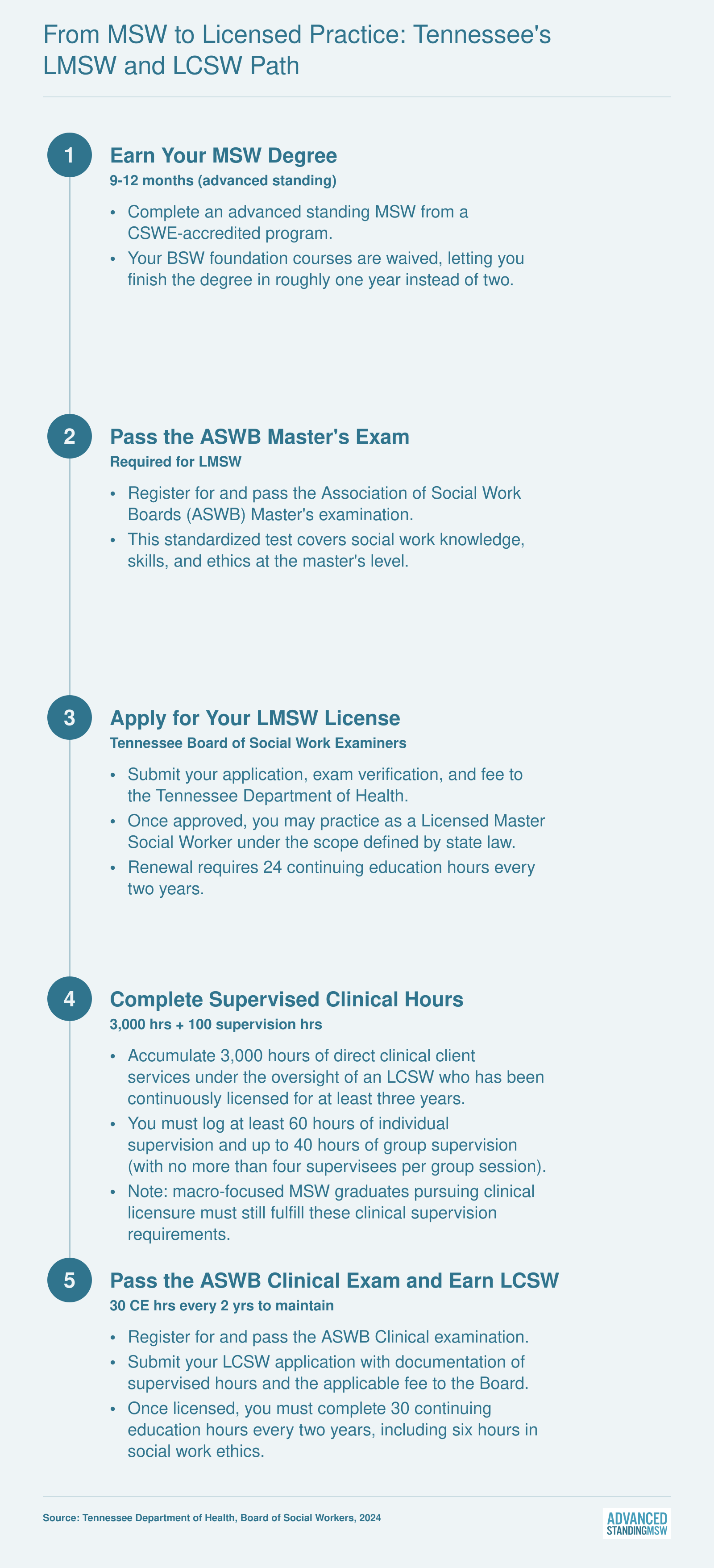
With median first-year earnings for Tennessee MSW graduates reaching approximately 43,000 dollars and typical program debt for advanced standing students often under 25,000 dollars, most graduates can expect their investment to pay for itself within five to seven years of licensed practice.
Common Questions About Advanced Standing MSW Programs in Tennessee
BSW graduates researching Tennessee's advanced standing MSW options tend to ask the same handful of practical questions. Below are concise, fact-checked answers to the three most common.
- Can I complete an advanced standing MSW entirely online from a Tennessee school?
- Yes. The University of Tennessee Knoxville offers its MSSW fully online, with an advanced standing track that can be finished in as little as 12 months full time or 24 months part time. East Tennessee State University also provides an online advanced standing MSW, though its admissions page lists specific BSW recency criteria. Field placements for either program may still need to be completed in person at an approved site near you.
- What happens if my BSW is older than the recency window? Can I still qualify for advanced standing?
- It depends on the school. King University offers a Master of Social Work with a five-year window but explicitly encourages applicants with older degrees and relevant work experience to apply. ETSU accepts BSW graduates whose degrees were conferred after 1984. If your degree falls outside a program's stated window, contact the admissions office directly, because exceptions or bridge coursework may be available.
- What is the cheapest advanced standing MSW program in Tennessee after financial aid?
- Program-level net price data (tuition minus all aid) are not currently published for every Tennessee school, so a definitive post-aid comparison is not possible. Because scholarships, assistantships, and employer tuition benefits vary widely, request a personalized financial aid estimate from each program you are considering.