What you’ll learn in this article…
- Four Alabama universities offer CSWE-accredited advanced standing MSW programs for 2026.
- Expect 450 to 600 supervised field placement hours before graduation.
- Most application deadlines fall between January and March for summer entry.
Advanced standing MSW programs in Alabama compress the traditional 60-credit master's down to roughly 30 to 39 credits, letting BSW holders finish in as few as 12 months of full-time study rather than the standard two-year sequence. This accelerated path works because CSWE-accredited BSW coursework already satisfies the generalist foundation year.
Alabama offers several CSWE-accredited pathways across online, on-campus, and hybrid formats, ranging from University of Alabama's hybrid online model to campus-based programs in Tuscaloosa, Montgomery, and Birmingham. Each program differs in delivery format, tuition, and clinical concentration.
The practical decision often hinges on trade-offs: a faster online cohort with limited specialization, or a longer hybrid track with stronger clinical placement networks in Alabama's health and child-welfare sectors.
Alabama's Top-Ranked Advanced Standing MSW Programs for 2026
If you already hold a BSW, these four Alabama universities offer the strongest advanced standing MSW paths in the state, each with a different mix of cost, delivery, and clinical focus. The right fit depends on whether you need a fully online schedule, a summer start, or a program rooted in a specific practice area like healthcare or social justice. Graduation rates listed here are institution-wide, so treat them as useful context rather than a guarantee about any single MSW program.
- Net price
- Institution-wide graduation rate
- Graduate earnings outcomes
- Independent program research
- Internal program database
- College Scorecard graduate earnings — collegescorecard.ed.gov
- NCES-IPEDS federal institutional data — nces.ed.gov
| Rank | School | Location | Net price | Best for | |
|---|---|---|---|---|---|
| #1 | Auburn University | Auburn, AL | $13,000 – $35,000/yr | Online learners specializing in health equity | |
Auburn University's advanced standing MSW pairs a demanding clinical curriculum with the highest institution-wide graduation rate in this group, at roughly 82%. The 39-credit pathway covers psychopathology, evaluation in practice, and advanced clinical skills, then adds a 512-hour clinical internship plus electives in health equity or nonprofit governance. Published tuition runs about $11,000 for in-state students and $33,000 for out-of-state students, and graduates go on to clinical leadership roles in healthcare, mental health, and community settings.
| |||||
| #2 | The University of Alabama | Tuscaloosa, AL | $22,000/yr | Working BSW holders wanting employment-based practicums | |
The University of Alabama's advanced standing MSW wraps a 42-credit curriculum around advanced generalist practice, with social justice and trauma-informed frameworks running throughout. Students complete 500 practicum hours, can choose employment-based or international placements, and finish in one year when they start in the summer. Published tuition sits near $11,400 for in-state students and $33,400 for out-of-state students, and the institution-wide graduation rate is about 73%.
| |||||
| #3 | University of Alabama at Birmingham | Birmingham, AL | $19,000/yr (net price) | Campus-based learners pursuing medical social work | |
The University of Alabama at Birmingham's advanced standing MSW targets students headed into behavioral health and medical social work, with 600 supervised field practicum hours completed in community agencies. The 42-credit program runs full-time in three semesters or part-time over 2.5 years, and a research project is integrated into the field experience. Published tuition runs about $9,000 for in-state students and $22,500 for out-of-state students, and the institution-wide graduation rate is about 64%.
| |||||
| #4 | University of North Alabama | Florence, AL | $12,000 – $22,000/yr | ||
The University of North Alabama's advanced standing MSW is a fully online, CSWE-accredited track that BSW graduates can complete in 12 months. The 30-credit curriculum covers advanced generalist practice, clinical assessment, policy analysis, and program evaluation, with field internships tailored to each student's career goals. Tuition runs $495 per credit hour, and the admission process includes a personal narrative essay and a 15-minute faculty interview, with no GRE required. The institution-wide graduation rate is about 55%.
| |||||


Accelerated MSW, One-Year MSW, Advanced Standing: The Same Program
If you have been searching for an "accelerated MSW" in Alabama and a "one-year MSW" in the same browser session, you may wonder whether those are two different degrees. They are not. Advanced Standing MSW, Accelerated MSW, One-Year MSW, and 12-Month MSW are different labels that schools attach to the same shortened pathway: the MSW track reserved for applicants who already hold a BSW from a CSWE-accredited BSW program.
Why the Names Vary
Each university chooses its own branding. The University of Alabama refers to its shortened track as the "Advanced Standing" program, while other schools across the country may market an identical structure as a "one-year program" or an "accelerated MSW." The underlying mechanics are the same. Because you completed generalist social work coursework during your BSW, the program waives its foundational year and places you directly into concentration-level classes. The result is roughly 30 to 39 credit hours completed in about 12 months of full-time study, compared with the 60 credits and two full years required of traditional MSW students.
What Does Not Count as Advanced Standing
Not every applicant who feels prepared will qualify. Three common disqualifiers catch BSW graduates off guard:
- Non-CSWE-accredited BSW: A bachelor's degree from a program that lacks CSWE accreditation does not satisfy the prerequisite, regardless of coursework.
- BSW beyond the recency limit: Most Alabama programs require your BSW to have been earned within the last five to seven years. If your degree is older, you will typically need to apply to the traditional two-year track.
- Related but different bachelor's degree: A BA in psychology, sociology, or human services is not a BSW. These degrees, while relevant to social work practice, do not include the supervised field education and CSWE-mandated generalist curriculum that advanced standing is designed to build upon.
If any of those situations apply to you, the traditional MSW track is your entry point, and it remains a strong path to the same license and the same career outcomes.
Why This Distinction Matters for Your Search
When you are browsing Alabama programs, do not assume that a school without an "accelerated" label on its website lacks a shortened option. Search for "advanced standing" as well. Conversely, if a program advertises an "accelerated" format open to applicants without a BSW, that is a different structure entirely, often a compressed two-year schedule rather than a waived-year pathway. The key question is always whether the program grants credit for your CSWE-accredited BSW foundation. If it does, you are looking at an advanced standing track by any name.
Questions to Ask Yourself
Which Alabama Universities Offer an Advanced Standing MSW You Can Complete Online?
Flexibility matters, but so does knowing exactly what "online" means before you commit. Some Alabama advanced standing MSW programs deliver every lecture and assignment through your laptop, while others attach in-person requirements that can surprise you mid-semester. Understanding the real delivery model, not just the marketing label, is how you avoid schedule conflicts and unexpected travel costs.
Fully Online Programs
Two Alabama universities currently offer advanced standing MSW tracks that are fully online with no required campus visits.
- University of North Alabama (UNA): This 30-credit program can be completed in 12 months and is explicitly open to students regardless of location. UNA is one of the few Alabama options that clearly welcomes out-of-state applicants into its online advanced standing track, making it a strong pick if you live outside Alabama but want an in-state tuition rate or a CSWE-accredited credential from an Alabama institution.
- Samford University: Samford's advanced standing MSW is also delivered fully online with no on-campus requirements noted. However, Samford's public-facing materials do not explicitly address out-of-state eligibility, so prospective students living outside Alabama should confirm enrollment authorization with the admissions office before applying.
Hybrid Programs With In-Person Components
Several programs market themselves as online-friendly but require face-to-face elements you need to plan around.
- University of Alabama's hybrid MSW program: The online MSW offering is actually a hybrid. Coursework is primarily online, but required in-person skills lab sessions held on select Saturdays at regional locations in Alabama and the broader Southeast make it impossible to skip travel entirely. If you are weighing this option against a fully online alternative, factor in those Saturday sessions.
- Alabama A&M University: This hybrid track includes a mandatory face-to-face orientation before classes begin and in-person field practicum components.
- Jacksonville State University: Hybrid delivery with campus-based sessions is part of the program structure, though a separate residency weekend is not specified.
- Alabama State University's master of social work: Listed as hybrid, though details about specific campus visit or orientation requirements are not clearly published. Contact the program directly for current expectations.
Campus-Only Programs
The University of Alabama at Birmingham (UAB) delivers its 42-credit advanced standing MSW entirely on campus. There is no online pathway for this track at UAB.
Can Out-of-State Students Enroll?
This is the question most competitor guides skip. Among Alabama's online and hybrid options, only UNA explicitly confirms that out-of-state students are eligible. Auburn's online advanced standing track does not publish a geographic restriction, but the program pages do not make a clear statement either way. For every other school on this list, state-authorization status and out-of-state eligibility are not addressed in publicly available materials. Before you invest time in an application, contact the admissions office directly and ask two things: whether your home state is covered under the institution's reciprocity agreements (such as NC-SARA), and whether field placement supervision must occur with an Alabama-based agency. Those two answers will tell you whether an Alabama program is genuinely accessible from wherever you live.
How Long Does an Advanced Standing MSW Take in Alabama?
One of the biggest advantages of the advanced standing pathway is speed. Because your CSWE-accredited BSW covers foundational coursework, Alabama programs let you skip a full year of generalist content and move straight into the advanced curriculum. Credit requirements range from 30 to 42 hours depending on the university, and most full-time students finish in about 12 months. Several schools also offer a part-time track for students who need to balance work or family obligations alongside their studies.
| School | Total Credits | Full-Time Length | Part-Time Available? | Part-Time Length |
|---|---|---|---|---|
| University of North Alabama | 30 credits | 12 months | Not confirmed | Not confirmed |
| Alabama State University | 36 credits | 1 year | Yes | Up to 4 years |
| Auburn University | 39 credits | 1 year | Yes | 2 years |
| Jacksonville State University | 39 credits | 1 year | No | N/A |
| University of Alabama at Birmingham | 42 credits | Not confirmed | Yes | 2.5 years |
| University of Alabama | 42 credits | 1 year | Not confirmed | Not confirmed |
| Troy University | 42 credits | 1 year | Not confirmed | Not confirmed |
Related Articles
GPA Thresholds, BSW Recency Rules, and Other Admission Requirements
Specific GPA minimums, BSW recency windows, and supplemental requirements for advanced standing MSW programs in Alabama are not published in a single centralized source and change frequently. The table below lists each Alabama school known to offer or consider an advanced standing MSW track; because verified program details were not available at the time of publication, you should go directly to each university's official MSW admissions page for current figures. Most CSWE-accredited programs nationwide require a minimum GPA between 2.5 and 3.0 on a 4.0 scale, and BSW recency limits typically fall within five to seven years, but Alabama programs may set their own thresholds.
| School | Minimum GPA (4.0 Scale) | BSW Recency Limit | Key Prerequisites and Other Requirements |
|---|---|---|---|
| Alabama A&M University | Verify with program | Verify with program | Contact the MSW admissions office for current prerequisites, recommendation requirements, and background check policies |
| Alabama State University | Verify with program | Verify with program | Check the program's Advanced Standing section for personal statement, recommendation letter, and screening details |
| Jacksonville State University | Verify with program | Verify with program | Visit the official MSW program page for prerequisite courses, documents, and eligibility criteria |
| University of Alabama at Birmingham (UAB) | Verify with program | Verify with program | Look for the dedicated Advanced Standing admissions page for GPA, recency, and field placement prerequisites |
| Auburn University | Verify with program | Verify with program | Contact the graduate admissions coordinator for BSW recency rules and any additional screening steps |
| Samford University | Verify with program | Verify with program | Review the MSW admissions portal for recommendation, personal statement, and background check requirements |
| Troy University | Verify with program | Verify with program | Ask the admissions office about prerequisite coursework and any supplemental application materials |
| University of Alabama (Tuscaloosa) | Verify with program | Verify with program | Check the School of Social Work site for advanced standing eligibility, including GPA floors and BSW recency windows |
| University of North Alabama (UNA) | Verify with program | Verify with program | Reach out to the program's graduate coordinator for the latest admission standards and document requirements |
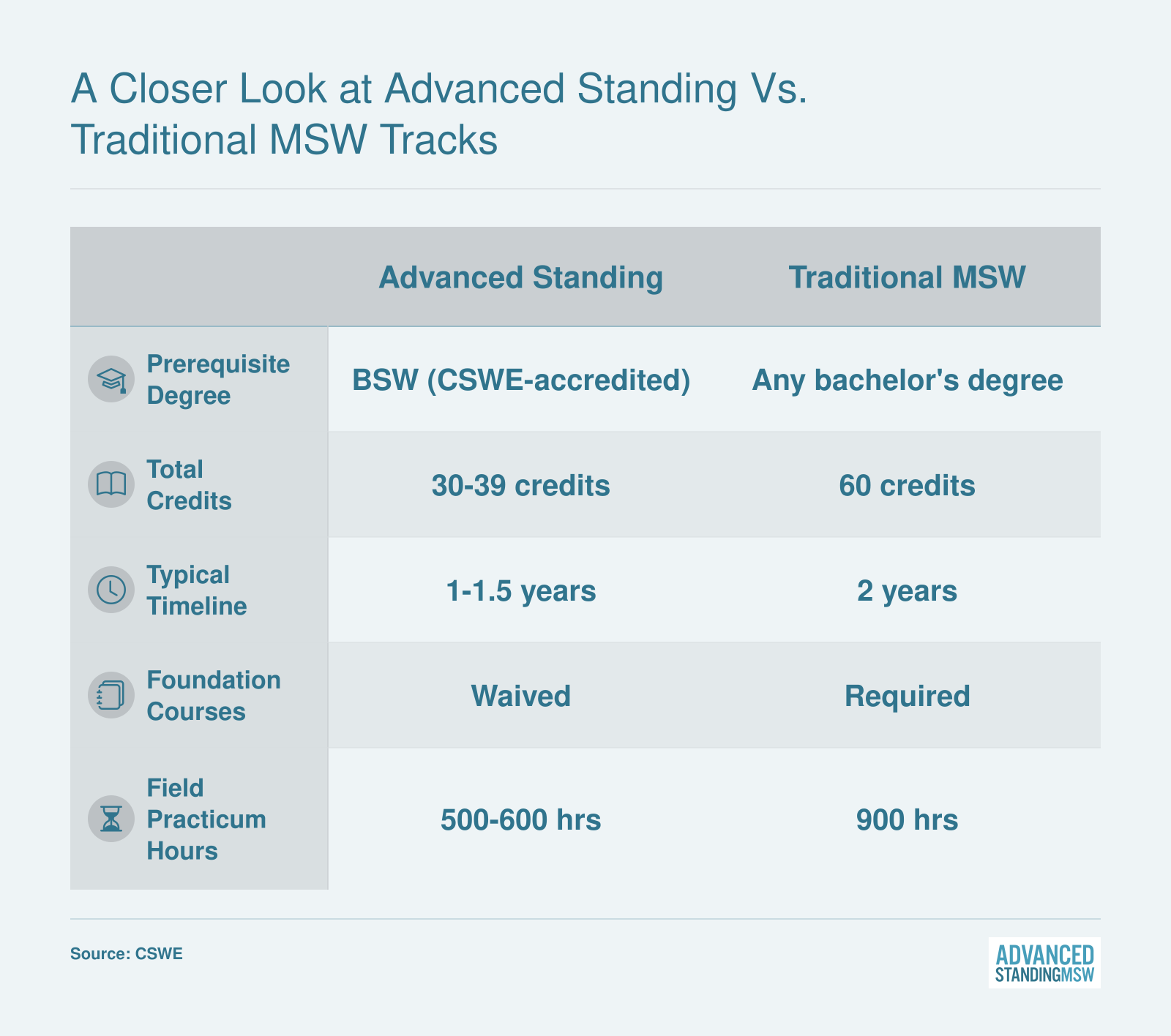
A Closer Look at Advanced Standing Vs. Traditional MSW Tracks
Both the advanced standing and traditional MSW tracks lead to the same CSWE-accredited degree and prepare you for licensure in Alabama. The critical difference is what you bring to the table on day one: a BSW from a CSWE-accredited program lets you skip foundation coursework entirely, compressing your timeline and credit load without sacrificing rigor.
Application Deadlines for Alabama Advanced Standing MSW Programs (2026-2027)
A fixed deadline gives you a clear target date, but miss it and you are out for the cycle. Rolling admissions offer more flexibility, yet seats can fill up months before a posted cutoff. Understanding these two models will help you time your application strategically for Alabama's advanced standing MSW programs.
Fall 2026 Start
- University of Alabama: The priority deadline is November 1, 20251, and the final deadline is February 15, 20262. The program does not use rolling admissions, so all applications are reviewed together after each deadline.
- Alabama State University: Both its priority and final deadline fall on March 15, 20263. There is no separate early deadline, so all materials must be in by that date.
Spring 2027 Start
- University of North Alabama: The only spring deadline is October 1, 20265. If you are aiming for a January 2027 start, mark that date.
- Alabama A&M University: The spring 2027 deadline is November 1, 20264, but the program operates on a rolling basis4. That means the admissions committee begins reviewing files as they arrive and may fill the cohort before the official deadline. Applying early is strongly advised.
For programs at Jacksonville State, UAB, Auburn University, Samford University, and Troy University, specific 2026-2027 deadlines were not yet published at the time of writing. Most will release their timelines by late summer or early fall 2026. Check each program's website directly for the latest information.
Rolling Admissions vs. Fixed Deadlines
- Fixed deadline (University of Alabama, Alabama State): Submit everything before the deadline and wait for a decision. This works well if you need a clear timeline to coordinate transcripts, references, and personal statements.
- Rolling (Alabama A&M): The earlier you apply, the sooner you hear back, and the better your odds of securing a spot. Rolling programs sometimes close unexpectedly early when cohorts fill.
Regardless of the deadline style, make sure you account for the time needed to send official BSW transcripts, request recommendation letters, and polish your statement of purpose. Most Alabama programs require that your BSW be earned within the last five to seven years; confirm the recency rule for each school before applying.
Tuition and Total Cost: What You'll Actually Pay
The sticker price of a graduate program rarely tells the full story, but it's the number most BSW graduates fixate on first. Below is a realistic breakdown of what each Alabama advanced standing MSW program will cost, based on published tuition rates and the credit-hour totals outlined earlier in this article.
Per-Credit Costs Across All Four Programs
Every school on this list is a public institution, which means in-state residents benefit from significantly lower tuition than out-of-state students. Here is the range:
- University of North Alabama (UNA): $345 per credit in-state, $642 per credit out-of-state (30 credit hours)
- Jacksonville State University (JSU): Approximately $295 per credit in-state, $459 per credit out-of-state (39 credit hours)
- University of Alabama at Birmingham (UAB): Roughly $206 per credit in-state, $504 per credit out-of-state (42 credit hours)
- University of Alabama (UA): Approximately $285 per credit in-state, $809 per credit out-of-state (42 credit hours)
These per-credit figures are derived from program-level tuition data and may shift slightly with university fees.
Estimated Total Program Cost
Multiplying per-credit tuition by total credit hours gives you a rough total before fees, books, and living expenses:
- UNA: Around $10,350 in-state or $19,260 out-of-state
- JSU: Around $11,488 in-state or $17,920 out-of-state
- UAB: Around $8,640 in-state or $21,168 out-of-state
- UA: Around $11,980 in-state or $33,972 out-of-state
UAB stands out as the most affordable option for Alabama residents at roughly $8,640 total, while UA carries the highest out-of-state price tag. Because none of the programs on this list are private institutions, every school draws a clear line between resident and non-resident rates.
What About Net Price?
Each university reports an institution-wide average net price that factors in grants and scholarships across all programs and degree levels. Those averages range from about $12,170 at UNA to $22,420 at UA. Keep in mind these figures reflect the entire student body, not MSW students specifically, so your actual out-of-pocket cost will depend on the financial aid package you receive at the graduate level.
Financial Aid Worth Pursuing
Do not assume you will pay sticker price. Several avenues can reduce your total bill considerably:
- Title IV federal aid: All four programs participate in federal student aid, making you eligible for Direct Unsubsidized Loans and, in some cases, graduate PLUS Loans.
- Employer tuition reimbursement: If you are already working at a hospital system, community mental health center, or child welfare agency, ask your HR department about education benefits. Many Alabama employers in the social services sector reimburse up to several thousand dollars per year.
- State-specific grants and loan repayment programs: Alabama occasionally funds workforce incentives for social work students willing to serve in high-need areas. Check with your program's financial aid office for current offerings.
- Graduate assistantships: Campus-based programs at UAB and UA sometimes offer assistantship positions that include tuition waivers or stipends.
Because the advanced standing track compresses your time in school to roughly one year, you save not only on tuition credits but also on the opportunity cost of being out of the full-time workforce. That accelerated timeline is one of the strongest financial arguments for the advanced standing pathway.
The Bureau of Labor Statistics projects a 6% increase in social worker jobs nationwide from 2024 to 2034, reflecting steady demand and around 73,100 new openings each year.
Field Placement and Practicum Hours: What to Expect
How many field hours will I actually need for my advanced standing MSW in Alabama, and can I complete them near my home?
Alabama advanced standing MSW students typically complete between 450 and 600 clock hours of supervised field work. That is noticeably fewer than the 900-plus hours often required in a traditional MSW because advanced standing builds on the foundation practicum you already finished in your BSW. Here's how the hours break down by school:
- Alabama A&M University: 450 hours1
- Alabama State University: 450 hours2
- University of Alabama at Birmingham: 600 hours over three semesters3
- University of Alabama: 500 hours in a single intensive placement, typically Monday through Friday, 32-40 hours per week for 15 weeks. A variable practicum option requires at least 16 hours per week5.
- University of North Alabama: 500 hours6
Which Alabama programs let you complete field placements near your home?
Most schools assume you will work with an agency in or near their campus region, but only University of North Alabama explicitly states in its field FAQ that placements can be arranged in the student’s own city or state.7 That flexibility is especially valuable if you are an online student living outside the Shoals area. For other programs , Alabama A&M, Alabama State, UAB, and UA , the handbooks reviewed do not confirm or deny home-community placement options, so you should directly ask the field coordinator before applying.
Can you use your current workplace for the practicum?
None of the Alabama advanced standing programs expressly advertise workplace-based or employer-sponsored placements in their official materials. However, UNA’s openness to placements in your own community creates a pathway to explore using your current employer if the setting meets CSWE competencies and supervision standards.7 Every program reserves final approval, so you will need to present a formal proposal to the field director early in the process.
How the practicum format affects online students
Online students must still complete their hours in person at an approved agency because remote supervision is not permitted at any Alabama program. UNA does mention limited virtual placements that require Director of Field approval, but those are exceptions, not the norm.7 For fully online tracks at UA or UAB, plan on dedicating full business days during the placement semester , UA’s 32-40 hour week across 15 weeks is particularly intensive and may be difficult to balance with employment. If you live far from the main campus, reaching out to the field office months in advance is critical so they can help identify a qualifying site near you.
Frequently Asked Questions About Advanced Standing MSW Programs in Alabama
BSW graduates exploring advanced standing MSW programs in Alabama tend to share a common set of concerns, from cost and accreditation to licensure pathways and exam readiness. The answers below draw on current Alabama Board of Social Work requirements and publicly available program details to give you straightforward, actionable guidance.
- How much does an advanced standing MSW cost in Alabama compared to a traditional MSW?
- Because you complete roughly one year of coursework instead of two, an advanced standing MSW typically cuts total tuition by 30 to 50 percent relative to the traditional track. Exact savings depend on the university's per-credit rate, residency status, and fee structure. Review the tuition breakdown for each program you are considering and factor in field placement costs, which remain similar across both tracks.
- Are all Alabama advanced standing MSW programs CSWE accredited?
- Every advanced standing MSW program currently offered by an Alabama university holds Council on Social Work Education (CSWE) accreditation. This matters because Alabama requires an MSW from a CSWE-accredited program as a prerequisite for the Licensed Master Social Worker (LMSW) credential1. Before enrolling, confirm that the specific program format you choose (online, hybrid, or on campus) falls under the school's accredited degree.
- Can I work full-time while completing an advanced standing MSW in Alabama?
- It is possible but demanding. Most advanced standing tracks compress coursework into three or four semesters, and field placement hours create scheduling pressure. Programs with evening, weekend, or online course options give working professionals more flexibility. Talk honestly with your advisor about weekly time commitments before locking in a full-time work schedule alongside full-time enrollment.
- What licensure can I pursue after finishing an advanced standing MSW in Alabama (LMSW, LICSW)?
- After graduation, you can sit for the ASWB Master's exam to earn your LMSW, which requires no post-degree clinical hours1. From there, you can pursue the Licensed Independent Clinical Social Worker (LICSW) credential by completing at least two years and 3,000 hours of post-master's practice under LICSW supervision (96 supervision hours total, at four hours per month, within 36 months)2 and then passing the ASWB Clinical exam3.
- Do I need to take the GRE for an advanced standing MSW in Alabama?
- Based on current admissions information, no Alabama advanced standing MSW program appears to require the GRE. Many schools nationwide have moved away from standardized test requirements for MSW applicants. That said, always verify directly with your target program's admissions office, because policies can change from one application cycle to the next.
- What happens if my BSW is older than the recency limit? Can I still apply?
- Most Alabama programs set a recency window, commonly five to seven years, for BSW coursework to qualify for advanced standing. If your degree falls outside that window, you may need to complete bridge coursework or enter the traditional two-year track instead. Some programs evaluate older BSWs on a case-by-case basis, so contact the admissions coordinator before assuming you are ineligible.
- How do Alabama advanced standing MSW graduates perform on the ASWB licensing exam?
- Program-specific ASWB pass rates for Alabama schools are not publicly disclosed at this time. As a reference point, the national first-time pass rate on the ASWB Master's exam was approximately 73 percent in 2024 across roughly 20,000 candidates. Ask each program directly whether it tracks and shares its own graduates' pass rates, and look for schools that offer exam prep resources as part of the curriculum.