What you’ll learn in this article…
- Boston University MSW graduates report the highest median earnings among Massachusetts programs ten years out.
- Field placement requirements range from 500 to 1,000 hours depending on the school.
- Most full-time advanced standing cohorts start in May or June and finish within 12 months.
The Massachusetts Board of Registration of Social Work requires an MSW from a CSWE-accredited program for all clinical licensure tracks. Advanced standing allows BSW graduates to meet that requirement in roughly one year instead of two, cutting a full year of tuition and lost wages.
Six CSWE-accredited universities in Massachusetts offer the accelerated track through online, hybrid, and campus formats. Admission standards, however, vary sharply: some programs demand a BSW earned within the last five years and a minimum 3.0 GPA, while others accept older degrees with lower grades.
The real friction in Massachusetts isn't program availability: it's whether your undergraduate record clears each school's specific threshold.
Top Advanced Standing MSW Programs in Massachusetts for 2026
These Massachusetts advanced standing MSW programs rose to the top for 2026 based on program depth, field training capacity, and graduate outcomes. Each offers a legitimate CSWE-accredited pathway for BSW holders, but the right choice depends on whether you need online flexibility, a campus cohort, or a particular clinical specialty.
- Accreditation and CSWE program status
- Field placement hours and structure
- Format flexibility and cohort support
- Graduate earnings and licensure outcomes
- Tuition and net price range
- Internal program database
- NCES-IPEDS federal institutional data — nces.ed.gov
- College Scorecard graduate earnings — collegescorecard.ed.gov
- Independent program research
| Rank | School | Location | Net price | Best for | |
|---|---|---|---|---|---|
| #1 | Boston University | Boston, MA | $20,000 – $25,000/yr | Working professionals needing flexible part-time online learning | |
Boston University's advanced standing pathway is built for BSW graduates who need a rigorous part-time option without relocating. The online MSW blends asynchronous coursework with weekly live sessions, and students pick between clinical and macro practice majors with specialty options in behavioral health and trauma. Small classes, one-on-one advising, and a single 1000-hour field internship support working professionals. BU's strong licensure pass rate and national field agency network make it a standout for career changers and career advancers alike.
| |||||
| #2 | Smith College | Northampton, MA | $25,000 – $30,000/yr | Campus-based students focused on psychodynamic clinical practice | |
Smith College's School for Social Work delivers an intensive campus-based advanced standing MSW with a strong clinical identity. The summer-start curriculum immerses students in psychodynamic theory, research methods, and social welfare policy before they move into advanced clinical practice. Smith's location in Northampton and its long legacy in social work education appeal to students who want a close-knit, academically demanding cohort experience.
| |||||
| #3 | Simmons University | Boston, MA | $25,000 – $30,000/yr | Online learners prioritizing hands-on clinical field experience | |
Simmons University is known for clinical social work education, and its advanced standing MSW doubles down on that identity. BSW graduates can finish in nine months, choosing a full-time online format or an on-campus experience in Boston. The curriculum pairs advanced clinical coursework with a 672-hour practicum and a robust network of 5,000-plus community partners. Simmons also emphasizes social justice and offers certificate pathways in trauma practice and mental health for students who want deeper specialization.
| |||||
| #4 | College of Our Lady of the Elms | Chicopee, MA | $18,000/yr | ||
Elms College brings one of the newest advanced standing MSW options to Massachusetts, with a distinctive primary care clinical track that is unique in the region. BSW graduates complete just 24 credits and 500 practicum hours, with evening or Saturday scheduling designed for working adults. The program also offers a macro social work concentration, and its faculty draw on electives from nursing, bioethics, education, and business to round out clinical training.
| |||||
| #5 | Merrimack College | North Andover, MA | $38,000/yr | ||
Merrimack College's advanced standing MSW is a 36-credit program rooted in social justice and advanced generalist practice. Students can take courses online, on campus, or a mix of both, with evening scheduling and a 900-hour field placement in local agencies, schools, or health centers. Electives in school social work, substance use disorders, and criminology let students shape the degree around their goals. The program waives the application fee and offers scholarships, including a Presidential Fellowship that covers all 36 credits.
| |||||
| #6 | Regis College | Weston, MA | $25,000 – $30,000/yr | ||
Regis College offers a fully online advanced standing MSW designed for BSW graduates who want to move into clinical practice. The 30-credit, 16-month part-time format includes 600 field hours and covers advanced practice with individuals, families, and groups, plus clinical assessment and evidence-based intervention. Small online classes, faculty advisors, and multiple start dates make this a practical option for working adults. Regis also accepts military benefits and employer reimbursement, and alumni receive a tuition discount.
| |||||
| #7 | Springfield College | Springfield, MA | ~$31,000/yr (est.) | ||
Springfield College's advanced standing MSW is a flexible hybrid program that mixes fully online coursework with optional on-campus classes in Springfield. BSW graduates complete 33 credits, including a 500-hour practicum, with asynchronous and synchronous options built for busy schedules. The curriculum emphasizes evidence-based practice with individuals, families, groups, and communities, and separate deadlines for online and on-campus applicants make the admissions path easy to navigate.
| |||||
| #8 | Salem State University | Salem, MA | $15,000 – $20,000/yr | ||
Salem State University offers an advanced standing MSW with a distinctive integration of health and behavioral health practice. The 38-credit curriculum weaves micro, mezzo, and macro coursework together, with a one-year practicum internship in real-world settings. Full-time and extended timelines accommodate working professionals, while small cohorts and dedicated faculty support a collaborative environment on the North Shore.
| |||||
| #9 | Westfield State University | Westfield, MA | $15,000 – $20,000/yr | ||
Westfield State University offers a one-year advanced standing MSW with three focused concentrations: child, youth, and family; health social work; and Latinx community health. The 37-credit curriculum is delivered in a hybrid format, with evening classes and bilingual options in the Latinx community health track. A 500-hour advanced clinical practicum and a cohort model help students build strong professional connections, and regional placement flexibility across Massachusetts and surrounding states is a major advantage for field education.
| |||||
| #10 | Anna Maria College | Paxton, MA | $28,000/yr | ||
Anna Maria College's advanced standing MSW takes an advanced generalist approach, combining a person-in-environment framework with evidence-informed practice and social justice values. Designed for BSW graduates who earned their degree within the past five to seven years, it lets full-time students finish in three semesters while part-time students typically complete the degree in two years. The program includes 620 field hours in advanced placements and offers on-campus or online formats with fall and spring start dates. An alumni tuition discount and a clear path to LCSW licensure round out the value.
| |||||


Accelerated MSW, One-Year MSW, Advanced Standing: The Same Program
"Advanced Standing MSW" versus "One-Year MSW" versus "Accelerated MSW": if you have been browsing program pages across Massachusetts schools, you have probably noticed that these labels shift from one university to the next. The distinction is largely cosmetic. All three phrases describe the same shortened MSW pathway built for applicants who already hold a CSWE-accredited BSW.
Why the Names Differ
Each school's marketing and admissions office chooses its own branding. Boston College labels its shortened track the "Advanced Standing Program," while Simmons University refers to its accelerated option for BSW holders using similar language. Boston University's program pages describe the route as an "Advanced Standing" pathway open to graduates of CSWE-accredited BSW programs. Regardless of the wording, the underlying structure is the same: the program waives foundational coursework you completed during your BSW, letting you enter at the advanced practice level and finish in roughly 30 to 39 credits instead of the standard 60.
The practical result is about one calendar year of study rather than two.
What Does Not Qualify
Not every fast-track MSW option is the same thing. Some programs use "accelerated" to describe a compressed two-year curriculum that still covers all 60 credits for students without a BSW. If a program admits applicants with bachelor's degrees in psychology, sociology, or another related field (but not a CSWE-accredited BSW), it is not an advanced standing track. It is simply a condensed version of the traditional MSW.
Eligibility for a true advanced standing pathway in Massachusetts typically requires:
- A BSW from a CSWE-accredited program
- Completion of that degree within the school's recency window, commonly five to seven years
- A minimum GPA, often 3.0 or higher in BSW coursework
If your BSW falls outside the recency limit, or if your undergraduate institution lacked CSWE accreditation at the time you graduated, most Massachusetts programs will direct you to the traditional two-year MSW track instead.
Why This Matters for Your Search
When you filter programs on our Advanced Standing MSW Programs Near Me page or on a school's own site, don't get thrown off by inconsistent terminology. Focus on two things: whether the program explicitly requires a CSWE-accredited BSW for entry, and whether it waives generalist-year coursework. If both answers are yes, you are looking at an advanced standing program, no matter what the school calls it.
How These Massachusetts MSW Programs Were Evaluated
Ranking programs by reputation alone versus measuring them with outcome data produces very different lists, and the difference matters when you are investing a year of your life and thousands of dollars in an accelerated degree. The evaluation framework behind this guide relies on verifiable metrics rather than subjective prestige.
Scoring Factors
Four dimensions shaped each program's placement:
- Net price after aid: This figure reflects the average estimated cost a student actually pays once grants and scholarships are factored in. It is an institution-wide average, not a number specific to MSW students, so treat it as an approximation rather than a quote.
- Institution-wide graduation rate: Completion rates reported here cover all degree-seeking students at the university, not exclusively the MSW cohort. A strong overall graduation rate signals institutional support systems that benefit graduate students too, though it is not a perfect proxy for MSW retention.
- Program-level earnings outcomes: Where available, post-graduation earnings and debt figures are drawn from federal College Scorecard data at the program level. This separates our evaluation from guides that rely solely on school-wide salary averages, capturing what social work graduates actually earn rather than blending them with business or engineering alumni.
- Delivery format availability: Programs that offer online, hybrid, or evening and weekend options scored higher for accessibility, reflecting that many BSW graduates work in the field and need scheduling flexibility.
The Accreditation Baseline
Every program included in this guide holds accreditation from the Council on Social Work Education. CSWE accreditation is not a bonus; it is the non-negotiable threshold for licensure eligibility in Massachusetts. Programs without it were excluded entirely, regardless of other strengths.
What Makes This Approach Different
Many competitor guides stop at tuition stickers and U.S. News rankings. By incorporating federal earnings and debt data tied to the specific degree program, this evaluation gives you a clearer picture of return on investment. You can see not just what a degree costs, but what graduates are actually earning, the metric that matters most when choosing between schools.
Admissions Requirements and BSW Eligibility at Each School
Admissions standards for advanced standing MSW programs in Massachusetts vary meaningfully from school to school, especially around GPA thresholds, how recently you must have earned your BSW, and the number of field hours expected before you enroll. The table below compiles the details we could verify for each program. Where a school has not publicly confirmed a requirement, we have noted it accordingly so you know where to follow up directly with the admissions office.
| School | Min. GPA | BSW Recency Limit | BSW Accreditation | Letters of Rec. | Prior Field Hours | Notable Application Details |
|---|---|---|---|---|---|---|
| Boston University | 3.0 | Within 6 years of entry | CSWE accredited | Not specified | 1,000 hours required | Fall 2027 application opens late August 2026; fall 2026 cycle closed August 3, 2026 |
| Boston College | 3.3 preferred (final two years) | Within 5 years of enrollment | CSWE accredited | 3 (including BSW director or advisor and field supervisor) | Not specified | Multiple deadlines: summer advanced standing Jan. 15; spring advanced standing Nov. 15, Jan. 15, Mar. 15. Foundation course waivers may be considered. |
| Smith College | Not confirmed | Not confirmed | Not confirmed | Not confirmed | Not confirmed | Contact admissions directly; program begins in the summer term |
| Simmons University | Not confirmed | Not confirmed | Not confirmed | Not confirmed | Not confirmed | 9 month program offered online and on campus; contact admissions for specific requirements |
| Elms College | 3.0 | Not confirmed | CSWE (candidacy) | Not confirmed | 500 hours (per program listing) | No entrance exam required; Saturday and weeknight scheduling available |
| Merrimack College | Not confirmed | Not confirmed | CSWE accredited | 2 (minimum) | 900 hours (per program listing) | No application fee; summer start; Presidential Fellowship may cover 36 credits |
| Regis College | 3.0 | Not confirmed | CSWE accredited | 0 | 600 hours (per program listing) | 16 month program; three start dates per year; prerequisite courses required |
| Springfield College | Not confirmed | Not confirmed | CSWE accredited | 2 (minimum) | 500 hours (per program listing) | Hybrid format with fall and summer start options; 15% tuition discount for partner employees |
| Salem State University | Not confirmed | Not confirmed | CSWE accredited | Not confirmed | Not confirmed | Full time and part time options; integrates health and behavioral health focus |
| Westfield State University | 2.8 | Not confirmed | CSWE accredited | 3 (minimum) | 500 hours (per program listing) | GRE or MAT may be required; one year full time option; cohort model; prerequisite courses required |
| Anna Maria College | Not confirmed | Not confirmed | CSWE accredited | Not confirmed | 620 hours (per program listing) | Three semester full time or two year part time; fall and spring starts available |
Questions to Ask Yourself
Online, Hybrid, and Campus Advanced Standing MSW Formats in Massachusetts
Massachusetts advanced standing MSW programs come in three delivery formats, and understanding the differences can save you months of confusion during the application process. Note that some schools describe their programs inconsistently across official pages, so always confirm format details directly with the admissions office before committing. Field placement requirements also vary by format, making this comparison essential for BSW graduates who live outside the Boston metro area or out of state entirely.
| School | Format | Approximate Duration | Field Placement Notes | Scheduling Details |
|---|---|---|---|---|
| Boston University | Fully online | 16 to 21 months | Over 2,000 partner field agencies nationwide; students typically arrange placements locally rather than traveling to campus | Synchronous and asynchronous options with multiple start dates per year; cohort based |
| Simmons University | Online and on campus options | 9 months | 672 clinical hours required; advanced clinical placement tailored to student goals | Fall start; first school of clinical social work in the U.S. |
| Regis College | Fully online | Approximately 16 months (30 credits) | 600 clinical hours required; specific geographic restrictions for placements have not been confirmed publicly | Synchronous and asynchronous coursework with three start dates per year; part time available |
| Westfield State University | Hybrid (online coursework with some synchronous sessions) | 12 months full time | 500 hour practicum; placements accepted across a six state region including Massachusetts, Connecticut, Rhode Island, New Hampshire, Vermont, and New York | Monday and Thursday evening classes offered on campus or via live video; roughly 20% of coursework is asynchronous |
| Springfield College | Hybrid | Approximately 12 months (33 credits) | 500 hour practicum internship required | Synchronous and asynchronous options; on campus classes held in Springfield with fall and summer start dates |
| Merrimack College | Hybrid (choose online or on campus per course) | Varies (36 credits) | 900 clinical hours at local agency placements | Evening classes; summer start |
| Salem State University | Campus based with some synchronous online components | Varies (38 credits, full time or part time) | One year practicum internship | Evening cohort meets Wednesday evenings; two online courses per semester with in person campus meetings twice per semester |
| Smith College | Campus only | Condensed (8 courses) | Clinical placement arranged through the program | Summer start; registration coordinated by the registrar |
| Elms College | Campus only | Varies (24 credits) | 500 practicum hours for advanced standing students | Flexible scheduling on Saturday mornings or weeknight evenings |
| Anna Maria College | Campus only (with some online components noted) | Three semesters full time | 620 clinical hours with concurrent fieldwork alongside classes | Fall or spring start; part time option spans two years |
How Long Does an Advanced Standing MSW Take in Massachusetts?
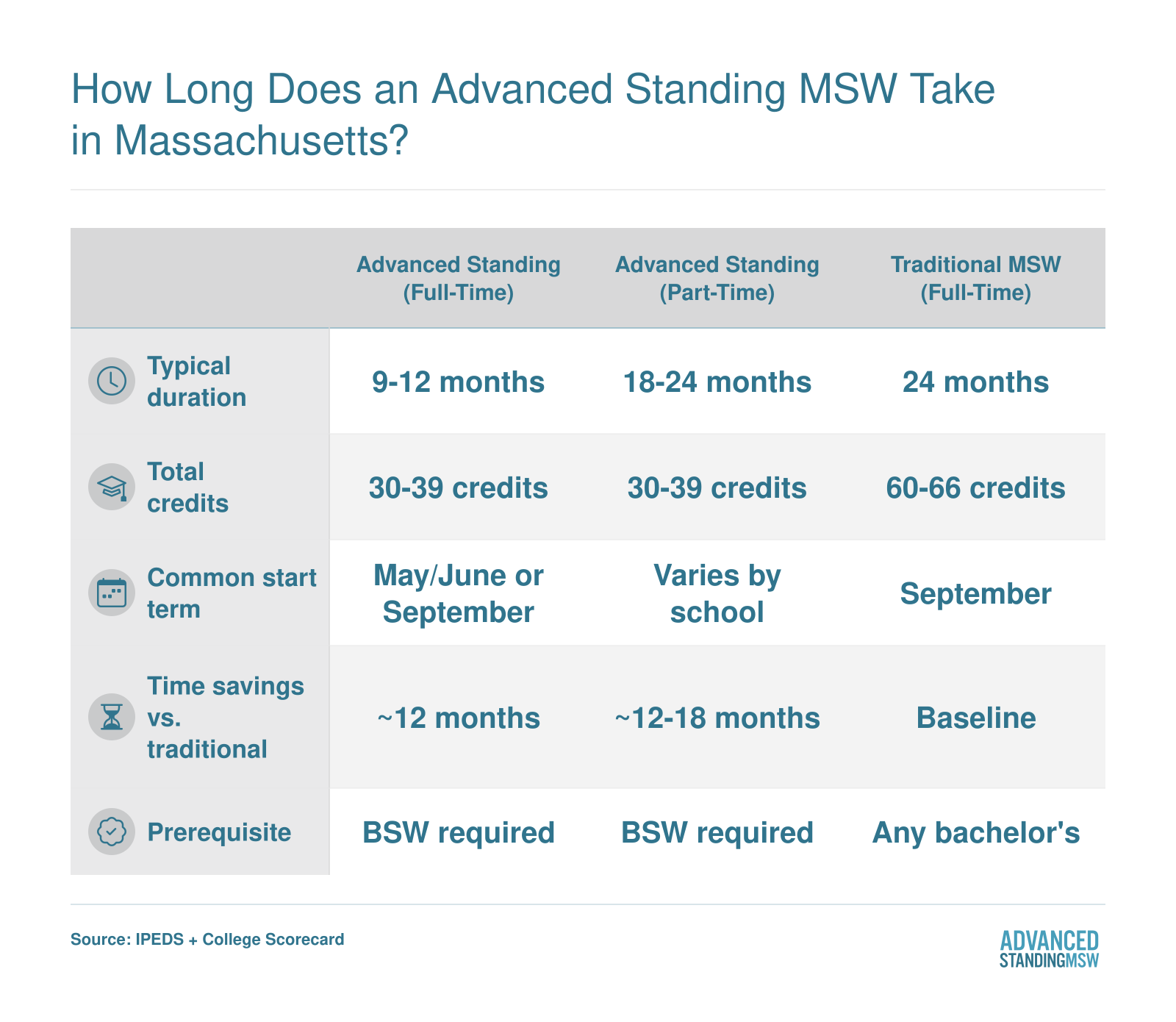
Your BSW gives you a head start. Advanced standing MSW programs in Massachusetts typically cut the standard two-year timeline in half, saving you roughly a full year of coursework and tuition. Most full-time cohorts launch in May or June and wrap by the following spring, though part-time options stretch the schedule to 18-24 months at several schools.
Frequently Asked Questions About Advanced Standing MSW Programs in MA
Below are the questions BSW graduates ask most often when exploring advanced standing MSW options in Massachusetts. Each answer draws on current program details and accreditation standards so you can plan with confidence.
- What is the difference between an advanced standing MSW and a regular MSW?
- An advanced standing MSW waives the foundation year required in a regular program, since your CSWE-accredited BSW already covered equivalent coursework. This translates to roughly 30 to 39 credits and 450 to 650 field hours instead of 60 to 70 credits and 900 to 1,200 field hours.1 The final degree and license eligibility are identical, so the distinction is purely about how quickly you reach the finish line.
- Does my BSW need to be recent to qualify for advanced standing in Massachusetts?
- Yes, though the exact window varies by school. Many Massachusetts programs require your BSW to have been completed within the last five years. Boston College, for example, requires graduation within five years of enrollment. A few programs may allow up to seven years. Always verify the recency policy with each school before applying, because there is no single statewide cutoff.
- Can I work full-time while completing an advanced standing MSW in MA?
- It depends on the program format. Some schools offer part-time or hybrid advanced standing tracks that make concurrent employment more realistic. Others compress the curriculum into as few as three semesters of full-time study, which leaves little room for outside work. Field placement hours add another scheduling layer. If maintaining full-time employment is a priority, look specifically for part-time or evening and weekend options before you commit.
Most Affordable Advanced Standing MSW Programs in Massachusetts
Tuition is one of the most important factors for BSW graduates weighing an accelerated MSW. The table below ranks Massachusetts advanced standing programs by estimated tuition cost, from lowest to highest. Figures reflect published tuition rates from each institution and federal data reported to the U.S. Department of Education (2023). Keep in mind that net price after financial aid, scholarships, and fellowships can reduce your actual out of pocket cost significantly.
| School | City | Format | Estimated Tuition (In-State) | Estimated Tuition (Out-of-State) | Total Credit Hours | CSWE Accredited |
|---|---|---|---|---|---|---|
| Westfield State University | Westfield | Hybrid | $8,676 | $8,676 | 37 | Yes |
| Salem State University | Salem | Campus | $9,360 | $11,069 | 38 | Yes |
| Elms College | Chicopee | Campus | $17,670 | $17,670 | 24 | Yes |
| Simmons University | Boston | Online and Campus | $28,561 | $28,561 | 65 | Yes |
| Boston University | Boston | Online | $67,626 | $67,626 | 43 | Yes |
Clinical Vs. Macro: Specializations Available by School
Your concentration choice in an advanced standing MSW defines not just the courses you take, but also the field placements you receive and the license you eventually pursue. In Massachusetts, programs cluster around clinical practice, macro practice, or a generalist model that blends both.
Clinical concentrations lead to LCSW eligibility
Most programs offer a clinical track: Boston College, Boston University, Regis College, Simmons University, and Westfield State all have designated clinical social work concentrations. Simmons goes further with optional certificates in mental health, trauma, and clinical practice with veterans and families.1 Salem State's Mental and Behavioral Health concentration also aligns with clinical licensure pathways.
Macro and generalist tracks: fewer but present
Only Boston College and Boston University list explicit macro practice specializations (e.g., leadership, policy, community practice). Springfield College and Anna Maria College offer an Advanced Generalist Practice model, preparing students for both clinical and macro roles without a strict track split. This is common in smaller programs.
Specialized tracks: health, school, and gerontology
Westfield State offers a Gerontology concentration alongside clinical practice. Salem State integrates health and behavioral health across its curriculum. While some guides mention school social work or substance abuse tracks, no program in our review confirmed a standalone advanced standing specialization in these areas.
What advanced standing students actually get
At most schools, advanced standing students enter the same concentration options as traditional second-year students, but a few programs (e.g., Anna Maria, Springfield) operate a single unified track. This means your options may be narrower if you prefer a pure clinical or macro focus. Always verify that the concentration aligns with your intended licensure: clinical concentrations directly map to LCSW requirements; macro tracks may lead to LSW or macro licensure pathways instead.
Field Placement Hours and Structure for Advanced Standing Students
Advanced standing promises a direct route from BSW to MSW, but field placement hours can either accelerate that journey or stretch it out. Massachusetts programs range from a manageable 500 hours to a demanding 1,000 hours, directly shaping your workload and time to graduation.
How Many Hours Are Required?
Because advanced standing waives the foundation-year placement, most MSW candidates complete only the advanced clinical or macro practicum. The Council on Social Work Education (CSWE) does not mandate a specific hour total, so schools set their own. In Massachusetts, most programs fall between 500 and 1,000 hours:
- 500 hours: Springfield College, Salem State University, Assumption University, Westfield State University, UMass Global (online), and Walden University (online) all require 500 hours.
- 672 hours: Simmons University extends its advanced standing window to seven years but expects 672 hours.
- 720 hours: Smith College’s fully campus-based program requires 720 hours.
- 1,000 hours: Boston University and Boston College each demand 1,000 hours, often spread across 10, 12 months of full-time internship.
Program length mirrors this range. Students completing 500 hours may finish in as few as 12 months (UMass Global, Westfield State), while those at BU or BC can expect 12, 16 months. Part-time paths extend the timeline proportionally.
How Do Online Students Handle Placements?
For online programs like UMass Global and Walden, field placement operates remotely but still requires a local site. Students typically identify an agency near home and submit it for pre-approval. The school’s field team verifies supervision by a licensed MSW and ensures the experience aligns with educational goals. Travel to campus is minimal, though some programs may request one or two site visits. On-campus programs (Smith, Salem State, Springfield, Assumption) arrange placements within commuting distance, so geography plays a role in where you apply.
Can You Use Your Job as a Placement Site?
Some programs allow employed BSW holders to count their workplace hours, but policies are not uniform. Walden University, for example, defines “worksite placements” explicitly, provided the role is distinct from routine employment and meets learning objectives.2 Other institutions like Boston University and Boston College do not advertise this option. If you hope to leverage your current position, contact the field education office directly , approval hinges on a clear separation between work tasks and new clinical or macro competencies.
From Advanced Standing MSW to Massachusetts LCSW Licensure
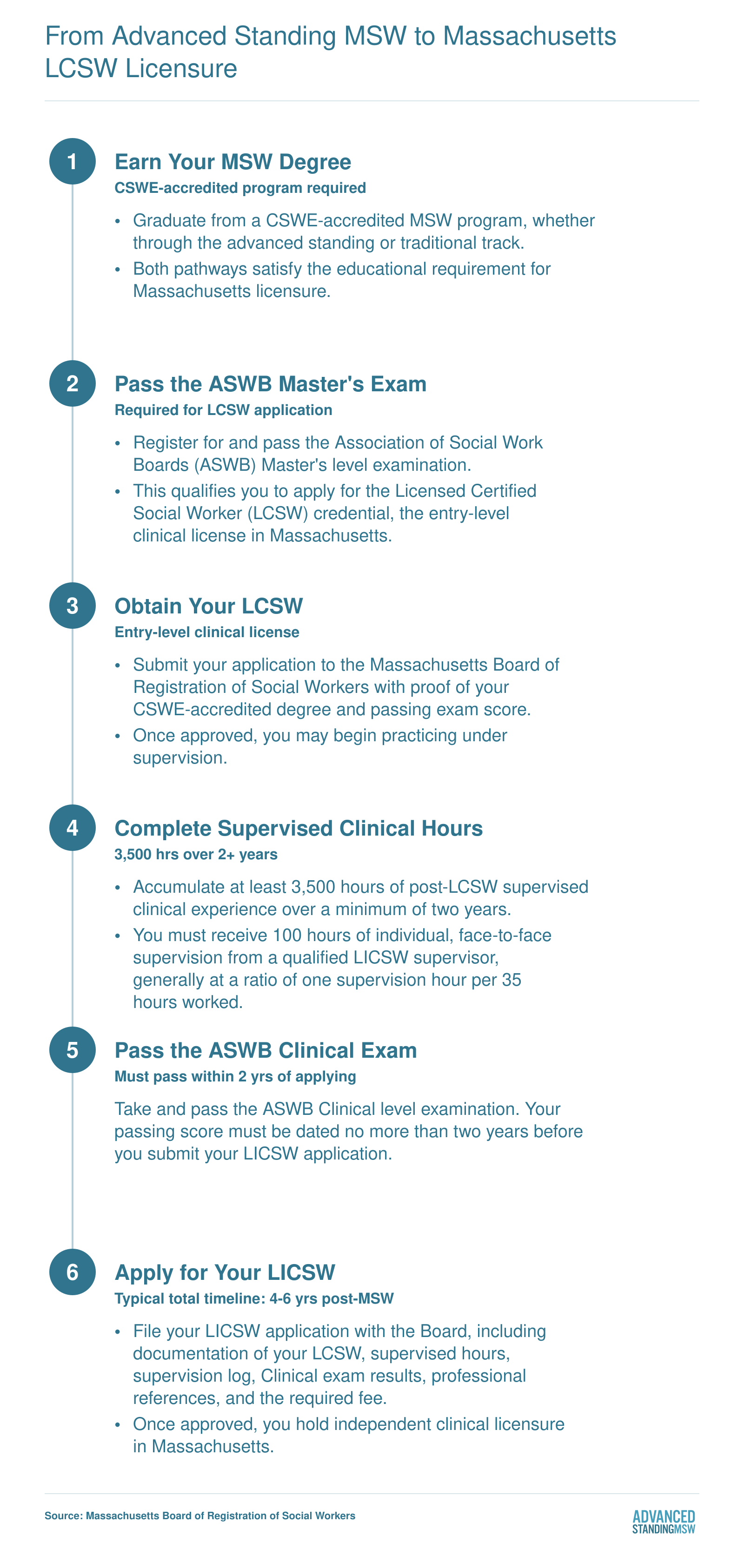
Advanced standing graduates meet the same degree requirements as traditional MSW graduates for licensure eligibility in Massachusetts. The path from diploma to independent clinical practice follows a clear, multi-year credentialing ladder overseen by the Massachusetts Board of Registration of Social Workers.
What Advanced Standing MSW Graduates Earn in Massachusetts
Median Earnings 10 Years After Entry
The U.S. Department of Education's College Scorecard tracks median earnings for former students a decade after they first enrolled. Among Massachusetts advanced standing MSW providers, the top-earning institutions stand out clearly. Boston University leads at $83,238, followed by Merrimack College ($75,584) and Smith College ($64,027). Simmons University ($63,494) and Westfield State University ($57,346) round out the upper tier. Salem State ($56,662), Regis College ($52,873), Elms College ($51,540), Springfield College ($48,036), and Anna Maria College ($46,651) fill out the list. While these figures represent earnings across all programs at each institution, not solely MSW graduates, they offer a directional signal of long-term earning power aligned with each school's alumni network and regional reputation.
Early-career earnings one year after graduation are not yet reported separately for advanced standing MSW completers in the Scorecard. Prospective students should ask programs directly for employment outcomes from their most recent cohort.
Graduate Debt and Affordability
Median graduate debt tells only part of the story but helps gauge financial headroom. Smith College's advanced standing cohort carries the lowest typical debt at $17,550. Westfield State follows at $22,457, and Boston University at $23,250. Simmons University ($24,840), Salem State ($25,000), Regis College ($25,500), and Anna Maria College ($25,000) cluster in the mid-$20,000s. Merrimack College ($27,000) and Springfield College ($26,250) sit slightly higher. Monthly repayment amounts under a standard 10-year plan are not yet published in the Scorecard data, but pairing debt with 10-year earnings gives a practical lens.
ROI Ratio: Earnings Relative to Debt
A handy shortcut for value-conscious applicants is the earnings-to-debt ratio built into the Scorecard. Smith College delivers the strongest return at 3.65, meaning median earnings are 3.65 times median debt. Boston University follows closely at 3.58, and Merrimack at 2.80. Simmons (2.56), Westfield (2.55), Salem (2.27), Regis (2.07), Elms (2.06), Anna Maria (1.87), and Springfield (1.83) each offer ratios above 1.8. Any ratio above 2.0 suggests graduates can comfortably manage repayment on a standard schedule, while ratios approaching 3.5 or higher signal that earnings substantially outpace debt. Programs with the highest ratios tend to combine strong earnings records with relatively contained borrowing. For advanced standing students who typically complete in roughly half the time of a traditional MSW, these debt levels often represent a single year of tuition and fees, making the financial proposition especially compelling.