What you’ll learn in this article…
- The University of Wyoming offers Wyoming's only CSWE-accredited advanced standing MSW.
- Advanced standing students complete roughly 37 credits in one year.
- Graduates report median earnings of $56,880 ten years after enrollment.
Wyoming faces one of the nation's most acute shortages of licensed social workers, with rural counties often going years without a single MSW-level clinician. For BSW graduates already rooted in the state, the advanced standing MSW pathway offers a direct response: earn your master's degree in roughly one year instead of two, entering the workforce while demand remains far ahead of supply.
The University of Wyoming operates the state's only CSWE-accredited MSW program, making it the sole option for students seeking graduate training locally. That singular status shapes cohort size, field placement logistics, and post-graduation hiring patterns across Wyoming's health and human services agencies.
Cswe-Accredited Advanced Standing MSW Programs in Wyoming (2026)
Wyoming has exactly one CSWE-accredited MSW program, so this ranking is short by design. The figures below come from the U.S. Department of Education's federal data, and graduation rates reflect the university as a whole rather than the MSW program alone. Net price is an average after grant aid, not a guaranteed figure for any individual student.
- CSWE accreditation status
- Graduate earnings outcomes
- Borrower debt levels
- Rural practice emphasis
- Program delivery flexibility
- Independent program research
- Internal program database
- College Scorecard graduate earnings — collegescorecard.ed.gov
- NCES-IPEDS federal institutional data — nces.ed.gov
| Rank | School | Location | Net price | Best for | |
|---|---|---|---|---|---|
| #1 | University of Wyoming | Laramie, WY | $14,000/yr (net price) | Rural-focused BSW graduates | |
The University of Wyoming stands alone as the state's CSWE-accredited MSW provider, and its advanced standing track is designed for BSW graduates ready to move directly into advanced practice. The curriculum centers on advanced generalist social work with a strong rural and frontier focus, preparing graduates for clinical, community, and administrative roles across underserved areas. College Scorecard data show median earnings near $56,880 for former students and median federal debt around $18,000; a typical 10-year monthly payment is not separately published in the latest data.
| |||||

Why Wyoming's Advanced Standing MSW Pathway Stands Out
An advanced standing MSW pathway is a condensed graduate program designed specifically for students who already hold a Bachelor of Social Work from a CSWE-accredited institution. Instead of repeating foundational content you mastered as an undergraduate, you enter directly into advanced clinical or specialized coursework and finish your degree in roughly half the time of a traditional MSW track.
Addressing Workforce Gaps in a Frontier State
Wyoming presents a unique challenge for social work practice. With a population of just under 600,000 spread across nearly 98,000 square miles, much of the state qualifies as frontier territory, where population density falls below six people per square mile. Rural and frontier communities often struggle to attract and retain licensed social workers, leaving critical gaps in mental health services, child welfare, and healthcare social work. The advanced standing pathway directly addresses this shortage by preparing qualified BSW graduates for licensure-eligible practice in approximately 12 months rather than the standard two years. That accelerated timeline means you can enter the workforce and begin serving underserved communities a full year sooner than your peers in traditional programs.
The Accelerated Timeline Advantage
Because you have already completed generalist social work coursework during your BSW, the advanced standing track exempts you from repeating that material. At the University of Wyoming, this translates to roughly 33 to 37 credit hours of advanced study instead of the 60 or more credits required for students without a social work background. Most advanced standing students complete the program in three semesters, including summer terms, allowing for graduation in about one calendar year. This compressed schedule is demanding but efficient, letting you move from student to practitioner while your undergraduate training remains fresh.
Flexible Delivery for Remote Learners
Wyoming's geography makes commuting to Laramie impractical for many students. The program addresses this through hybrid and online delivery options that allow you to complete a significant portion of your coursework from anywhere in the state. Live synchronous sessions, asynchronous modules, and periodic on-campus intensives give you flexibility without sacrificing the interactive elements of graduate education. If you live in Casper, Gillette, or one of Wyoming's many small towns, you can pursue your MSW without relocating.
Personalized Support in a Smaller Cohort
Unlike large urban programs that enroll dozens of students per cohort, Wyoming's advanced standing track admits a smaller, more tightly knit group each year. This scale offers distinct advantages: faculty know your name, field placement coordinators can match you with sites that align with your career goals, and you have direct access to advisors throughout your studies. For students navigating the complexities of rural field placements or balancing coursework with employment, that personalized mentorship makes a measurable difference.
Questions to Ask Yourself
University of Wyoming Advanced Standing MSW: Program Deep Dive
How exactly does the University of Wyoming structure its accelerated MSW for BSW graduates, and what does the year actually look like? Here is a clear-eyed breakdown of the credits, the format, the concentration model, and the accreditation status you should verify before applying.
Credit Load and Track Comparison
The University of Wyoming offers two MSW tracks that share the same curriculum philosophy but differ sharply in length. The standard MSW runs roughly 60 credits over 24 months and requires 900 practicum hours. The advanced standing track, reserved for BSW graduates from CSWE-accredited programs, condenses the graduate-level content into about 33 credits and 500 practicum hours across 12 months.1 Note that official program materials list ranges rather than a single fixed number, so you should confirm the exact credit total with the School of Social Work when you apply, since the requirement can shift slightly depending on which capstone route you select.1
Semester-by-Semester Sequence
Advanced standing students begin in the summer term, taking 6 credits that bridge BSW-level content into graduate-level practice. Fall and spring semesters each carry 16 or 17 credits, with the exact load depending on whether you choose the Portfolio option or the Thesis option as your capstone, as detailed in the MSW admissions FAQ. Coursework covers advanced clinical practice, policy, research methods, and integrated field seminar hours tied to your practicum placement. Because course numbering and specific titles have been revised across recent cohorts, verify the current sequence directly with the program, using a recent curriculum document like the 2023 advanced standing curriculum rather than relying on older cohort handbooks.1
Delivery Format and Concentration
The advanced standing track is delivered in a hybrid format based out of the Laramie campus. Students attend intensive weekend sessions on campus combined with weekly synchronous Zoom classes, which allows working professionals across Wyoming and neighboring states to remain in their communities during the week. This is not a fully asynchronous online program; the campus intensives are required.1
Curriculum-wise, Wyoming follows an Advanced Generalist model rather than splitting students into clinical and macro concentrations. That single unified track prepares graduates for licensure-eligible clinical practice, rural community work, administration, and policy roles, which fits the realities of small-population states where practitioners routinely wear multiple hats.1
Accreditation Status
The University of Wyoming MSW program holds current accreditation from the Council on Social Work Education (CSWE), the recognized accreditor for social work education in the United States.1 That status is what makes the advanced standing pathway possible in the first place: only BSW graduates from CSWE-accredited undergraduate programs are eligible to apply, and CSWE accreditation of your MSW is what you will need for state licensure after graduation.1
Related Articles
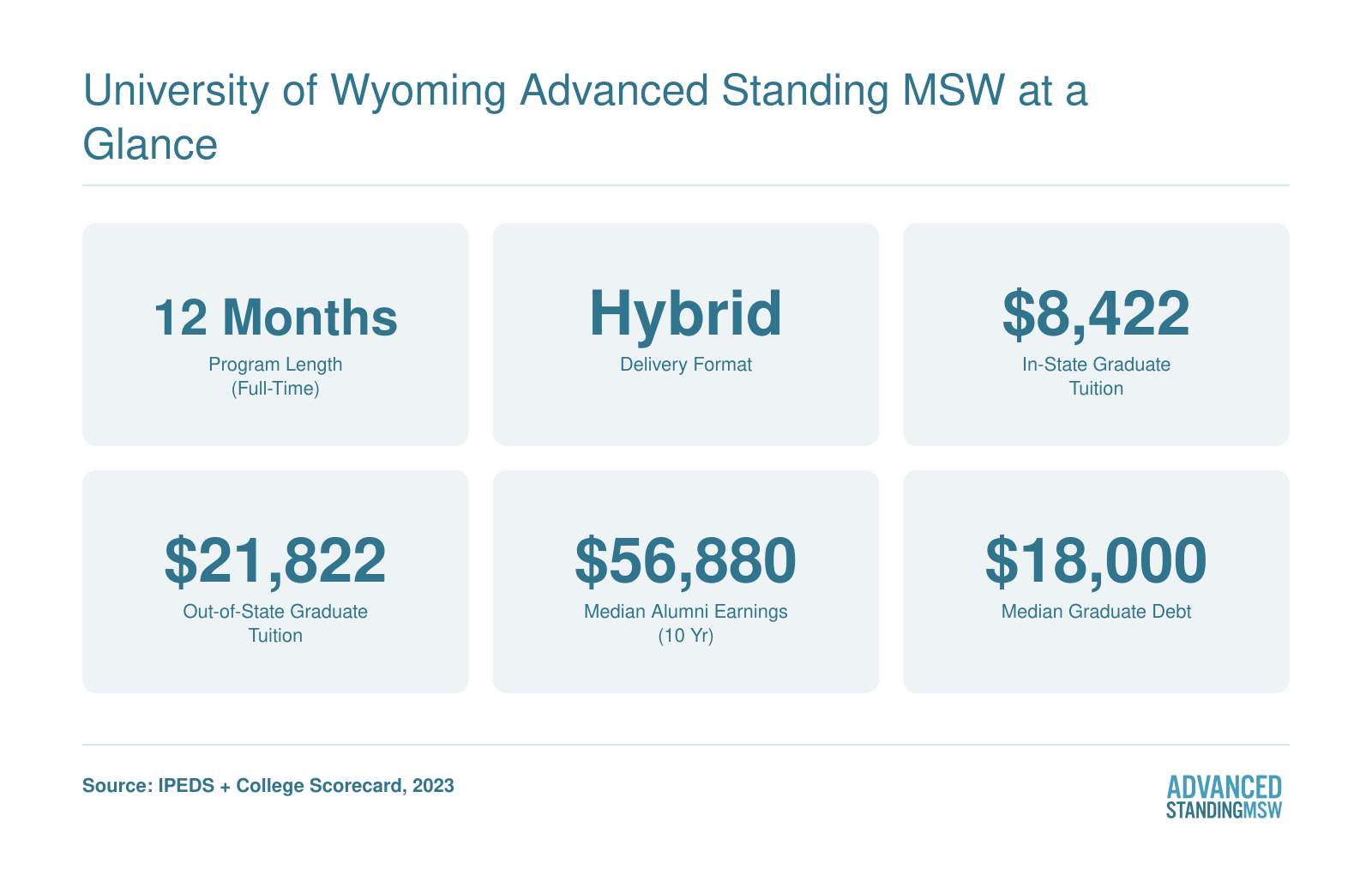
University of Wyoming Advanced Standing MSW at a Glance
The University of Wyoming offers the only CSWE-accredited advanced standing MSW in the state, giving BSW graduates a streamlined path to a graduate degree in just one year. Here are the numbers that matter most when evaluating this program.
Admissions Requirements and Application Timeline
The University of Wyoming's advanced standing MSW program has clearly defined admissions criteria. Gather every component early, missing even one piece can delay your review.
- BSW from a CSWE-Accredited ProgramYou must hold a Bachelor of Social Work from a CSWE-accredited institution. While the university does not publish a definitive recency window, secondary guidance suggests the degree should generally have been earned within the last seven to eight years. Contact the Division of Social Work directly to confirm how your graduation date will be evaluated.
- GPA ThresholdsApplicants need a minimum overall undergraduate GPA of 3.0 and a social work GPA of at least 3.25. You must also have earned a B or better (or a grade of Satisfactory) in your BSW field education practicum. These are firm minimums, not targets, the stronger your academic record, the more competitive your application.
- Application MaterialsPrepare the following before you start: official or unofficial transcripts from every institution attended, three letters of recommendation (at least one from a professional reference is advisable), a personal essay, an analytic academic essay, a current resume, and the MSW Application Information Sheet (a separate Advanced Standing Program Application is also available). International applicants must submit TOEFL or IELTS scores for English-proficiency documentation.
- Application FeesSubmit a $30 fee to the College of Health Sciences/Division of Social Work. First-time University of Wyoming applicants also pay an additional $50 UW graduate application fee. Both are non-refundable.
- Background CheckA criminal background check is required, but only after you receive provisional acceptance, it is not part of the initial application package. Plan to complete it promptly once notified so you can move forward without delays.
- Application Deadlines for the 2027–2028 CohortFull-time applicants must apply by November 1, 2026. Part-time applicants have until January 10, 2027. These deadlines are firm, and applying early gives the admissions committee more time to request any supplemental materials.
- Decision NotificationThe university does not publish an official notification date. Some external guides suggest decisions may arrive around April 1, but this is unconfirmed. Expect communication via email and monitor your applicant portal regularly after the deadline passes.
Tuition, Financial Aid, and Cost Comparison
The conversation around graduate program value has shifted from sticker price to net cost, with social work students increasingly weighing return on investment alongside initial tuition. At the University of Wyoming, the advanced standing MSW offers a financially efficient route to licensure.
What You'll Pay at University of Wyoming
For the 2026 academic year, the MSW advanced standing program lists in-state tuition at $8,422 and out-of-state tuition at $21,822. These figures represent the total program cost for the required 30 credits, not a single semester. The university’s institution-wide net price, which accounts for grants and scholarships across all graduate students, averages $13,599 annually. While that net price is not specific to the MSW program, it signals that many students pay substantially less than published tuition rates.
The Advanced Standing Cost Advantage
Because BSW holders skip foundation coursework and complete roughly half the credits of a traditional MSW, the total tuition burden drops significantly. A standard 60-credit MSW at University of Wyoming would cost roughly $16,844 for in-state students and $43,644 for out-of-state students. By contrast, the advanced standing track cuts those figures to $8,422 and $21,822, respectively. This structure makes the program one of the most affordable CSWE-accredited pathways in the region.
Financial Aid and Funding Resources
- Federal aid: Eligible students can apply for Federal Direct Unsubsidized Loans and Grad PLUS Loans by completing the FAFSA.
- Graduate assistantships: The university offers a limited number of teaching and research assistantships that provide tuition waivers and stipends. These are competitive and often require separate applications to departments.
- Scholarships: The College of Health Sciences and the Division of Social Work maintain several donor-funded scholarships; awards are typically need- or merit-based.
- Loan repayment programs: Wyoming participates in the National Health Service Corps Loan Repayment Program and the state’s own Wyoming Healthcare Professional Loan Repayment Program, both of which can cover significant debt for social workers serving in underserved areas.
Understanding the Numbers
Median graduate debt for University of Wyoming alumni is $18,000, which translates to an estimated monthly payment around $190 on a standard 10-year repayment plan. With an early-career median earnings of $56,880, the program’s return on investment is strong, graduates can expect to earn roughly $3.16 for every dollar spent on tuition. Keep in mind that the university’s institution-wide net price of $13,599 blends undergraduates and graduates across disciplines; your actual costs as an MSW student may differ based on aid eligibility and enrollment intensity.
According to HRSA data as of July 2026, Wyoming meets only 32.25 percent of its mental health care need, with 41 additional practitioners required just to remove existing shortage designations. For BSW graduates weighing an advanced standing MSW, this gap signals strong demand and meaningful career opportunities across the state.
Field Placement Requirements and Rural Placement Sites
Field education is the signature pedagogy of social work, and Wyoming's advanced standing pathway compresses it into a single year of intensive practice. Understanding the hour requirements, site options, and logistical realities up front will help you plan your work life, travel, and finances around the placement.
Required Field Hours for Advanced Standing Students
Advanced standing students at the University of Wyoming complete 500 field practicum hours during the MSW year1, split evenly across the fall and spring advanced generalist semesters at 250 hours each. Because BSW graduates already logged 400 or more supervised hours in their undergraduate program, the field handbook frames the combined pathway as roughly 900 hours across the full degree trajectory.1 Traditional MSW students, by contrast, complete significantly more field time inside the graduate program itself, which is precisely what allows advanced standing to finish in one year rather than two.
How Placements Are Coordinated
Students do not simply pick a site on their own. The School of Social Work operates a practicum system that matches each student to an approved partner site based on the chosen specialization, learning goals, and geographic constraints. If you want to complete your placement at your current employer, expect to submit a formal petition to the Field Committee, and know that approval is not automatic. Paid placements are infrequent, and summer field placements are exceptionally rare because of limited faculty and site resources.2
Placement Sites Across Wyoming
Placements are distributed statewide and include settings well suited to rural and frontier practice, according to MSW Online's University of Wyoming MSW program profile:
- Community mental health and behavioral health agencies, including Wyoming Behavioral Health partners
- Hospitals and VA clinics serving veterans across the state
- School districts and school-based mental health teams
- Child welfare and legal advocacy organizations such as the Wyoming Children's Law Center
- Nonprofits, courts, legislative offices, and research institutes
Logistics for Remote and Rural Students
If you live in Sheridan, Rock Springs, or a frontier county, plan for real windshield time. Virtual or remote field supervision is not established as a standard option2, and the program emphasizes in-person attendance for its intensive weekends on campus. Discuss travel radius and scheduling with the practicum office early, and pair your field hours with the integrative practice seminar that runs alongside placement, where you process cases and connect field experience to advanced generalist theory.
Career Outcomes and Licensure After Graduation
Graduates of the University of Wyoming’s Advanced Standing MSW program report median earnings of $56,880 ten years after entering the program, providing a realistic benchmark for long-term earning potential in Wyoming. While short-term earnings data are not yet available at the program level, this figure reflects strong return on investment: graduates earn more than three dollars for every dollar of median student debt they carry.
Licensure Steps to Become an LCSW in Wyoming
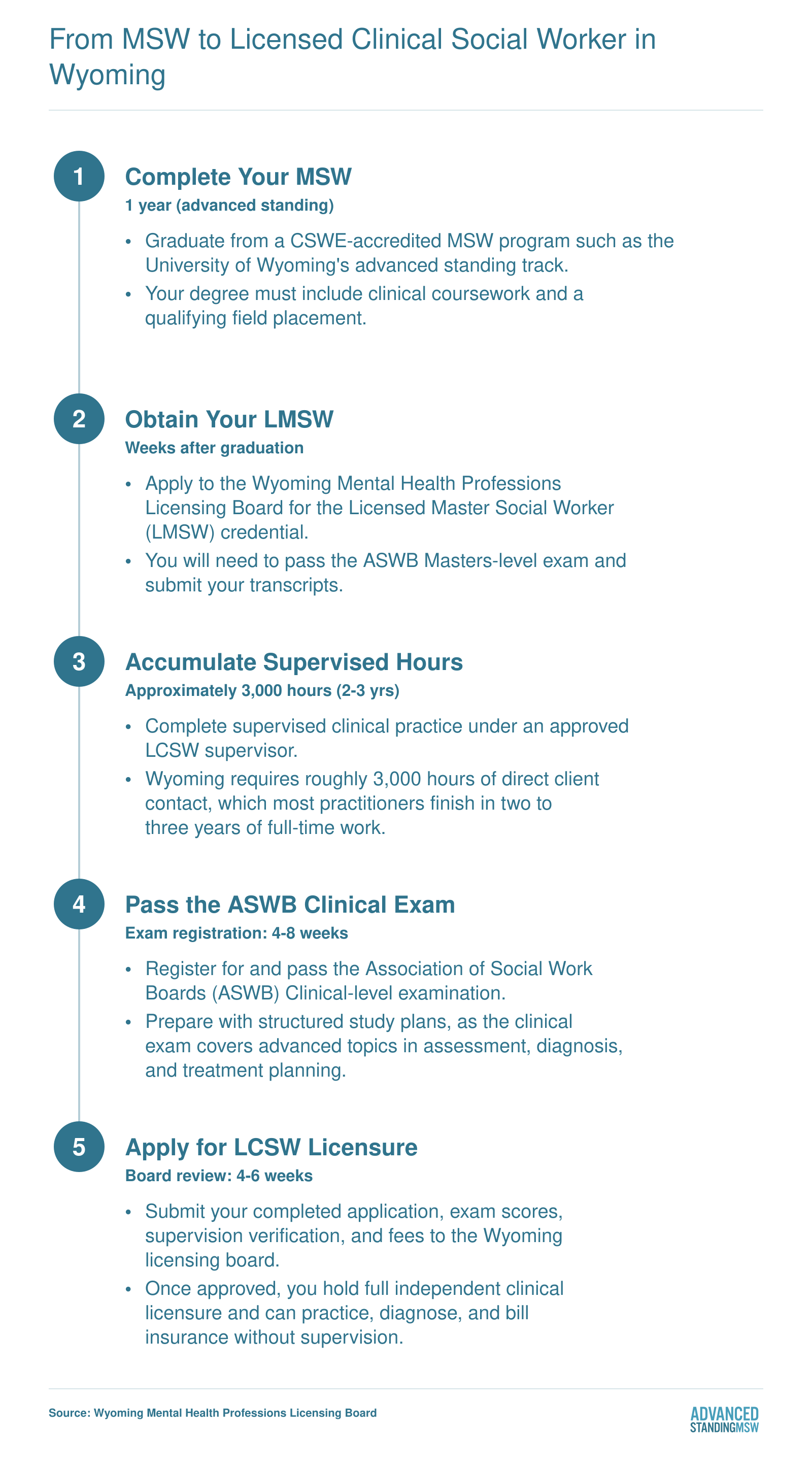
Securing the Licensed Clinical Social Worker (LCSW) credential in Wyoming is a structured licensure pathway that begins after earning a CSWE-accredited MSW5.
- Post-degree hours: 3,000 hours of supervised clinical practice5, including 1,200 to 1,500 hours of direct client contact (confirm exact threshold with the current board rules).
- Supervision: 100 hours of face-to-face individual clinical supervision over a period of 18 to 36 months3. Triad supervision may be accepted in some circumstances.
- Exam: Achieve a passing score on the ASWB Clinical examination4. The exam fee is $260 as of 2026.
- Application: Submit your LCSW application to the Wyoming Mental Health Professions Licensing Board with a $200 fee.
From MSW graduation to full licensure, expect a timeline of two to three years, depending on how quickly you accrue supervised hours and schedule the exam.
Earnings Prospects for Advanced Standing Graduates
The median earnings of $56,880 ten years after entry, reported for the Advanced Standing MSW at the University of Wyoming, serve as a reliable long-term salary indicator. Earnings typically rise with experience, clinical endorsement, and specialization. Early-career salaries are lower, but program-level data for the first few years post-graduation are not yet published. The favorable return on investment (over three times median debt) underscores the financial viability of this accelerated pathway, especially for BSW holders who reduce both time and tuition costs.
Licensure Portability Across State Lines
Wyoming does not participate in the Social Work Licensure Compact as of 2026, meaning there is no automatic license recognition with neighboring states. Social workers moving into Wyoming from Montana, Colorado, South Dakota, Nebraska, Idaho, or Utah must apply for licensure by endorsement. The process requires verification of an active license in good standing, ASWB exam scores, documentation of supervised clinical hours, and possibly additional coursework or jurisprudence exams depending on the state of origin. Outbound Wyoming-licensed clinical social workers face similar requirements when seeking licensure in other states; each jurisdiction evaluates endorsements individually, so plan ahead if interstate practice is a goal. While the lack of a compact introduces administrative steps, it is a manageable hurdle with proper preparation.
Where Wyoming MSW Graduates Work
Licensed clinical social workers in Wyoming find employment across a diverse set of mission-driven organizations:
- State and county agencies, such as the Department of Family Services and Department of Health
- Indian Health Service clinics and tribal health programs
- Rural hospitals, critical access hospitals, and hospital-based behavioral health units
- Community mental health centers and substance use treatment facilities
- School districts and special services cooperatives
- Private practice, often with a telehealth component to reach frontier patients
The state’s persistent behavioral health workforce shortage means advanced standing graduates can move quickly into roles with substantial responsibility and the potential to shape services in underserved communities.
From MSW to Licensed Clinical Social Worker in Wyoming
Earning your MSW is a major milestone, but clinical licensure requires additional supervised experience and a national exam. Here is the step-by-step pathway Wyoming MSW graduates follow to reach full LCSW status.
Frequently Asked Questions About Wyoming Advanced Standing MSW Programs
Below are answers to questions BSW graduates ask most when exploring the advanced standing MSW pathway at the University of Wyoming. Each response reflects the most current information as of 2026.
- Is the University of Wyoming advanced standing MSW CSWE accredited?
- Yes. The University of Wyoming's MSW program, including its advanced standing track, holds full accreditation from the Council on Social Work Education (CSWE). This means your degree meets the national standard required for licensure in Wyoming and nationwide. You can verify the program's status through the CSWE accreditation directory.
- How many credits is the advanced standing MSW at the University of Wyoming?
- Third-party program guides report the advanced standing track at approximately 30 to 36 credits, though the University of Wyoming's own published materials do not confirm an exact number. Contact the UW School of Social Work directly to verify the current credit total, as curriculum updates can shift requirements.
- Can you complete the University of Wyoming MSW program entirely online?
- No. The University of Wyoming delivers its MSW program in a hybrid format that combines online coursework with in-person components, including required field placements. A fully online option is not available. BSW graduates should plan for some on-site participation, particularly during practicum semesters.
- How long does it take to complete the advanced standing MSW at the University of Wyoming?
- The advanced standing track is designed to be completed in approximately 12 months, or one academic year. This accelerated timeline is possible because BSW graduates receive credit for foundational coursework already completed during their undergraduate program, allowing them to move directly into advanced clinical or macro content.
- What happens if my BSW is more than seven years old? Can I still apply for advanced standing?
- Some program guides reference a seven-year recency requirement for the BSW degree, meaning applicants whose degree is older may not qualify for advanced standing. However, the University of Wyoming's published admissions pages do not explicitly confirm this rule. If your BSW was conferred more than seven years ago, reach out to the admissions office to discuss your eligibility and any possible alternative pathways.