What you’ll learn in this article…
- Advanced standing MSW programs in Montana can be completed in nine to twelve months.
- Only two CSWE-accredited in-state options exist: University of Montana and Carroll College.
- Montana MSW graduates earned a median salary near 51000 dollars in recent reporting.
Advanced standing lets BSW graduates finish their MSW in roughly 12 months rather than the standard two-year track, saving a full year of tuition and forgone earnings. In Montana, this accelerated path runs through a narrow gateway: one public university, one private college, and a handful of out-of-state online programs that explicitly admit Montana residents.
That limited in-state supply means most BSW graduates will weigh the public in-state tuition at the University of Montana against Carroll College’s private pricing, or consider a fully online program from an out-of-state institution. Each choice carries distinct trade-offs in cost, scheduling, and field placement logistics across Montana’s rural counties.
Montana's Cswe-Accredited Advanced Standing MSW Programs, Ranked for 2026
Montana BSW graduates weighing an advanced standing MSW in 2026 have one clear in-state option and a small set of out-of-state online programs that explicitly accept Montana residents. The ranking below compares what each pathway costs, how it is delivered, and what it leads to after graduation, so you can judge each program on the things that matter most for your budget and career timeline. Use these program cards as a starting point, then check application deadlines and start dates on the program pages.
| Rank | School | Location | Net price | Best for | |
|---|---|---|---|---|---|
| #1 | Carroll College | Helena, MT | ~$24,000/yr (est.) | Montana BSW grads seeking a fully online MSW | |
Carroll College's advanced standing MSW is the only Montana-based program on this ranking, and its clinical focus makes it a natural fit for BSW graduates who want direct practice skills. The online track blends live sessions with self-paced study, so working professionals can keep their jobs while earning the degree. Graduates are prepared for LCSW licensure, and the first cohort reported 100% job placement within two months of graduation. Small cohorts and faculty with clinical and research experience add a level of support that distance learners often miss.
| |||||

Accelerated MSW, One-Year MSW, Advanced Standing: The Same Program
One label promises completion in 12 months, another emphasizes an "accelerated" pace, and a third highlights your "advanced standing" as a BSW graduate. Despite the different branding, all three phrases describe the same structural pathway: a shortened Master of Social Work designed for applicants who already hold a CSWE-accredited BSW program.
Why Schools Use Different Names
Universities choose whichever title they believe will resonate with prospective students. Some call it an "Advanced Standing Program," others market it as a "One-Year MSW" or "12-Month MSW," and a few opt for "Accelerated MSW." The eligibility requirement is identical in every case: a CSWE-accredited BSW. The structure is also consistent. Because your undergraduate social work education already covered foundational content, the program waives those courses and moves you directly into advanced or concentration-level work. That typically means completing roughly 30 to 39 credits in about one academic year, compared to the 60 credits and two full years required in a traditional MSW track.
Montana has a limited number of in-state MSW programs, and the terminology you encounter on their pages may lean toward one label over another. If you are exploring CSWE-accredited online MSW programs open to Montana residents, you will see the full spectrum of naming conventions across institutions nationwide. Regardless of what a school calls it, confirm that the program holds CSWE accreditation and explicitly lists BSW holders as eligible for the shortened track.
What Does Not Qualify
Not every applicant with a social-services background can enter this pathway. You must hold a BSW specifically from a CSWE-accredited program. A bachelor's degree in psychology, sociology, human services, or a related field does not meet the threshold, no matter how much overlap exists in coursework. Additionally, most schools impose a recency requirement, commonly five to seven years from the date your BSW was conferred. If your degree falls outside that window, you will likely need to apply to the traditional two-year MSW track instead.
The Bottom Line for Montana BSW Graduates
When you see listings for advanced standing, accelerated, one-year, or 12-month MSW programs, you are looking at variations on one idea: a faster route that rewards the professional foundation your BSW already provided. Focus less on the label and more on three non-negotiable checkpoints: CSWE accreditation, explicit eligibility for BSW holders, and a recency window that fits your graduation date. If those three align, the program qualifies as the accelerated pathway you are searching for, regardless of what any school chooses to call it.
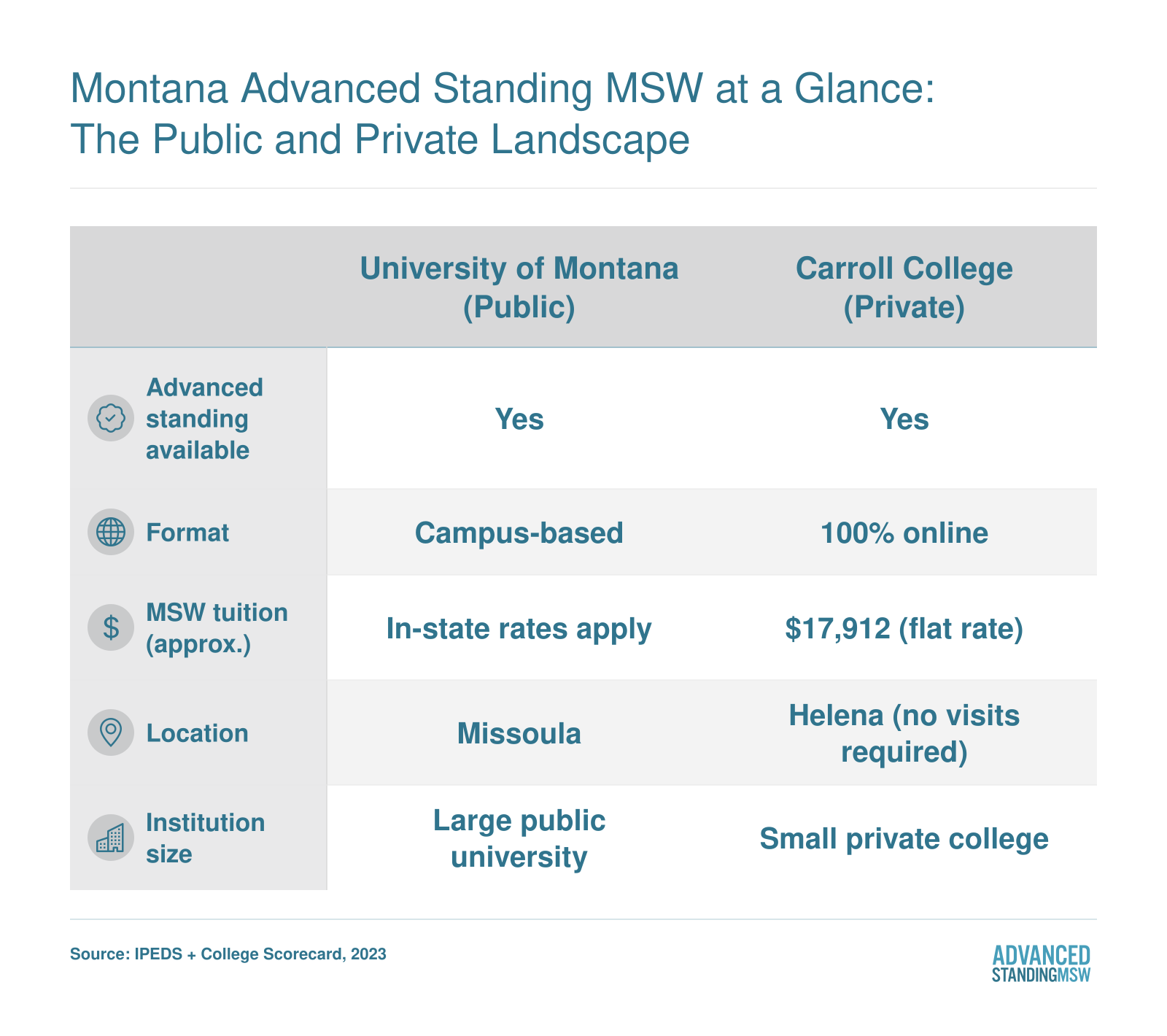
Montana Advanced Standing MSW at a Glance: The Public and Private Landscape
Montana has just two CSWE-accredited options for BSW graduates seeking an advanced standing MSW. The University of Montana is the only public university in the state offering a CSWE-accredited MSW program, making it the default choice for residents who want in-state tuition rates. Carroll College, a private institution in Helena, provides an alternative with a fully online format and a compact nine-month timeline, though its private status means tuition is set at a flat rate regardless of residency.
Online Vs. Campus Formats: Which Montana MSW Fits Your Life?
Choosing between an online or on-campus MSW in Montana hinges on a tradeoff few BSW graduates anticipate: the flexibility of virtual coursework against the immersive value of in-person learning. With only two in-state programs (one public, one private), the format may determine where you apply.2
The University of Montana: Montana's Sole Online Advanced Standing Provider
The University of Montana (UM) is the only school in the state offering an online MSW program, and its delivery varies by track. The full three-year program runs asynchronously, meaning you complete coursework on your own schedule each week. However, the Advanced Standing track, which shaves a year off the degree, is delivered synchronously online. That 37-credit sequence, including a summer bridge and specialization year, requires real-time virtual attendance at set class times.1 While the on-campus MSW program historically scheduled core courses on Thursdays and Fridays to reduce travel, neither online track is described as weekend- or evening-specific; actual schedules are arranged with faculty and advisors.
Carroll College: A Likely Campus-Only Program
Carroll College’s MSW, housed in the Hunthausen School of Social Work in Helena, has not publicly detailed its delivery format. No online or hybrid information appears in available materials. Prospective students should assume a campus-based experience until the college states otherwise, and contact admissions directly for confirmation.
Rural Montana Considerations: Internet, Travel, and Time Zones
For students in remote areas, connectivity is a real constraint. UM’s synchronous Advanced Standing track demands reliable internet for live sessions; spotty service can derail participation. If your schedule or broadband is unpredictable, an out-of-state fully asynchronous Advanced Standing program may be a better fit, though you’ll lose in-state tuition benefits. Travel to occasional campus residencies, if required, adds cost and time. Also, if you enroll in an online program based in another time zone, synchronous sessions may land early or late in your day; confirm schedules before committing.
Accreditation and Licensure: Online MSWs Carry the Same Weight
CSWE accreditation applies equally to online and campus programs. An online MSW from an accredited school meets the same educational standards as a traditional degree, and Montana’s licensure board treats them identically. Do not let delivery format undermine confidence in your credential. Focus instead on the fit for your learning style and life circumstances.
Related Articles
Admission Requirements for Advanced Standing MSW in Montana
Gaining admission to an advanced standing MSW program means demonstrating that your undergraduate social work foundation is strong enough to bypass the first year of a traditional two-year master’s track. In Montana, two institutions offer this accelerated path: the University of Montana in Missoula and Carroll College in Helena, and each sets its own academic thresholds and application timelines.
University of Montana Advanced Standing Requirements
The University of Montana sets a clear baseline for advanced standing applicants. The program expects a minimum BSW GPA of 3.25 on all undergraduate social work coursework. Alternatively, students may present an overall undergraduate GPA of 3.0 combined with a 3.25 in core social work classes.1 Your BSW degree must come from a program accredited by the Council on Social Work Education (CSWE) or an internationally recognized equivalent.1 The university prefers that you earned your BSW within the last seven years; however, applicants with an older degree can still be considered if their resume demonstrates recent social work experience and continuing education credits.1
Required application materials include three letters of reference. At least one must be academic, ideally from a BSW faculty member. If you graduated less than two years ago, a field education or practicum supervisor reference is also expected.1 Two essay questions and a personal statement round out the narrative portion of the application.1 The UM advanced standing MSW does not require GRE scores, though applicants with an undergraduate GPA below 3.0 may choose to submit them to strengthen their file.1 The application window opens September 15 and all materials must be received by February 15 for the following fall cohort.1
Carroll College Advanced Standing Admission
Carroll College offers an advanced standing MSW option, but the detailed admission criteria, including GPA cutoffs, recency limits, and reference requirements, are presented in a separate program-specific checklist (see “What Carroll College Requires for Advanced Standing MSW Admission”). Generally speaking, Carroll’s advanced standing pathway expects a CSWE-accredited BSW and a strong academic record, and it follows a rolling or fixed deadline similar to other small private programs in the region. Since the college is a private institution, its fee structure and application timeline differ from UM’s public university calendar, so prospective students should consult the current checklist directly.
How the Two Pathways Compare
Even with Carroll’s specifics housed in a dedicated checklist, some immediate contrasts stand out:
- GPA Expectations: UM’s 3.25 BSW GPA requirement is common for public flagship programs. Private institutions like Carroll may adopt a holistic review that weighs experience alongside grades, but the official minimum is likely similar.
- BSW Recency: UM’s seven-year preference with a bridge for experienced professionals is relatively flexible. Carroll’s recency policy may be stricter or more lenient; applicants should verify.
- Application Timeline: UM operates on a single annual deadline (February 15), while Carroll may offer multiple start terms or a later deadline. This can affect timing for BSW graduates who need an immediate start.
- References: UM asks for three letters with specific source requirements. Carroll’s expected number and source mix may differ, particularly if the college emphasizes pastoral or service-oriented references given its Catholic identity.
What If Your BSW Is Not CSWE-Accredited?
Neither Montana program accepts a BSW from a non-CSWE-accredited program for advanced standing. The accelerated pathway is predicated on a standardized social work foundation. If your undergraduate degree is in a related field but not CSWE-accredited, you would need to apply to the traditional two-year MSW track instead. UM does not offer a formal bridge course or conditional path to convert a non-CSWE degree into advanced standing eligibility. Carroll College is similarly structured: advanced standing requires a CSWE-accredited BSW with no exception for other majors.
This means that for BSW holders from accredited programs, the advanced standing route is a streamlined, efficient choice. But it is an all-or-nothing prerequisite; verify your program’s CSWE status before initiating either application.
What Carroll College Requires for Advanced Standing MSW Admission
Carroll College's advanced standing MSW track can be completed in as few as nine months, but you need to meet specific eligibility benchmarks before you start. Unlike the University of Montana's public-university model, Carroll is a private, Catholic-affiliated institution, though no explicit faith-based or mission-alignment requirement appeared in the program's published admissions materials as of 2026. Use the checklist below to confirm you are ready to apply.
- CSWE-Accredited BSW or BSSW DegreeYou must hold a Bachelor of Social Work (or Bachelor of Science in Social Work) from a CSWE-accredited program. This is the non-negotiable gateway to the advanced standing track.
- Minimum 3.00 Cumulative GPACarroll requires a 3.00 GPA over the last two years of undergraduate study for unconditional admission. If you fall slightly below that mark, conditional admission may still be possible, contact the program directly to discuss your situation.
- Prerequisite Coursework, 18 Semester CreditsYou need 18 semester credits across the humanities, social sciences, and natural sciences. These do not have to be finished when you apply, but they must be completed before the program begins, a key difference from UM, where prerequisite expectations are embedded in the BSW curriculum review.
- TranscriptsUnofficial transcripts are accepted for initial application review, but official transcripts from every institution attended must be on file before you start coursework.
- Application DeadlineCarroll has not published a specific deadline for the current cycle in its publicly available materials. Because the advanced standing cohort is small, reaching out early through the program's inquiry form is strongly recommended, seats can fill before any posted cutoff.
- No Published BSW Recency RuleUnlike some programs that require your BSW to have been earned within a set number of years, Carroll does not list a degree-recency requirement in its current admissions documentation. If your degree is older, confirm directly with the admissions office that no additional review applies.
Questions to Ask Yourself
Do you need evening or online classes to keep working while you earn your MSW?
Many Montana social workers hold daytime jobs at agencies. Programs offering evening or fully online courses let you continue earning while completing coursework, so you avoid an income gap during field placements.
Is your BSW from a CSWE-accredited program, and was it completed within the recency window your target school requires?
Advanced standing eligibility depends on a CSWE-accredited bachelor's and a recent graduation, often within 5 to 7 years. If your BSW is older, you may need to apply to a traditional MSW track instead.
Are you planning to stay in rural Montana for field placements, or are you willing to relocate temporarily to an urban site?
Montana's few advanced standing programs can arrange placements statewide, but concentrated opportunities in cities like Missoula or Billings cut commute times and give you broader agency choices.
Field Placements and Practicum Support Across Rural Montana
Field placement is where MSW coursework becomes real clinical practice, and for students scattered across Montana's vast rural landscape, the logistics of finding supervised hours can feel daunting. The good news is that Montana's MSW programs have built infrastructure specifically to support students living far from urban centers.
How Placements Are Arranged at the University of Montana
At the University of Montana, the field education office coordinates placements rather than leaving students to secure sites independently. Students review approved agency lists, meet with the Director of Field Education, and interview two to three potential supervisors before finalizing their site1. No practicum hours can begin until all required paperwork is filed with the field office1.
For the 2024 to 2025 academic year, UM reported partnerships with over 200 agencies statewide, with roughly 30% of placements occurring in rural or tribal communities2.
The program explicitly aims to keep online students in their home communities, reducing the need to relocate or commute long distances for practicum4.
Rural Placement Site Types
Montana's rural placement network spans a range of agencies serving underserved populations:
- Tribal health centers and tribal programs: UM has built partnerships with tribal colleges to expand placement availability on and near reservations2.
- Community mental health centers: These serve as primary clinical training grounds in counties without hospitals or large social service agencies.
- Public schools: School social work placements address behavioral health and family intervention in districts that may lack dedicated counseling staff.
- VA clinics and rural hospitals: Where available, these sites offer exposure to healthcare social work in settings serving veterans and isolated populations.
Practicum Hours for Advanced Standing Students
Traditional MSW students at UM complete 900 total practicum hours across two years, typically split into two 450-hour placements3. Advanced standing students, having already completed foundation-level field hours during their BSW, generally face reduced practicum requirements. This shorter timeline benefits rural students who may have limited local placement options or need to balance work and family obligations.
Support for Distance and Online Students
UM's online MSW program provides structured support for students completing placements away from campus. The field office maintains a dedicated contact for online students, assists with identifying suitable agencies near each student's Montana residence, and has developed remote supervision policies for areas lacking an on-site MSW supervisor. Students with at least two years of post-degree social work experience may arrange employer-based practicums3, provided weekly MSW supervision is available.
Comparable practicum logistics for Carroll College could not be independently verified for 2026, though the program holds CSWE accreditation as Montana's private MSW option. Prospective Carroll students should contact admissions directly for current field placement policies.
Concentrations and Earnings After Completing Your Montana MSW
Montana's advanced standing MSW programs launch graduates into high-demand clinical roles, and the financial return on that investment is substantial.
Concentration: The Clinical Foundation
Carroll College's advanced standing MSW builds on a generalist clinical framework, intentionally designed to prepare you for LCSW licensure. Every graduate completes the program with the clinical coursework and supervised field hours required to pursue independent practice, without a separate post-graduate clinical sequence. There is no separate macro, policy, or community organizing track, so the concentration choice is clear-cut when your goal is direct client care. In Montana's rural and frontier communities, this clinical focus directly addresses the state's shortage of licensed behavioral health providers.
Earnings and Return on Investment
Program-level early-career earnings at 1 year and 4-5 years after completion are not yet published for this program. However, median earnings for Carroll College MSW graduates once established in their careers stand at $61,772. With a median graduate debt of $25,757, the earnings-to-debt ratio is approximately 2.4, meaning annual income is more than double the total amount borrowed. This strong return holds up well against Montana's moderate cost of living and far outpaces the debt burden. Employment-focused metrics, such as the share of graduates working or earning above the poverty threshold, have not been reported for this program, but the existing earnings figure signals solid long-term financial outcomes.
Career Paths That Put Your MSW to Work
- LCSW private practice: After completing state-mandated post-degree supervision, many graduates open independent practices in underserved areas.
- School social work: Montana schools regularly hire MSW-level clinicians to support student mental health, especially in rural districts.
- Tribal health: Partnerships with Indian Health Service facilities and tribal clinics offer meaningful work for graduates committed to culturally grounded care.
- Hospital and VA social work: Clinical roles in medical settings, including veterans' services, remain some of the most stable and well-compensated positions in the state.
Carroll College reports a 100% job placement rate for the program, so the bridge from the advanced standing MSW to a clinical social work career is strong and direct.
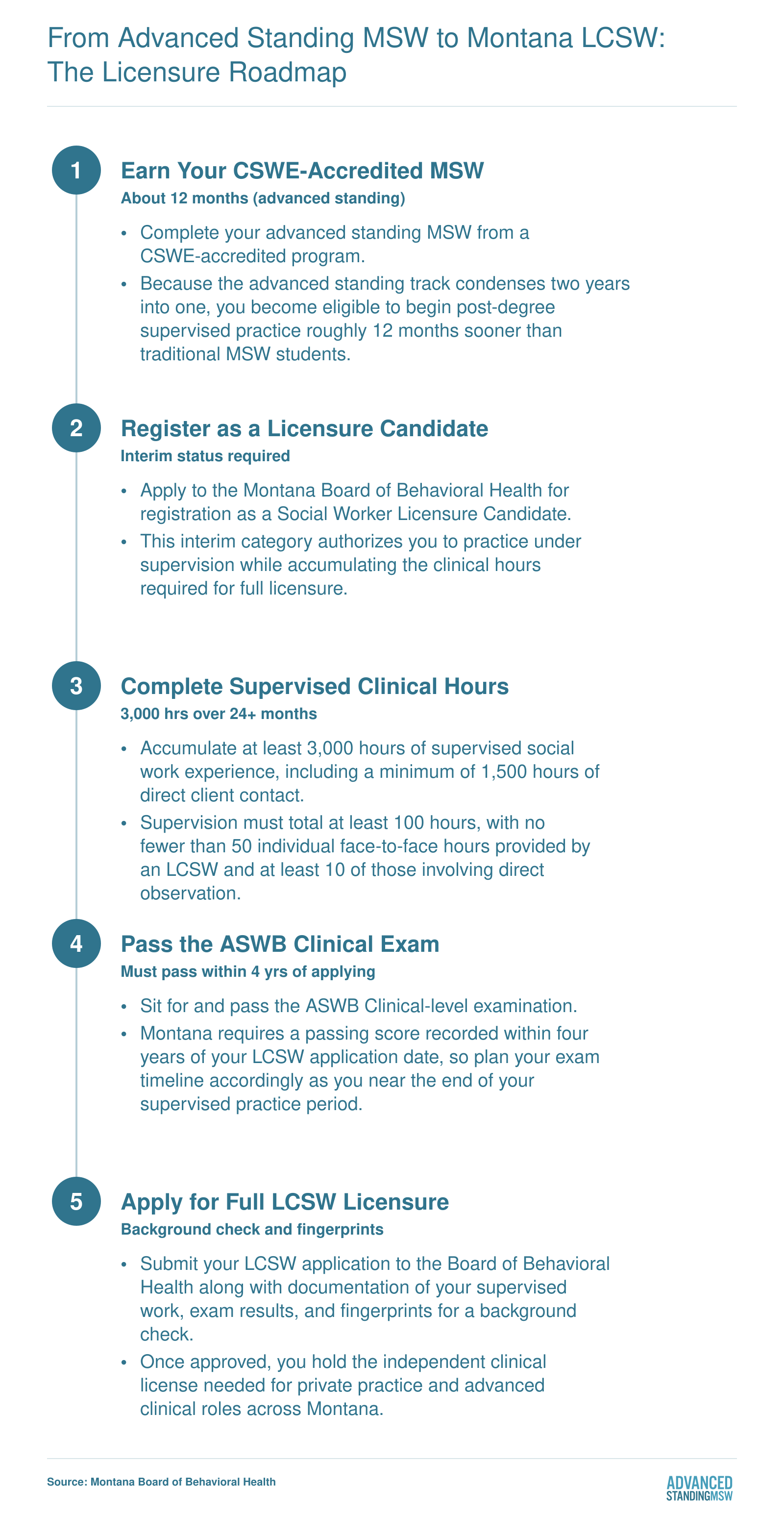
From Advanced Standing MSW to Montana LCSW: The Licensure Roadmap
Finishing your advanced standing MSW in roughly 12 months puts you on the licensure clock a full year ahead of traditional MSW graduates. However, Montana's post-degree supervised practice requirements remain the same regardless of how quickly you earned your degree. Here is the complete sequence from graduation to full LCSW status.
Frequently Asked Questions About Montana Advanced Standing MSW Programs
Below are answers to the questions BSW graduates most often ask when exploring an advanced standing MSW in Montana. Each response draws on current program details and licensure guidance to help you plan with confidence.