What you’ll learn in this article…
- Advanced standing MSW students at Jackson State complete 450 field hours, not 900.
- Mississippi projects a need for 4,570 licensed social workers by FY2026.
- Expect to finish your accelerated MSW in roughly three to four semesters.
Advanced standing compresses the MSW into roughly one academic year for BSW graduates, reducing the traditional two-year track to three or four semesters when summer is included. Mississippi programs such as Jackson State University's online option and the University of Mississippi's on-campus cohort replace foundation coursework that BSW holders already completed with advanced clinical training.
The state projected a need for 4,570 licensed social workers by FY2026, yet only 4,353 were licensed in FY2025. Rural and medically underserved counties feel the shortage most acutely, where access to mental health care often depends on a limited pool of master's-level practitioners.
Accelerating licensure through advanced standing does more than shorten the timeline; it addresses a critical gap that leaves entire communities without enough clinicians to meet rising demand.
Mississippi's Best Advanced Standing MSW Programs for 2026
These are the strongest advanced standing MSW options in Mississippi for BSW graduates who want an accelerated path to clinical practice. Each school takes a different approach to format and cost, so consider not only the ranking but how each program fits your work and family life. Graduation rates cited below are institution-wide figures, not MSW-specific outcomes.
- Net cost after aid
- Institutional graduation rate
- Format flexibility
- CSWE accreditation status
- College Scorecard graduate earnings — collegescorecard.ed.gov
- Independent program research
- Internal program database
- NCES-IPEDS federal institutional data — nces.ed.gov
| Rank | School | Location | Net price | Best for | |
|---|---|---|---|---|---|
| #1 | University of Mississippi | University, MS | $10,000 – $15,000/yr | Campus-based learners wanting clinical practice focus | |
The University of Mississippi offers a campus-based advanced standing MSW for BSW graduates who are ready to commit to clinical practice. The one-year, 36 credit hour track includes field instruction across four semesters, with coursework in clinical assessment, psychotherapy, trauma response, and substance abuse treatment. The net price after aid is about $13,314, and the institution's graduation rate stands at roughly 72 percent.
| |||||
| #2 | University of Southern Mississippi | Hattiesburg, MS | $22,000/yr | Part-time students balancing work and family | |
The University of Southern Mississippi runs a campus-based advanced standing MSW that trims the traditional degree to 34 credit hours, which full-time students can finish in three semesters. The curriculum spans addictions, trauma, forensics, and social welfare policy, and field work totals 600 supervised hours across more than 200 agency partners. The net price after aid is about $21,708, and the institution's graduation rate is roughly 49 percent.
| |||||
| #3 | Jackson State University | Jackson, MS | $24,000/yr (net price) | Remote BSW graduates needing online flexibility | |
Jackson State University is the only fully online option in this ranking, a meaningful advantage for working BSW graduates who need scheduling flexibility. Its one-year advanced standing MSW emphasizes advanced direct practice with children, youth, and families, with required field placements in the summer and spring terms. The net price after aid is about $23,836, and the institution's graduation rate is roughly 51 percent.
| |||||


Accelerated MSW, One-Year MSW, Advanced Standing: The Same Program
What's the real difference between an accelerated MSW, a one-year MSW, and an advanced standing MSW in Mississippi? The answer is simpler than the jumble of terms makes it seem: they all describe the same accelerated pathway.
Different Names, Same Pathway
Every Mississippi school with a CSWE-accredited MSW program, including the University of Mississippi, Jackson State University, and the University of Southern Mississippi, offers a shortened route for applicants who already hold a bachelor's degree in social work from an accredited program. You will encounter several labels: "Advanced Standing," "Accelerated MSW," or even "One-Year Program." The University of Mississippi's MSW program, for example, calls it an "Advanced Standing" track, while Jackson State University frames it as an "accelerated" option. The wording varies, but the core structure is identical: the foundational or generalist year is waived because your BSW already covered it. You jump straight into advanced coursework and complete roughly 30, 39 credits instead of the full 60 required in the traditional two-year degree.
What Does NOT Qualify as Advanced Standing
A common point of confusion is which bachelor's degrees unlock the fast track. Only a BSW from a CSWE-accredited program qualifies. A bachelor's in psychology, sociology, criminal justice, or any related field does not meet the requirement, nor does a BSW from a non-accredited program. Even if you have a CSWE-accredited BSW, many Mississippi schools enforce a recency limit, typically 5 to 7 years, after which you must retake foundation courses. If your degree falls outside that window, the traditional two-year path becomes the appropriate route.
How Many Credits Will You Actually Take?
The practical difference between traditional and advanced standing plans is significant. Traditional MSW students complete around 60 credits over two years. As an advanced standing student in Mississippi, you tackle roughly 30, 39 credits, which a full-time cohort can finish in about 11 to 12 months. This compressed timeline means you move into the field and start earning sooner, often with the same clinical or macro concentration as your traditional-entry peers. When you hear "one-year MSW" or "12-month MSW," that is exactly what the term describes: an advanced standing path that respects the foundation you already built.
How BSW Holders Save a Full Year With Advanced Standing
How long does an advanced standing MSW actually take in Mississippi? For BSW graduates who meet the eligibility requirements, the accelerated track typically wraps up in one academic year, roughly three to four semesters if summer is included. That’s a full year shaved off the traditional 60-plus-credit path, dropping your total coursework to somewhere between 30 and 39 credits.
The Core of Advanced Standing: Skipping Foundation Year
The logic is straightforward: if you already hold a Bachelor of Social Work from a CSWE-accredited program, you’ve demonstrated mastery of generalist practice, human behavior theories, and introductory field skills. Mississippi programs recognize this by waiving the entire foundation curriculum, courses that non-BSW students spend their first year completing. You then jump directly into advanced concentration courses, clinical or macro electives, and your final field placement.
Credit reductions vary slightly by institution, but the pattern is consistent. For example, the University of Southern Mississippi’s advanced standing track requires just 35 credit hours, compared to the 60-hour regular program.
The Recency Window: Don’t Let Your BSW Expire
Most Mississippi schools enforce a recency window on your BSW degree, meaning you must have graduated within a certain number of years to qualify. At the University of Southern Mississippi, that window is five years. If your BSW was earned more than five years before your intended MSW start date, you’d need to apply to the full-length program instead. Other schools may allow six or even seven years, but because specific policies for Jackson State, Mississippi Valley State, the University of Mississippi, and Mississippi State aren’t publicly documented in the same detail, you’ll need to contact each program directly to confirm their cutoff.
GPA requirements layer on top of the recency policy. Southern Miss mandates a 3.0 cumulative GPA over your last 60 undergraduate hours and a 3.5 GPA specifically in social work courses, with no grade below C. These thresholds ensure you’re prepared for the rigor of a condensed, graduate-level experience.
Field Hours: Still Required, but Streamlined
Advanced standing doesn’t eliminate field education, it reduces the total. While a traditional student might clock 900 or more hours, advanced standing students often complete a single, intensive placement over two semesters, totaling around 500, 600 hours. This still meets CSWE standards but acknowledges that your BSW internship already gave you foundational practice experience.
All Mississippi Advanced Standing MSW Programs Compared
The table below lines up every CSWE-accredited advanced standing MSW program currently offered in Mississippi so you can weigh format, focus area, credit requirements, and cost side by side. Because each school structures its curriculum differently, pay close attention to the concentration or emphasis listed; it shapes the electives, field placements, and career paths available to you. Tuition figures reflect published in-state rates and may change by semester, so confirm directly with each institution before committing.
| School | City | Format | Concentration or Emphasis | Credit Hours | In-State Tuition | Out-of-State Tuition | CSWE Accredited |
|---|---|---|---|---|---|---|---|
| University of Mississippi (Ole Miss) | University | On Campus | Advanced Generalist Practice with Rural Nonurban Emphasis | 36 | $9,772 | $28,600 | Yes |
| University of Southern Mississippi | Hattiesburg | On Campus | Curriculum includes specialized coursework in areas such as human rights and social justice, addictions treatment, trauma-informed care, forensic social work, aging and gerontology, school social work, and grant writing | 34 | $9,998 | $11,998 | Yes |
| Jackson State University | Jackson | Fully Online | Children, Youth, and Families | Not published | $8,965 | $11,965 | Yes |
Questions to Ask Yourself
Fully Online, Hybrid, or On-Campus: Which Mississippi Schools Offer What
Fully online delivery and traditional campus attendance sit at opposite ends of the spectrum, and Mississippi's MSW landscape includes both, plus hybrid formats that split the difference. Knowing which school offers which format narrows your options quickly.
Program Formats Across Mississippi
Among the CSWE-accredited MSW programs in Mississippi, delivery formats break down as follows:
- University of Southern Mississippi: Offers an advanced standing MSW with online coursework, making it the most flexible option for working BSW holders across the state.
- Jackson State University: Delivers its advanced standing MSW primarily on campus in Jackson, with some hybrid elements depending on the cohort.
- Mississippi College: Offers its MSW in a hybrid format, blending in-person sessions at the Clinton campus with online components.
- Delta State University: Operates a traditionally campus-based MSW in Cleveland, with limited online coursework built into the curriculum.
If a fully online advanced standing MSW is your priority, Southern Miss is the most direct answer in-state. Out-of-state online options are worth considering if in-state schools do not match your schedule.
How Field Placements Work Online
Online students rarely travel to campus for field placements. Instead, programs partner with local agencies in your community, whether that is a hospital in Tupelo, a school district in Gulfport, or a nonprofit in Hattiesburg. A field coordinator vets the site, matches you with an MSW-credentialed supervisor, and monitors your progress remotely. You complete your required field hours right where you live.
Synchronous Sessions and On-Campus Intensives
Expect some live components even in "fully online" programs. Southern Miss and similar programs typically schedule synchronous seminars, occasional weekend residencies, or orientation intensives. Read the format details carefully before enrolling if your work schedule is inflexible.
Accreditation Applies Equally
CSWE accreditation does not distinguish between online, hybrid, and campus formats. An online MSW from a CSWE-accredited Mississippi program qualifies you for LMSW and LCSW licensure identically to a campus degree. Employers and licensing boards treat the credential the same. Choose the format that fits your life, not the one you assume looks better on paper.
Common Questions About Advanced Standing MSW Programs in Mississippi
BSW graduates exploring the advanced standing pathway in Mississippi tend to share a common set of questions about credit requirements, admissions standards, and how the degree is viewed professionally. The answers below draw on verified program details and general CSWE accreditation standards to give you a clear starting point.
- How many credits is an advanced standing MSW in Mississippi?
- Credit totals vary by program, but advanced standing MSW curricula in Mississippi typically range from about 33 to 42 semester hours. Because your BSW foundation courses are recognized, you skip roughly a full year of coursework. Check each school's catalog directly, as elective tracks and concentration requirements can shift the final count.
- Do Mississippi MSW programs require the GRE for advanced standing applicants?
- GRE requirements vary among Mississippi programs. Some have dropped the GRE entirely, while others may still request scores or offer a GPA-based waiver. Always confirm with the specific admissions office, since policies can change from one cycle to the next.
- What GPA do you need for advanced standing MSW programs in Mississippi?
- Most CSWE-accredited programs in the state expect a minimum cumulative GPA of 3.0 in your BSW coursework, though some may consider applicants slightly below that threshold on a case-by-case basis. A strong GPA in upper-level social work courses can strengthen a borderline application.
- Can I transfer advanced standing credits between Mississippi MSW programs?
- Transferring credits between MSW programs is generally limited and handled on a case-by-case basis. Each school sets its own residency and transfer credit policies. If you are considering a move, contact the receiving program's admissions office early. In most cases, field placement hours do not transfer.
- Is an advanced standing MSW treated differently by employers or licensing boards?
- No. The Mississippi Board of Examiners for Social Workers and Licensed Professional Counselors treats an advanced standing MSW from a CSWE-accredited program exactly the same as a traditional MSW. Employers and licensing boards evaluate your degree, not the timeline you followed to earn it.
- Which Mississippi advanced standing MSW programs accept spring semester starts?
- Jackson State University is one Mississippi program that has offered both summer and spring entry points for advanced standing students, with a spring application deadline of November 1 and a priority date of August 15. Availability of spring starts at other Mississippi schools varies, so contact each program directly for the most current admissions calendar.
What Advanced Standing MSW Programs Cost in Mississippi
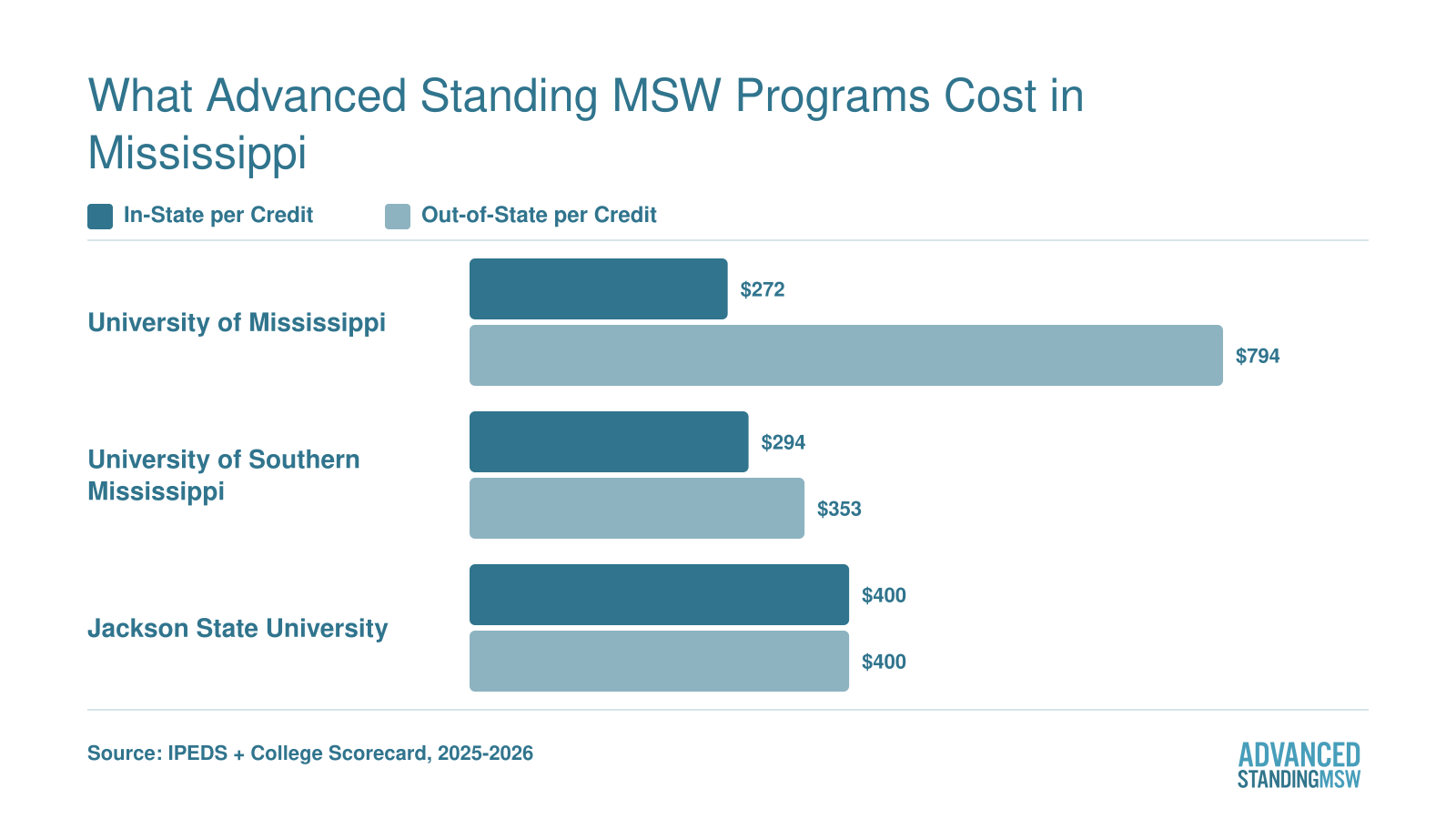
Total program cost equals credits multiplied by the per-credit rate, plus any mandatory fees. But sticker price rarely tells the full story. After institutional aid, grants, and scholarships, the net price students actually pay is typically thousands of dollars lower. The table below compares published per-credit tuition at each Mississippi school offering an advanced standing MSW. Keep in mind that the University of Southern Mississippi charges a single rate regardless of residency, while the University of Mississippi and Jackson State University differentiate between in-state and out-of-state students.
Paying for Your MSW: Financial Aid and Assistantships
Paying for your advanced standing MSW in Mississippi should not mean taking on overwhelming debt when multiple funding streams can cover most of your costs. The accelerated timeline itself is a financial advantage: shaving a full year off your program reduces tuition, fees, and living expenses by thousands of dollars compared to the traditional two-year route.
Federal Loans and Grant Eligibility
Start with the Free Application for Federal Student Aid (FAFSA), which unlocks Federal Direct Stafford Loans and Graduate PLUS Loans. Graduate students typically qualify for up to $20,500 per year in unsubsidized Stafford loans, with PLUS loans covering any remaining cost of attendance. While loans are the backbone, Pell Grant eligibility does not extend to graduate study, but looking at the share of undergraduates receiving Pell Grants on a campus can be a useful affordability proxy. Several Mississippi MSW programs sit at institutions where Pell participation is high, signaling a culture of support for students from lower-income backgrounds.
Assistantships and Title IV-E Stipends
Graduate assistantships are the hidden gem of MSW funding. Most Mississippi programs offer paid positions that include a tuition waiver and a monthly stipend. These range from research roles to administrative support within the social work department, and they often align with your field placement schedule. The Title IV-E Child Welfare Stipend Program is even more targeted and widely available in Mississippi. If you commit to work in public child welfare after graduation, this stipend can cover your full tuition and fees, and provide a living allowance. For advanced standing students, the one-year program length means a shorter post-graduation service commitment, making the math especially attractive.
Loan Repayment and Forgiveness Programs
Beyond upfront aid, look to loan repayment assistance. The National Health Service Corps (NHSC) offers up to $50,000 in loan repayment for clinical social workers who serve in designated Health Professional Shortage Areas, many of which are in rural Mississippi. The state also participates in loan forgiveness programs for social workers in underserved communities and public service roles. When you combine these with the reduced borrowing that advanced standing permits (median debt among advanced standing graduates tends to sit well below that of two-year MSW completers), you leave with a degree that pays itself back sooner.
Mississippi counted 4,353 licensed social workers in FY2025, with a projected need for 4,570 by FY2026, while the U.S. Bureau of Labor Statistics projects 6 percent national employment growth for social workers from 2024 to 2034.
Field Placement Hours and What to Expect as an Advanced Standing Student
At Jackson State University, advanced standing MSW students complete 450 field hours according to the 2025-2026 MSW Program Manual1, compared to 900 clock hours for the traditional two-year track1. That is a full 450-hour reduction, which reflects the credit Mississippi programs give BSW graduates for the foundation-year practicum they have already logged. Note that older JSU licensure paperwork lists 500 hours for advanced standing students, so if you see conflicting figures across university documents, defer to the current program manual.
How Mississippi Programs Compare
Requirements vary by school. The University of Southern Mississippi requires 600 field instruction hours for advanced standing students per its Academic Bulletin3, structured as two concurrent 300-hour internships on a 34-hour weekly model. Its standard 60-credit track requires 900 hours3. Requirements at Mississippi State, Mississippi Valley State, and the University of Mississippi should be confirmed directly with each program's field office, as published field-hour totals for advanced standing tracks were not available at the time of writing.
Placement Logistics for Online and In-State Students
Field offices at Mississippi MSW programs typically work with students to arrange placements in or near their home communities, which is especially important if you are enrolled online or living outside the immediate Jackson or Hattiesburg areas. You do not relocate to complete your practicum. You do complete a placement agreement, and the field office vets the site and the on-site supervisor.
Where Mississippi Students Get Placed
Common placement settings across the state include:
- Mississippi Department of Child Protection Services and DHS offices: child welfare casework, family services, adult protective services.
- Community mental health centers: the 14 regional CMHCs across Mississippi provide clinical placements with diverse populations.
- Hospitals and health systems: medical social work, discharge planning, behavioral health units.
- K-12 school districts: school social work, student support services, IEP teams.
- Nonprofit and community-based agencies: substance use treatment, domestic violence services, veterans programs.
Hours That Count Toward Licensure
Field hours completed during your MSW are not just an academic requirement. They also feed directly into the supervised experience narrative you will present to the Mississippi Board of Examiners for Social Workers and Marriage & Family Therapists when you sit for the LMSW exam. After licensure as an LMSW, you will accumulate additional supervised clinical hours to qualify for the LCSW, but your MSW field placement is the foundation the board expects to see documented on your application.
The LMSW and LCSW Licensure Path in Mississippi
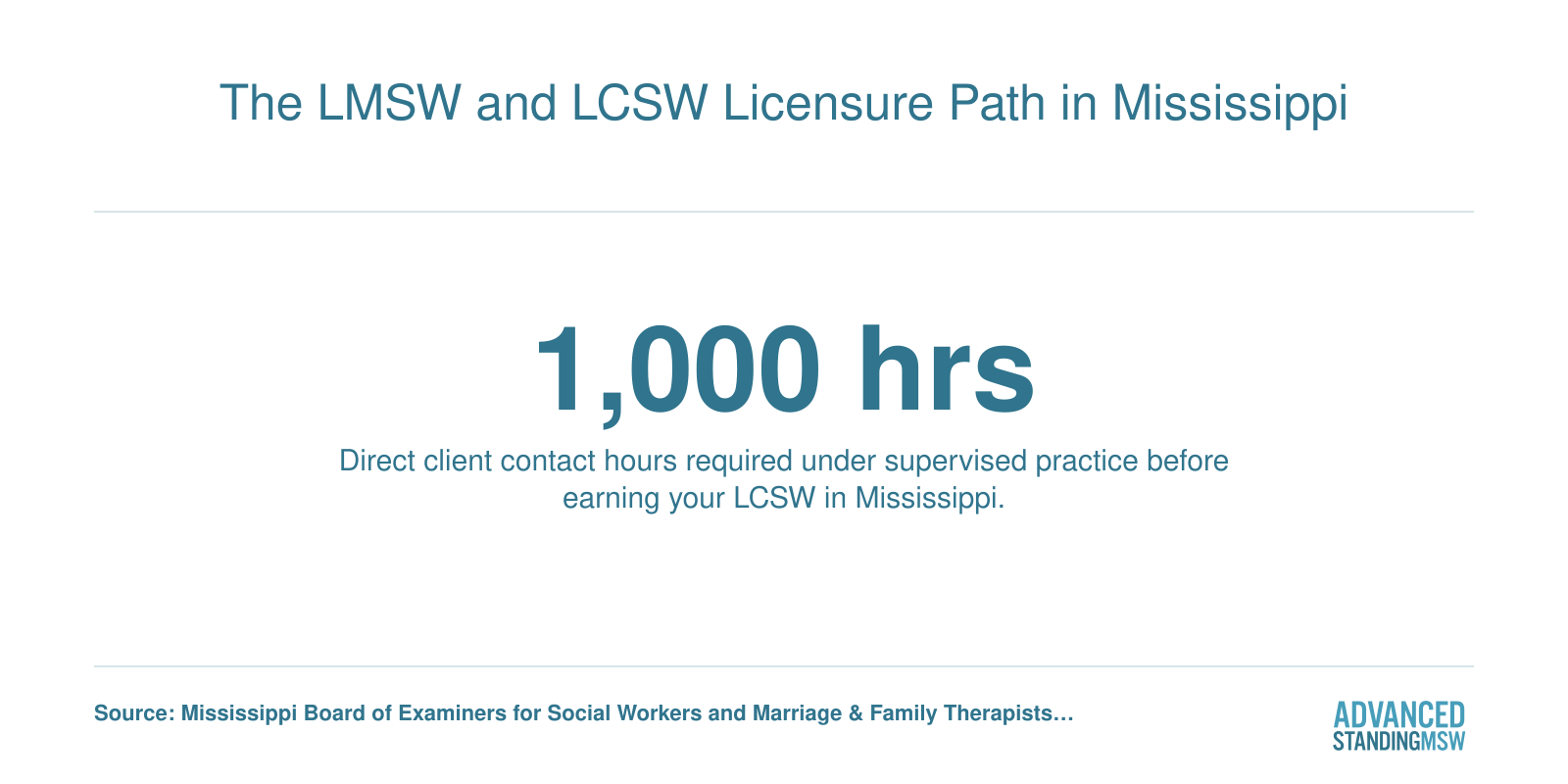
After completing your advanced standing MSW, Mississippi offers a clear two-tier licensure ladder. First, you earn your LMSW by passing the ASWB Master's exam and submitting a $110 application to the Mississippi Board of Examiners for Social Workers and Marriage & Family Therapists. To advance to the LCSW, you must hold an active LMSW in good standing, pass the ASWB Clinical exam, and complete a Board-approved supervision period of at least 24 months (with a maximum window of roughly 30 months). During that time you must log 1,000 hours of direct client contact and 100 hours of clinical supervision, with formal evaluations at approximately six-month intervals. You will also need at least one reference from a licensed clinical social worker who is not your supervisor. The upgrade application fee from LMSW to LCSW is $32, plus a $50 background check fee. Mississippi-specific ASWB pass-rate data is not publicly reported by the Board at this time.