What you’ll learn in this article…
- Advanced standing MSW programs in Minnesota can be completed in roughly 9 to 12 months.
- GPA minimums range from 2.75 to 3.0, and BSW recency windows span 7 to 10 years.
- Minnesota's three-tier licensure ladder starts at LGSW immediately after graduation.
An advanced standing MSW in Minnesota typically requires just 30 credits, cutting the coursework of a traditional master's program in half. BSW graduates must weigh that time savings against wide variation in field requirements, licensure outcomes, and post-grad earnings.
Admission hinges on a BSW earned within the last seven to ten years, adding a hard cutoff to an already narrow field.
Fewer than ten CSWE-accredited programs deliver these accelerated tracks, with online, hybrid, and campus options that make geography less of a barrier than program selectivity.
The state's LGSW credential demands a degree from one of these programs, so your choice directly shapes your licensing path and first job prospects.
Minnesota's Top Advanced Standing MSW Programs, Ranked
Minnesota holds more advanced standing MSW options than many BSW graduates expect, with programs spread from the Twin Cities to Duluth, Moorhead, Mankato, and Winona. We evaluated Minnesota's CSWE-accredited advanced standing MSW options on affordability, graduate outcomes, and delivery flexibility, then ranked the strongest fits for graduates who want an accelerated route into clinical social work. One caution: the net price figures on each card are institution-level averages after financial aid, not guaranteed quotes for any individual student.
- Affordability after financial aid
- Graduate earnings and debt
- Graduation and retention rates
- Program delivery flexibility
- Field and licensure preparation
- College Scorecard graduate earnings — collegescorecard.ed.gov
- NCES-IPEDS federal institutional data — nces.ed.gov
- Internal program database
- Independent program research
| Rank | School | Location | Net price | Best for | |
|---|---|---|---|---|---|
| #1 | University of St Thomas | Saint Paul, MN | $29,000/yr | Aspiring LICSWs seeking structured clinical training | |
St. Thomas anchors its advanced standing curriculum in clinical social work, with a faculty where 90 percent hold clinical licenses and a field network of more than 200 practicum sites. Students can layer on Areas of Emphasis in immigrant and refugee practice or older adult practice, and a dual MSW and LADC licensure pathway is also available. Graduates leave positioned for LICSW licensure, supported by an alumni network of more than 2,500 clinically prepared social workers.
| |||||
| #2 | Bethel University | Saint Paul, MN | $29,000/yr (net price) | Faith-based learners wanting online flexibility | |
Bethel's advanced standing format compresses the MSW into 12 months and 36 credits, centered on justice-informed clinical practice with a sustained focus on trauma, mental health, and crisis intervention. The program deliberately integrates faith and social justice, including coursework that touches on theodicy and liberation theologies, an angle rare among Minnesota options. A capstone seminar and 500 field practicum hours round out the experience, and the emphasis on antiracism, equity, and inclusion prepares graduates for healthcare, child welfare, and community organizations.
| |||||
| #3 | University of Minnesota-Duluth | Duluth, MN | $15,000 – $20,000/yr | Child welfare concentrators interested in American Indian services | |
UMD's advanced standing track delivers an advanced generalist MSW in 12 months, preparing graduates for careers as therapists, case managers, community organizers, and administrators. Students can concentrate in child welfare, clinical social work, or macro community-based practice, and the program carries a distinctive focus on American Indian social services. With more than 200 agency partnerships, small classes, and individualized faculty mentorship, the program reports that more than half of students receive scholarships. It is structured to serve both recent BSW graduates and social workers returning after time in the field.
| |||||
| #4 | Saint Mary's University of Minnesota | Winona, MN | $12,000/yr (net price) | ||
Saint Mary's builds its advanced standing curriculum around clinical practice, preparing students to assess and diagnose mental health conditions and work with individuals, couples, and families. A dedicated field placement coordinator arranges the clinical practicum near where the student lives, and an optional Addiction Studies Certificate adds a specialization layer. The track is open to applicants regardless of where they live, though a BSW earned more than ten years ago typically requires additional coursework for advanced standing entry.
| |||||
| #5 | Winona State University | Winona, MN | $18,000/yr | ||
Winona State centers its advanced standing curriculum on trauma-informed practice, with coursework on mental illness, social injustice, and human behavior alongside critical thinking and supervisory skills. Students complete 600 clinical hours through practicum placements supported by more than 140 partner agencies, and seven-week course blocks keep the program structured and efficient. Graduates are positioned for LICSW licensure and careers as clinical social workers, mental health therapists, or school social workers. One admissions constraint to know: the advanced standing path requires a BSW conferred within the last seven years.
| |||||
| #6 | St Catherine University | Saint Paul, MN | $15,000 – $20,000/yr | ||
St. Kate's frames advanced standing study around justice-oriented clinical practice, blending clinical theory, social policy, and advocacy. Fieldwork draws on more than 200 partner agencies serving children, families, immigrants, and refugees, and evening classes make the program workable for students with day jobs. A dual degree option with Holistic Health Studies adds a distinctive pathway, and the program is open to all genders.
| |||||
| #7 | Minnesota State University-Mankato | Mankato, MN | $10,000 – $19,000/yr | ||
Mankato's advanced standing route uses an Advanced Generalist framework, equipping graduates for direct clinical practice and leadership roles in public agencies, medical centers, behavioral health clinics, and schools. A fall-start cohort model with small classes and close faculty mentorship gives the program a focused, collaborative feel, and the curriculum includes a preparation seminar built specifically for advanced standing students. The degree leads to LGSW licensure eligibility, and applicants must document relevant experience as part of the admissions process.
| |||||
| #8 | Minnesota State University Moorhead | Moorhead, MN | ~$18,000/yr (est.) | ||
Moorhead's program stands out for its two specializations, Multicultural Clinical and Social Change and Leadership, which are unique within the Minnesota State system. Coursework spans mental health, substance abuse, child and family services, geriatrics, and policy, preparing graduates for healthcare, school, and community organization roles. A cohort model pairs students with a faculty advisor and mentor, and the program reports median graduate earnings around $67,000.
| |||||


Accelerated MSW, One-Year MSW, Advanced Standing: The Same Program
If you have already read through the ranked Minnesota programs above, you likely noticed a mix of labels: some programs call it an Advanced Standing MSW, others an Accelerated MSW, and a few simply the One-Year MSW. These are not separate degrees or different pathways. They are the same accelerated route built specifically for applicants who hold a CSWE-accredited BSW program.
Same Shortcut, Different Names
All of these names describe the same structural advantage. Because you completed foundational coursework during your BSW, you skip the generalist year of a traditional MSW and move directly into the advanced curriculum. This is what makes a one-year timeline possible. The terminology varies by school. While the list above shows the exact program names used across Minnesota, the practical meaning is consistent: you complete roughly 30 to 39 credits instead of the 60 credits required in a standard two-year MSW.
A common point of confusion: some schools use "accelerated MSW" to describe a fast-paced program for career changers who did not study social work at the undergraduate level. That is not the same as advanced standing. For Minnesota's advanced standing options, the eligibility requirement remains a CSWE-accredited BSW, typically earned within the last five to seven years, depending on the institution.
What Does Not Count as Advanced Standing
A bachelor's in psychology, sociology, human services, or any other non-social-work field does not qualify for advanced standing, even if the content seems related. Similarly, a BSW from a program not accredited by the Council on Social Work Education (CSWE) will not make you eligible. If your BSW is older than the program's recency limit, you would need to apply to the traditional MSW route instead.
Credit and Timeline Savings
The practical difference is substantial. Traditional MSW students complete about 60 credits across two years of full-time study, including a foundational placement. Advanced standing students enter with roughly half the coursework already satisfied, cutting the total to around 30 to 39 credits and a completion window of about 12 months. The exact credit load and number of semesters vary slightly among Minnesota programs, but the one-year accelerated structure holds true for all of them.
Frequently Asked Questions About Advanced Standing MSW in Minnesota
BSW graduates exploring the advanced standing MSW pathway in Minnesota often ask the same core questions about timelines, cost, and format. Below are concise, data-backed answers to help you compare your options.
- How long does an advanced standing MSW take in Minnesota?
- Most full-time advanced standing MSW programs in Minnesota can be completed in about 12 to 13 months. The University of Minnesota Twin Cities and the University of Minnesota Duluth each require 34 credits and offer a 12-month full-time track. Augsburg University's 37-credit program takes roughly 13 months full-time or about 26 months part-time. UMD and St. Catherine University also offer part-time formats, although precise part-time timelines vary.
- What is the cheapest advanced standing MSW program in Minnesota?
- Based on published tuition figures, St. Cloud State University and Minnesota State University Mankato are among the most affordable options, with in-state tuition ranging from $10,449 to $10,924 for the program. St. Catherine University advertises a total program cost of approximately $25,080 for its 33-credit advanced standing track, which may be competitive once you factor in financial aid and credit load.
- Which Minnesota schools offer fully online advanced standing MSW programs?
- Saint Mary's University of Minnesota offers a fully online advanced standing MSW that can be completed in one year. Minnesota State University Moorhead and Winona State University also deliver their programs in an online format. If you prefer a hybrid model with limited on-campus sessions, the University of Minnesota Duluth and Augsburg University are strong choices, blending online coursework with periodic in-person meetings.
Credits, Tuition, and Completion Time: A Side-By-Side Look
This table gives you the clearest possible comparison of what each Minnesota advanced standing MSW program will cost, how many credits you need, and how quickly you can finish. Public universities (marked below) generally offer lower in-state tuition, while private institutions charge a flat rate regardless of residency. Few competitors publish this data in one place, so bookmark this for your decision-making process.
| School | Sector | Total Credits | Per-Credit Tuition (In-State / Out-of-State) | Estimated Total Tuition | Full-Time Completion | Part-Time Option |
|---|---|---|---|---|---|---|
| Minnesota State University Mankato | Public | 34 | $307 / $588 per credit | $10,449 / $19,989 | 4 semesters (about 12 months) | No |
| Minnesota State University Moorhead | Public | 34 | $350 / $350 per credit | $11,902 / $11,902 | 4 semesters (about 12 months) | No |
| St. Cloud State University | Public | N/A | $321 / $321 per credit | $10,924 / $10,924 | N/A | Yes |
| Winona State University | Public | N/A | N/A | $10,886 / $15,953 | N/A | N/A |
| University of Minnesota Duluth | Public | 34 | $636 / $967 per credit | $21,630 / $32,862 | About 12 months | Yes |
| University of Minnesota Twin Cities | Public | 34 | N/A | N/A | N/A | N/A |
| St. Catherine University | Private | 33 | $760 / $760 per credit | Approximately $25,080 | 1, 2, or 3 years | Yes |
| Augsburg University | Private | 37 | $372 / $372 per credit | $13,766 / $13,766 | 13 months | Yes (about 25 months) |
| Saint Mary's University of Minnesota | Private | 30 | $925 / $925 per credit | $12,474 / $12,474 | About 12 months | Yes |
Questions to Ask Yourself
Field Placement Hours at Each Minnesota Program
Advanced standing MSW students in Minnesota complete significantly fewer field placement hours than their traditional-track counterparts: a tangible advantage that saves both time and tuition. Because BSW graduates already logged 400-plus hours of supervised practicum during their undergraduate program, most Minnesota MSW programs waive the foundation-year field requirement, allowing students to move directly into the concentration-level placement.
Advanced Standing Field Placement Requirements
The exact number of field hours varies by program, and not all schools publish every detail online. Below is a consolidated look at what each CSWE-accredited advanced standing MSW program in Minnesota requires, based on the most current publicly available data. When information on employment-based placements or evening/weekend scheduling is absent, that means the program has not disclosed it in their official materials; prospective students should contact the program directly.
- University of Minnesota Twin Cities: 600 hours. The program does not explicitly state whether employment-based placements are accepted, nor does it detail evening or weekend placement availability; inquire with the field education office.
- St. Catherine University: 600 hours (note: one university webpage cites 500 hours, creating internal inconsistency; always call to confirm). Employment-based and scheduling flexibility data are not published.
- Minnesota State University Moorhead: The advanced standing curriculum includes 10 credit hours of practicum and seminar combined. The school does not convert this to a specific clock-hour figure on its website; based on typical credit-to-hour ratios in social work education, this often translates to approximately 450-500 field hours, but only the program can confirm the exact number. Employment-based and after-hours placement information is not publicly disclosed.
- University of Minnesota Duluth and Augsburg University: Neither program publishes advanced standing field hour totals as of this writing. Contact the MSW program coordinators directly for up-to-date details.
Why Advanced Standing Students Complete Fewer Hours
Traditional MSW students must accumulate 900 or more field hours across foundation and concentration placements. Advanced standing students bypass the foundation placement entirely because their CSWE-accredited BSW practicum satisfies that requirement. This typically cuts field hours by 400 or more, meaning students can graduate faster and begin licensure supervision sooner.
What Employers and Licensure Boards Expect
Minnesota's LGSW and LICSW pathways do not differentiate between advanced standing and traditional MSW graduates; both streams lead to the same credentials. Employers focus on your degree and licensure status, not how many field hours you completed. The key is confirming your program’s field placement structure aligns with your schedule and career goals, particularly if you need an evening or weekend placement or want to use your workplace as your practicum site.
Online, Hybrid, and Campus Formats Across Minnesota MSW Programs
Choosing the right delivery format is one of the most consequential decisions BSW graduates face when selecting an advanced standing MSW program in Minnesota. The state offers a genuine spread of options, from fully online programs you can complete from anywhere to traditional campus cohorts that meet in person every week. Understanding what each label actually means in practice will help you match a program to your schedule, location, and learning style.
| School | Format | What That Looks Like in Practice | Accessible Out of State? | Format Differences vs. Traditional Track |
|---|---|---|---|---|
| Bethel University | Fully Online | 100% online coursework with asynchronous delivery. Field placements are arranged in your local community through the university's field coordinator. No campus visits required. | Yes | The advanced standing track follows the same fully online model used for the traditional MSW, though it is completed in roughly 12 months instead of two years. |
| Saint Mary's University of Minnesota | Fully Online | Combines synchronous live sessions with asynchronous modules, giving students flexibility across three annual start dates. Field work is coordinated near the student's home. | Yes | Both the advanced standing and traditional MSW tracks are delivered online, with the advanced standing path requiring only 30 credits. |
| Winona State University | Fully Online | Asynchronous online classes structured in 7 week course blocks. Clinical field hours (600 total) are completed locally. No on campus residency is required. | Yes | The same asynchronous online format applies to both advanced standing and traditional MSW students, though advanced standing students move through fewer course blocks. |
| Minnesota State University Moorhead | Fully Online | Described as a flexible "online plus" model, coursework is delivered online with faculty advising and mentorship built in. Field placements are arranged in the student's region. | Yes | Advanced standing students enter the same online platform as traditional MSW students but follow an accelerated course sequence. |
| University of St. Thomas | Hybrid | Students choose between two learning modalities: hybrid or fully in person. The hybrid option blends online coursework with scheduled on campus sessions at the Saint Paul campus. Over 200 field practicum sites are available. | Limited (campus components required) | The advanced standing MSW offers the hybrid option, while the traditional track may have different scheduling structures. Both share the same practicum network. |
| University of Minnesota Duluth | Hybrid | Classes meet on campus one day per week (Thursdays and Fridays), with the remainder of coursework completed remotely. Full time and part time pacing are both available. | No (weekly campus attendance required) | The hybrid format is consistent across advanced standing and traditional tracks, though advanced standing students complete 34 credits in about 12 months. |
| St. Catherine University | Campus Only | All coursework is delivered on the Saint Paul campus in evening class sessions. Students complete 500 clinical hours at one of over 200 fieldwork settings. | No | Advanced standing students attend the same campus based evening classes as traditional MSW students but can finish in as few as one year rather than two or three. |
| Minnesota State University, Mankato | Campus Only | In person classes on the Mankato campus with a cohort model designed for smaller class sizes. The program starts only in fall, and documented work experience is required for admission. | No | Both the advanced standing and traditional MSW tracks are delivered on campus. Advanced standing students complete 34 credits in an accelerated timeline. |
Minnesota's community and social service occupations, which include social workers, are projected to grow about 4.0 percent from Q2 2025 to Q2 2027, according to the Minnesota Department of Employment and Economic Development. That's roughly in line with the national outlook, where the Bureau of Labor Statistics projects 6 percent growth for social workers through 2034, signaling steady demand for MSW graduates.
BSW Eligibility Windows and GPA Minimums for Minnesota Programs
One of the most overlooked factors in choosing an advanced standing MSW program is the BSW recency window, which determines how recently you must have earned your BSW to qualify. Across Minnesota, these windows range from 7 to 10 years, and some programs do not publicly state a cutoff at all. The table below consolidates minimum GPA requirements, recency limits, prerequisite expectations, and available start term information so you can compare programs at a glance. Where a program has not published specific details, we note that clearly rather than guess.
| School | Min GPA | BSW Recency Window | Prerequisites | Application Deadline | Start Terms |
|---|---|---|---|---|---|
| University of Minnesota Twin Cities | Not publicly stated | 7 years | Generalist curriculum waived for advanced standing; a proficiency exam or an Advanced Standing Generalist Social Work Review course may be required | Not publicly stated | Not publicly stated |
| University of Minnesota Duluth | 3.0 | Not publicly stated | At least 6 credits in social sciences | Not publicly stated | Not publicly stated |
| Saint Catherine University | 2.75 | 10 years | If BSW is older than 10 years, four generalist courses may be required before clinical coursework: Generalist Practice I and II, and Human Behavior in the Social Environment (HBSE) I and II | Not publicly stated | Not publicly stated |
| Minnesota State University Moorhead | 3.0 | Not publicly stated | Not publicly stated | Not publicly stated | Not publicly stated |
| Augsburg University | Not publicly stated | Not publicly stated | At least one year of post BSW full time practice is required if not otherwise documented; no prerequisite course list is stated | Not publicly stated | Not publicly stated |
Earnings and ROI After an Advanced Standing MSW in Minnesota
Where Do Earnings Data Stand?
Federal earnings data for advanced standing MSW graduates in Minnesota are not yet published. While standard metrics like median earnings one, two, and four years after completion exist for many undergraduate programs, the specialized advanced standing MSW track often falls outside standard reporting windows or has insufficient sample sizes. Prospective students should keep this data gap in mind: the absence of published earnings does not signal poor outcomes. The data is simply still maturing.
ROI Ratios Point to Strong Returns
Even without precise dollar figures, the return on investment ratio (earnings-to-debt) offers a reliable snapshot. Across Minnesota's advanced standing MSW programs, every school posted a ratio above 2.5, meaning graduates' earnings quickly outpace their loan balances. The University of Saint Thomas leads with the highest ratio, followed closely by Bethel University and the University of Minnesota Duluth. Winona State, Saint Mary's, Minnesota State Mankato, St. Cloud State, and Minnesota State Moorhead all deliver ratios that signal a master's degree worth the financial commitment.
Debt Burden: Public vs. Private Programs
Median federal loan debt for advanced standing MSW graduates ranges from about $20,000 to $23,250. Private institutions, such as the University of Saint Thomas, Bethel, and Saint Mary's, see slightly higher debt medians, though the difference is narrow. Public universities like Winona State, Mankato, St. Cloud State, and Minnesota State Moorhead cluster in the $20,000 to $22,000 range. These figures reflect the trimmed credit requirements of advanced standing (typically 30-36 credits instead of 60) and the comparatively lower in-state tuition at public schools. With monthly payments often under $250 on a standard 10-year plan, graduates can manage debt while entering a field with strong licensure and earning trajectories.
Fewer Credits, Lower Debt for Advanced Standing Students
Advanced standing students bypass foundational coursework, shaving a full year or more off the program length. That directly reduces tuition bills and living expenses, which in turn lowers overall borrowing. Combined with Minnesota's relatively affordable public tuition rates, this structure makes the advanced standing MSW one of the most cost-effective ways to enter clinical or macro social work practice. For BSW holders weighing next steps, the financial math is compelling: a debt-to-income ratio that stays manageable from the start of their career.
Minnesota Social Work Licensure: LGSW to LICSW
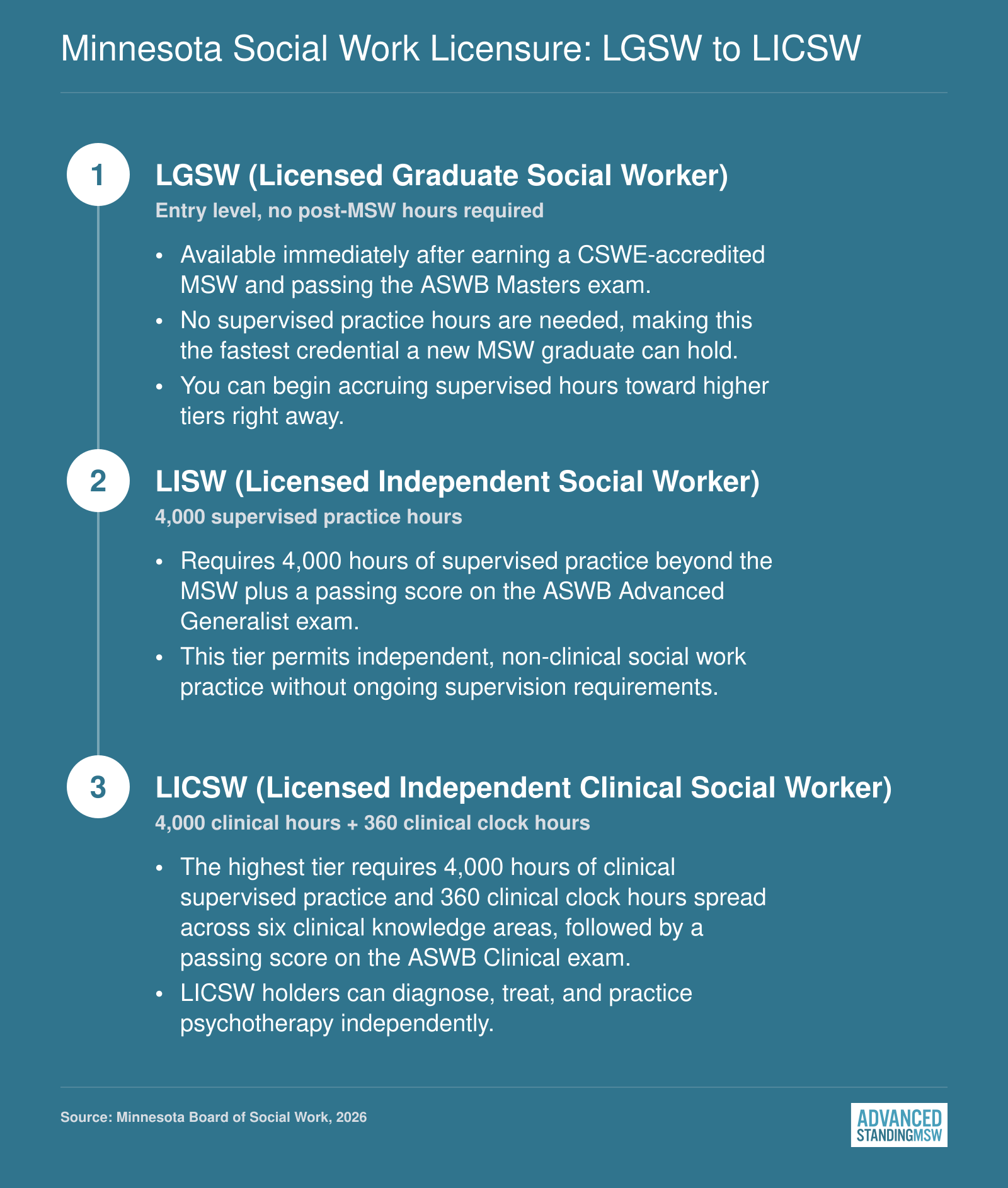
Minnesota uses a three-tier licensure system administered by the Minnesota Board of Social Work. The pathway begins the moment you finish your advanced standing MSW and scales through progressively independent practice levels. Every tier requires its own ASWB exam, and all licensed social workers must complete 40 hours of continuing education every two years.
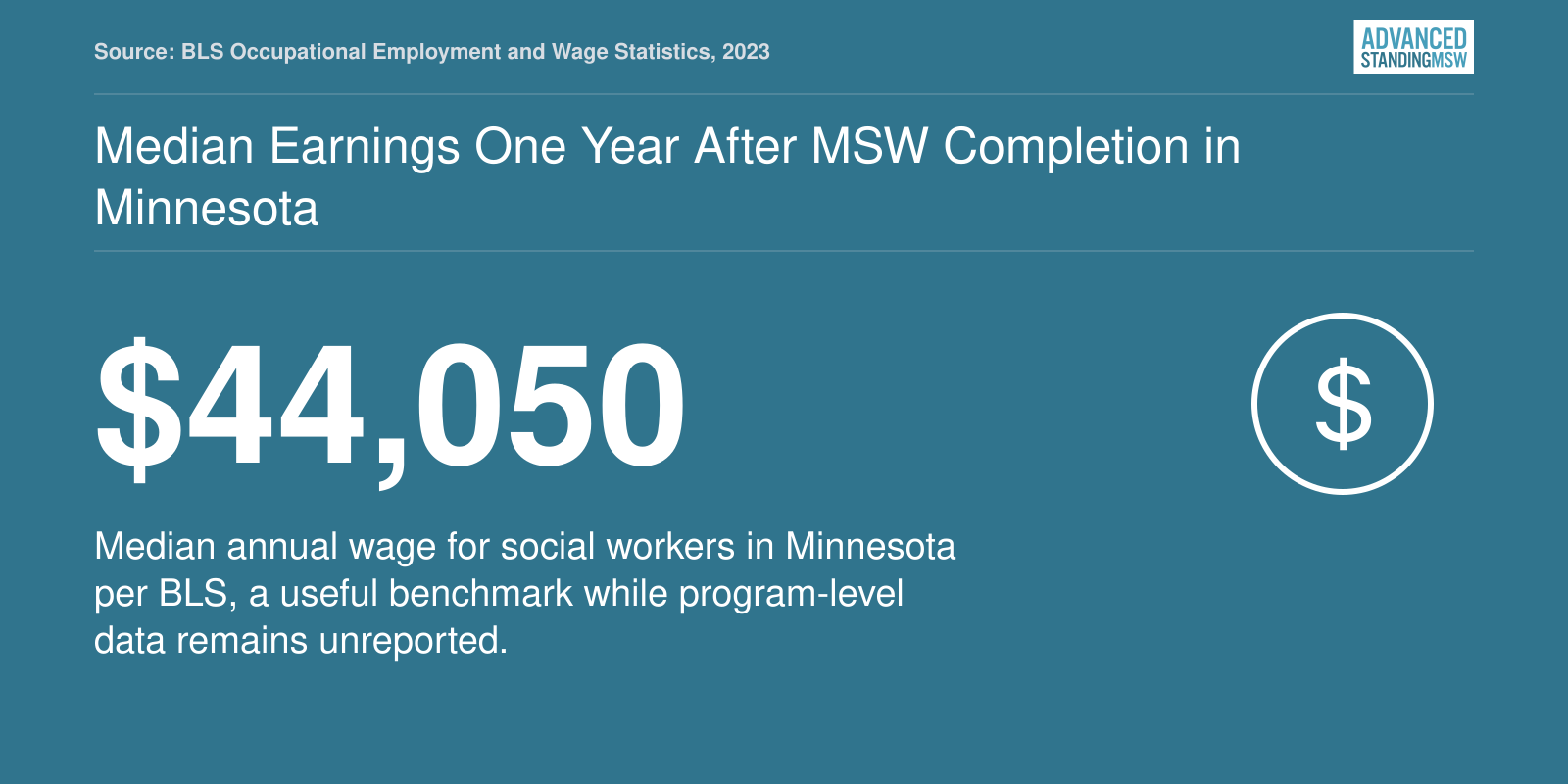
Median Earnings One Year After MSW Completion in Minnesota
Program-level median earnings one year after completion are reported through the College Scorecard for individual MSW programs. However, one-year post-completion earnings data for Minnesota's advanced standing MSW programs are not currently published at the program level. As updated figures become available, this section will reflect a side-by-side comparison so you can weigh the return on your accelerated investment.