What you’ll learn in this article…
- In-state advanced standing tuition in Maryland starts around $9,900 total.
- Three CSWE-accredited programs offer hybrid or fully online formats statewide.
- Social work employment is projected to grow 6 percent through 2034.
Maryland BSW graduates weighing an advanced standing MSW face a real tradeoff: the fastest, cheapest route may not match the concentration, format, or licensure pathway you actually need. Three CSWE-accredited Maryland programs offer this accelerated track, with credit requirements ranging from 32 to 36 credits and in-state tuition landing between roughly $9,900 and $17,800.
Format is where the programs diverge most sharply. One anchors students at a research university with hybrid coursework, another runs fully online with a social justice concentration, and a third caters to military-connected and global learners at a lower per-credit rate. GPA floors sit at 3.0 across the board, and most schools require a BSW earned within the last five years, a recency rule that quietly disqualifies many otherwise eligible applicants.
Maryland Advanced Standing MSW Programs, Ranked by Cost and Outcomes
Maryland offers three practical advanced standing MSW routes for BSW graduates: a hybrid option anchored at a research university, a fully online track with a social justice focus, and an affordable online pathway designed for global and military-connected students. Graduation and earnings figures cited here come from institution-level federal reporting, so use them as directional context rather than MSW-specific guarantees. Start with the factors that matter most to you: total cost, completion profile, and the flexibility of the delivery format.
- Degree-aware tuition costs
- Institution-wide graduation rates
- Program-level median earnings
- Delivery format flexibility
- Independent program research
- College Scorecard graduate earnings — collegescorecard.ed.gov
- NCES-IPEDS federal institutional data — nces.ed.gov
- Internal program database
| Rank | School | Location | Net price | Best for | |
|---|---|---|---|---|---|
| #1 | University of Maryland, Baltimore | Baltimore, MD | Hybrid learners seeking clinical concentrations | ||
This public research university anchors one of Maryland's strongest advanced standing MSW options. Its 36-credit hybrid pathway is built for BSW graduates from CSWE-accredited programs, with online coursework and in-person sessions at two campus locations. Clinical, macro leadership, and combined concentration tracks prepare graduates for licensure and roles in healthcare, schools, community organizations, and government.
| |||||
| #2 | Morgan State University | Baltimore, MD | $10,000 – $15,000/yr | Online students prioritizing social justice practice | |
A historically Black university with a strong social justice mission, Morgan State University offers an online advanced standing MSW that pairs interactive coursework with a supportive cohort model. The accelerated pathway emphasizes advanced clinical practice and community engagement while requiring an admissions interview and recommendations from the applicant's BSW program. Graduates leave ready for clinical licensure, supervision, policy advocacy, and direct practice.
| |||||
| #3 | University of Maryland Global Campus | Adelphi, MD | $22,000/yr (net price) | Military-connected students needing flexible online study | |
With a global online footprint, University of Maryland Global Campus delivers a flexible advanced standing MSW in partnership with Salisbury University. The 32-credit clinical pathway includes online coursework, select on-site and hybrid options, and supervised field placements, making it a fit for military and civilian students stationed in Europe. Its anti-racist practice lens and evidence-based curriculum support clinical careers in private practice, healthcare, community organizations, and government.
| |||||


Online, On-Campus, or Hybrid: Choosing a Format for Your Advanced Standing MSW
Advanced standing MSW programs in Maryland compress the typical 60-plus-credit traditional MSW into roughly 30 to 42 credits, but the way you experience those credits varies sharply by delivery format. The comparison below maps each Maryland program against the practical dimensions that matter most to working BSW graduates: how coursework is delivered, how long you should expect to be enrolled, and how field placements fit into each model. Confirm current details directly with each school, as program structures can shift between admission cycles.
| Dimension | University of Maryland, Baltimore (UMB) | Morgan State University | Salisbury University |
|---|---|---|---|
| Delivery Format | Online, hybrid, and campus options (Baltimore and Universities at Shady Grove locations) | Fully online coursework | Campus based |
| Total Credits | 36 | 30 | 32 |
| Typical Completion Timeline | Approximately 16 months (four consecutive semesters) for the online track; hybrid and campus tracks may follow a similar or slightly longer schedule | One year (full time) | Consult the program directly for the current completion timeline |
| Coursework Delivery Style | Online track uses asynchronous and synchronous online sessions; hybrid track blends in-person class meetings with online coursework; campus track is primarily face to face | Online delivery; check with the program for synchronous session requirements | In-person classroom instruction |
| Field Placement Structure | All tracks require in-person, site-based practicum hours regardless of coursework format | 624 hours of site-based field education completed at approved agency placements | 8 credits of supervised field practicums completed at approved sites |
| Online Availability for Clinical Concentration | Yes, the online track is currently offered for the Clinical concentration only | The program is delivered online; verify available concentrations with Morgan State | Not applicable (campus only) |
| Best Fit For | Students who want format flexibility and access to multiple concentrations, or who live near Baltimore or Shady Grove | BSW graduates seeking the shortest credit load and a fully online classroom experience while completing local field hours | Students who prefer a traditional, fully in-person learning environment on Maryland's Eastern Shore |
Tuition and Affordability: What an Advanced Standing MSW Costs in Maryland
The price tag for an advanced standing MSW in Maryland can vary significantly depending on the institution and your residency status. Among the programs listed below, in-state tuition ranges from roughly $9,900 to just under $10,000, but out-of-state costs can nearly double at some schools. Keep in mind that the net price figures shown are institution-wide averages after financial aid, so your individual cost will depend on your aid package, enrollment status, and eligibility for program-specific funding. Maryland BSW graduates should also explore the state's Graduate and Professional Scholarship Program (effective July 1, 2026), Title IV-E child welfare stipends administered through university and county partnerships, and school-based fellowships. At UMB, for example, scholarships for MSW students typically range from $2,000 to $4,000, while specialty fellowships such as the BHWISE-SUDWE award offer stipends up to $15,000 for advanced standing students in qualifying concentrations. Salisbury University lists social work scholarships starting at $600 and reaching $1,200 for full-time MSW students. The Maryland Department of Human Services has also offered a Human Services Careers Scholarship covering 100% of tuition for students pursuing high-demand human services credentials, though application availability varies by cycle.
| School | Format | In-State Tuition | Out-of-State Tuition | Institution-Wide Average Net Price |
|---|---|---|---|---|
| Morgan State University | Online | $9,981 | $18,207 | $14,985 |
| University of Maryland Global Campus (UMGC) | Online | $9,882 | $12,132 | $22,063 |
Related Articles
Admissions Checklist for Maryland Advanced Standing MSW Programs
Before you start any application, gather every document and confirm each school's specific requirements. Advanced standing admissions criteria overlap considerably across Maryland programs, but the details, GPA thresholds, recency windows, and deadlines, can differ enough to trip you up. Use this checklist as your baseline, then verify directly with each program.
- BSW from a CSWE-accredited program within the recency windowEvery advanced standing MSW program in Maryland requires a Bachelor of Social Work from a CSWE-accredited institution. The recency window varies by school. At the University of Maryland, Baltimore, your BSW must have been earned within five years of your intended enrollment. Morgan State University and Salisbury University also offer advanced standing pathways, but their specific recency requirements should be confirmed directly with each program's admissions office.
- Minimum GPA, typically 3.0, but confirm per programA 3.0 cumulative GPA on a 4.0 scale is the standard threshold. The University of Maryland, Baltimore requires a 3.0 overall and a 3.0 in your last 60 undergraduate credits. Applicants whose GPA falls just below that mark are encouraged to use an optional personal statement to address how they plan to maintain a 3.0 in the MSW program. Other Maryland schools may set their own cutoffs, so check each program individually.
- GRE status, largely waived, but always verifyMost Maryland MSW programs have dropped or waived the GRE. The University of Maryland, Baltimore does not require the exam for advanced standing applicants. GRE policies can shift from year to year, however, so confirm the current status with Morgan State and Salisbury before assuming you can skip it.
- Application deadlines, priority and finalDeadlines vary by program and by cohort start term. At the time of writing, clearly posted 2026–2027 deadlines for the University of Maryland, Baltimore's advanced standing program are not yet publicly available; check the admissions page regularly for updates. Morgan State and Salisbury deadlines should likewise be confirmed directly. Applying by a program's priority deadline can improve your chances of receiving financial aid.
- Personal statement and supporting documentsPlan to submit a personal statement that articulates your commitment to social work and your readiness for graduate study. Most programs also require two or three professional or academic letters of recommendation, a current résumé highlighting any relevant social work or human-services experience, and a field education evaluation from your BSW practicum. Some schools request transcripts from every institution you have attended, not just the one that awarded your BSW.
- Field evaluation from your BSW practicumYour BSW field placement evaluation is a critical piece of the application. Admissions committees use it to gauge your readiness for advanced clinical or macro practice. If your BSW program does not automatically provide this document, contact your former field education office early, retrieval can take weeks.
Questions to Ask Yourself
Field Education Hours: How Maryland Programs Compare
CSWE requires a minimum of 900 total field hours for the MSW degree, but advanced standing students typically complete fewer hours during their graduate program because qualifying BSW field hours transfer in. The table below compares what each CSWE-accredited Maryland program expects of advanced standing students. Where specific policies on employment-based placements have not been published or confirmed, that is noted accordingly.
| School | Advanced Standing Field Hours | Placement Type | Notes |
|---|---|---|---|
| Morgan State University | 670 hours | Not confirmed | The program requires 670 practicum hours for advanced standing students. Whether employment-based placements are accepted has not been confirmed in published materials. |
| Salisbury University | 500 hours minimum | Not confirmed | Advanced standing students must complete at least 500 field hours. The program has not publicly clarified whether employment-based placements are an option. |
| University of Maryland Baltimore | Not published | Not confirmed | The program specifies that practicum days must be at least four hours and may not exceed eight hours, but an explicit total hour requirement for advanced standing students is not stated in the current student handbook. Employment-based placement policies are also not confirmed in published sources. |
Concentrations and Specializations Across Maryland Programs
Your choice of concentration directly shapes your career trajectory, especially if you intend to pursue clinical licensure as an LCSW-C in Maryland. Advanced standing MSW programs in the state structure their curricula around distinct clinical and macro practice paths, with some offering additional specializations that let you target specific populations or settings.
Clinical and Macro Tracks by Campus
- University of Maryland, Baltimore (UMB): The Baltimore campus offers both Clinical and Leadership, Policy and Social Change (Macro) concentrations. The Shady Grove campus and online MSW provide the Clinical concentration only.1
- Morgan State University: Available information indicates two tracks: Clinical Social Work and Advocacy (clinical focus) and Social Change and Leadership (macro focus). Confirm directly with the program for the most current options.
- Salisbury University: Specific advanced standing concentration listings are not publicly detailed, so prospective students should contact the department for the latest offerings.
Specializations Within UMB's Concentrations
UMB's Clinical concentration houses four sub-specializations: Aging, Behavioral Health, Families and Children, and Health.2 The Macro concentration adds Community Action & Social Policy and Organizational Leadership to those four areas, totaling six sub-specializations. Additionally, UMB designates Areas of Specialized Practice that students can weave into their plan of study. These include School Social Work, Addictions, Gerontology, Public Health, and Urban Children, Youth, and Families.2 No new tracks for the 2026-2027 academic year have been publicly announced as of August 2026, but programs periodically update offerings, so check official sites.
Licensure Alignment
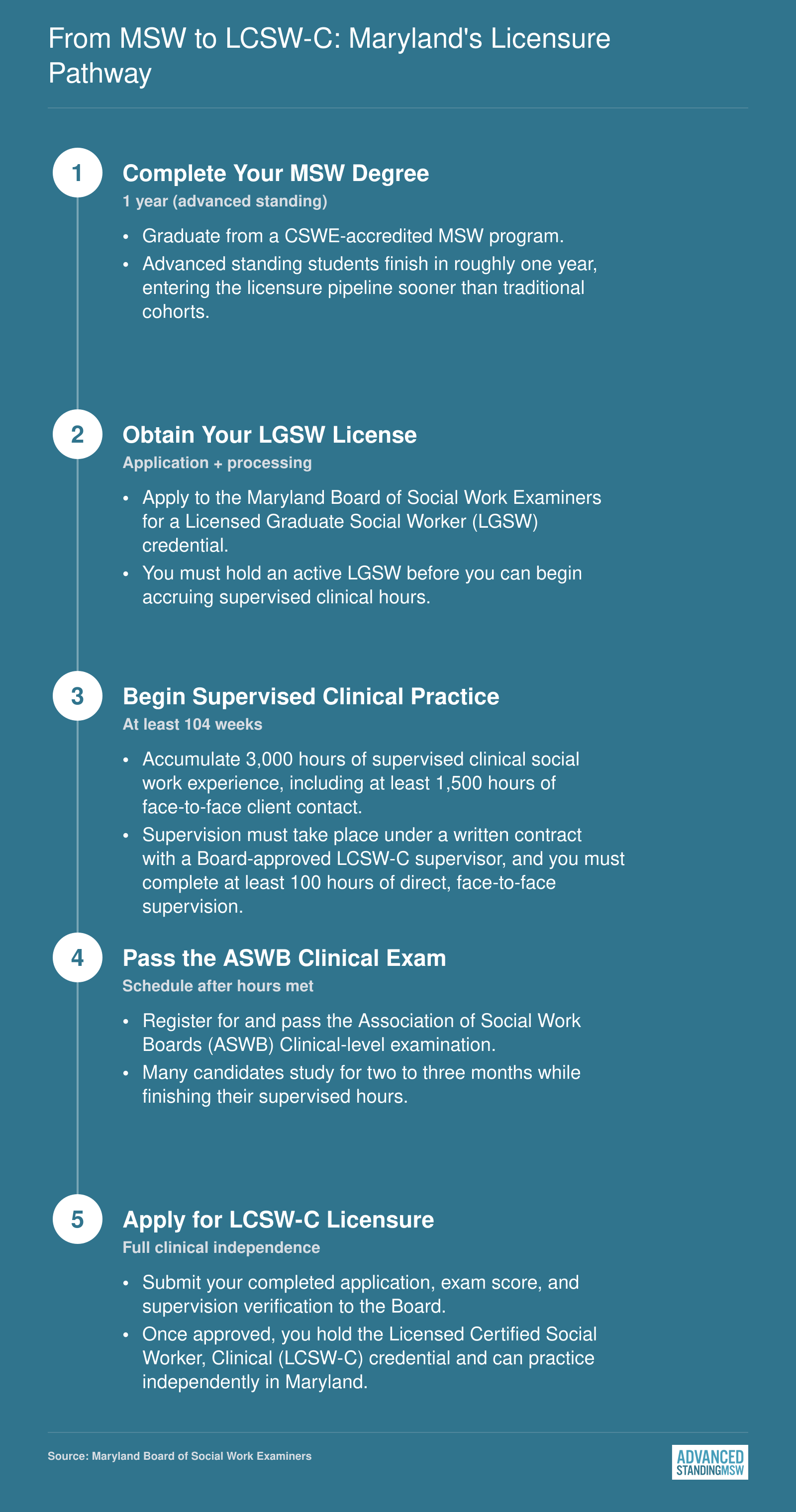
Maryland's LCSW-C credential requires clinically focused coursework and supervised post-degree practice. A clinical concentration ensures you meet the foundational educational requirements for clinical licensure. If you intend to become a Licensed Clinical Social Worker, prioritize programs with a robust Clinical track. Macro concentrations, while valuable for leadership, policy, and community organizing roles, typically do not align with the clinical licensure pathway. Research each program's MSW curriculum to verify that clinical specialization includes the diagnostic, assessment, and treatment-focused content the Maryland Board of Social Work Examiners expects for LCSW-C candidates.
From MSW to LCSW-C: Maryland's Licensure Pathway
Earning your advanced standing MSW is a major milestone, but full clinical licensure in Maryland requires a structured post-graduate journey. The path from diploma to LCSW-C follows a clear sequence set by the Maryland Board of Social Work Examiners. Plan on a minimum of two years of supervised practice after graduation before you can apply for independent clinical status.
Maryland Social Work Salaries and Career Outcomes After Graduation
Maryland's social work labor market continues to reward licensure and specialization, but new graduates must weigh early-career earnings against education debt. Program-level earnings data for advanced standing MSW graduates is not publicly available for most schools, but institutional outcome measures offer a glimpse into long-term earning potential. At the University of Maryland, Baltimore, median earnings for former students who received federal aid reach $88,174 a decade after entry, while median debt at completion sits at just $15,000. By contrast, graduates of UMGC and Morgan State report 10-year medians of $65,287 and $50,698, with median debt of $21,000 and $27,250, respectively. Early-career program-specific figures are not yet tracked, so new social workers should approach these broad, institution-wide numbers as directional guides rather than precise salary forecasts.
How Maryland's Social Worker Wages Vary by Setting and Geography
State-level data from the Maryland Department of Labor shows that child, family, and school social workers earn a median annual wage between $41,240 (10th percentile) and $105,570 (90th percentile), with 4,710 employed statewide. While metro-level breakdowns for Baltimore-Columbia-Towson and Washington-Arlington-Alexandria are not available in recent state releases, national BLS data consistently shows that urban centers pay substantially more than nonmetropolitan regions. Healthcare social workers and mental health and substance abuse social workers nationally earn medians of $71,790 and $68,030, respectively, suggesting that clinical and healthcare-focused roles in Maryland likely push toward the upper end of the state range. Social workers practicing on the Eastern Shore, where demand is high but cost of living is lower, may see starting offers closer to the 10th percentile.
The Licensure Earnings Premium: LCSW-C vs. LMSW
Clinical licensure unlocks the highest earning tier in Maryland. Licensed Certified Social Worker-Clinical (LCSW-C) designation allows independent practice, third-party insurance reimbursement, and supervision of others. While precise wage differentials are not published by license type, employers consistently price LCSW-C roles 20% to 40% above early-career Licensed Master Social Worker (LMSW) positions, which are typically supervised and limited in scope. BSW graduates who pursue advanced standing and then complete the required 3,000 hours of post-MSW supervised experience can accelerate their path to that higher earning category, often reaching it within three to four years post-graduation.
Debt-to-Earnings Reality Check
For an advanced standing MSW student, the return on investment depends heavily on net price and post-graduation salary. Morgan State's median debt of $27,250 against a $50,698 institutional median earnings yields a ratio of about 1.86, while UMB's ratio of approximately 5.88 reflects far lower debt and higher earnings. UMGC falls in between at 3.11. These ratios are based on all programs at each institution and do not isolate social work graduates, but they underscore a central truth: minimizing debt through employer tuition benefits, scholarships, or in-state tuition at public universities dramatically improves the financial upside. Early-career social workers earning $50,000-$55,000 in Maryland can service moderate debt without strain, but those who emerge with six-figure loans will feel the pinch even on LCSW-C salaries that reach $80,000 or more.
According to the Bureau of Labor Statistics, overall employment of social workers is projected to grow 6 percent from 2024 to 2034. This steady demand signals strong opportunities for advanced standing MSW graduates, including those in Maryland and the mid-Atlantic region.
Frequently Asked Questions About Advanced Standing MSW Programs in Maryland
Below are answers to the questions BSW graduates ask most often about advanced standing MSW programs in Maryland. Each response draws on current program details and tuition data discussed earlier in this guide.
- How long does it take to finish an advanced standing MSW in Maryland?
- Timelines range from about 12 to 24 months depending on the school and enrollment status. Morgan State University offers a full-time track completable in roughly 12 months, as does Salisbury University's Master of Social Work program. The University of Maryland, Baltimore (UMB) runs approximately 18 months full-time or up to 24 months part-time.3 Its online coursework option can be finished in about 16 months, though field placements remain in person.
- Can I complete an advanced standing MSW entirely online through a Maryland university?
- Not entirely. UMB offers a hybrid advanced standing MSW in which coursework can be completed online, but practicum hours must be fulfilled at an approved field site in person. Morgan State also lists an online MSW program at Morgan State, yet field education requirements still apply. If location flexibility is your priority, the hybrid model at UMB is the closest option, letting you handle most academics remotely while completing fieldwork locally.
- What GPA do I need for an advanced standing MSW program in Maryland?
- A 3.0 GPA in your BSW coursework is the commonly referenced benchmark across Maryland programs.1 That said, individual schools may weigh other factors such as practice experience, personal statements, and faculty recommendations. UMB, for example, does not publicly list a strict minimum, so applicants slightly below a 3.0 should not assume automatic disqualification. Contact your target program's admissions office for the most current expectations.
- Does my BSW have to be recent to qualify for advanced standing?
- Yes, and the window varies by school. UMB requires that your BSW was awarded within five years of your expected start date. Other Maryland programs may allow up to seven years,1 so check each school's policy directly. If your degree falls outside the accepted range, some programs offer a portfolio review or bridge coursework, but this is not universal. Timely application planning is critical.
- What is the total cost difference between in-state and out-of-state tuition for Maryland advanced standing MSW programs?
- At UMB, based on 2025 per-credit rates, the gap is significant. For the 30-credit advanced standing track, in-state tuition totals roughly $21,870 compared to about $39,210 out of state, a difference of approximately $17,340. The 36-credit hybrid track runs about $26,244 in state versus $47,052 out of state, a gap exceeding $20,800. Comparable breakdowns for Morgan State and Salisbury were not available at the time of publication.