What you’ll learn in this article…
- Eleven CSWE-accredited advanced standing MSW programs operate in Florida as of 2026.
- Full-time students can finish in roughly 9 to 15 months depending on the school.
- Net tuition varies dramatically, so comparing estimated costs across all 11 programs matters.
Florida's advanced standing MSW tracks can be completed in as few as nine months for full-time students, cutting the standard two-year degree timeline by more than half. All 11 programs listed here hold CSWE accreditation, the baseline for LCSW eligibility in the state.
Tuition across these accelerated pathways ranges from roughly $6,700 to over $35,000, and admission hinges not just on GPA and BSW recency but on nuanced prerequisites like a human biology course and a statistics grade of C or above. The real tension is not whether you can finish quickly, but whether the program's field placement structure aligns with your licensure supervision clock. A degree earned in under a year is only as valuable as the clinical hours it unlocks.
Common Questions About Florida Advanced Standing MSW Programs
Before diving into program details, here are quick answers to the questions BSW graduates ask most often about the advanced standing MSW pathway in Florida. Each topic is covered in greater depth later in this guide.
- How long does an advanced standing MSW program take in Florida?
- Most advanced standing MSW programs in Florida can be completed in roughly one year of full-time study, compared to the traditional two-year timeline. Part-time options typically stretch the program to about 18 to 24 months. Because your BSW coursework is recognized, you skip the foundation year entirely and move directly into advanced clinical or macro practice courses and field placement hours.
- What GPA is required for advanced standing MSW admission in Florida?
- GPA requirements vary by school, but most CSWE-accredited programs in Florida look for a minimum cumulative GPA of 3.0 in your BSW coursework. Some programs set the bar slightly lower (around 2.5 to 2.75) and weigh other factors such as field evaluations, professional references, and relevant work experience. Always check each program's admissions page for its specific threshold, as policies differ.
- Does an advanced standing MSW qualify you for LCSW licensure in Florida?
- Yes. Florida's Board of Clinical Social Work accepts any CSWE-accredited MSW, including advanced standing degrees, to satisfy the educational requirement. You will still need to complete two years of post-master's supervised clinical experience totaling 1,500 face-to-face psychotherapy hours, at least 100 hours of supervision over a minimum of 100 weeks, and a passing score on the ASWB Clinical Examination. Your MSW coursework must also include 24 semester hours in clinical theory and practice methods, plus a course in psychopathology.
- Which Florida advanced standing MSW programs are fully online?
- Several CSWE-accredited schools in Florida offer fully online advanced standing MSW options, letting you complete coursework remotely while arranging field placements in your local community. Specific programs and their formats are detailed in a dedicated section later in this article. When evaluating online options, confirm that the program holds CSWE accreditation and that its curriculum meets Florida's clinical coursework requirements for LCSW eligibility.
Top-Ranked Advanced Standing MSW Programs in Florida
If you already hold a BSW from a CSWE-accredited program, you don't need to start over. The advanced standing MSW programs below are built to honor that foundation and move you into clinical practice quickly. Each school stands out for its credit hour efficiency, field placement support, and the outcomes graduates actually achieve.
- Tuition affordability
- Graduate earnings outcomes
- Institutional graduation rates
- Format flexibility
- College Scorecard graduate earnings — collegescorecard.ed.gov
- Internal program database
- NCES-IPEDS federal institutional data — nces.ed.gov
- Independent program research
| Rank | School | Location | Net price | Best for | |
|---|---|---|---|---|---|
| #1 | Florida State University | Tallahassee, FL | $11,000/yr | Therapists pursuing clinical specialization | |
A highly selective public research university with a nationally recognized social work college. The advanced standing MSW combines a 39 credit hour clinical curriculum with a 512 hour internship, and evening classes make it workable for professionals. Strong graduation and retention rates and median earnings near the top of the state make this a dependable path into clinical practice.
| |||||
| #2 | University of Central Florida | Orlando, FL | $10,000/yr | Working professionals needing part-time schedules | |
A large public research university in Orlando known for graduating students on schedule. Its advanced standing MSW is a 32 credit accelerated track organized as a cohort, with 7-week courses and a 600 hour supervised field experience. The curriculum prepares students for clinical licensure and careers in healthcare, mental health, and marital and family therapy.
| |||||
| #3 | University of South Florida | Tampa, FL | $10,000/yr | Future social workers planning private practice | |
A Tampa-based public university whose advanced standing MSW requires 35 credit hours and can be completed in as few as three semesters. Live evening sessions and more than 350 community partners for field placement make it practical for working professionals. Graduates leave prepared for clinical roles in therapy, veterans services, and independent practice.
| |||||
| #4 | Florida International University | Miami, FL | ~$9,000/yr (est.) | ||
A Miami-based public university with one of the most diverse student bodies in Florida. Its advanced standing MSW is a 33 credit clinical program grounded in the person-in-environment framework, with small classes and a focus on individuals, families, and groups. Field opportunities across healthcare, nonprofits, and government agencies make it a strong fit for students rooted in South Florida.
| |||||
| #5 | University of North Florida | Jacksonville, FL | $10,000 – $15,000/yr | ||
A Jacksonville public university with a deliberately streamlined advanced standing MSW. The 33 credit program can be completed in one year with a summer start and evening classes, and it includes a 500 hour field internship. Electives in hospice care, military social work, and clinical practice with children and families allow students to shape the degree.
| |||||
| #6 | Florida Atlantic University | Boca Raton, FL | $5,000 – $17,000/yr | ||
A public university serving the Boca Raton and broader South Florida region with a strong record of placing graduates in jobs. Its advanced standing MSW reports a 93 percent job placement rate within 12 months and offers optional certificates in addictions, child welfare, and healthy aging. The curriculum emphasizes evidence-based practice with diverse populations.
| |||||
| #7 | University of West Florida | Pensacola, FL | $5,000 – $10,000/yr | ||
A Pensacola public university offering one of the most efficient advanced standing MSW options in the state at 30 credit hours. The clinical concentration covers mental health, crisis intervention, and family therapy, and students can finish in 12 or 24 months. Faculty members are licensed clinicians who bring real-world expertise into the classroom.
| |||||
| #8 | Florida Gulf Coast University | Fort Myers, FL | $13,000/yr | ||
A Fort Myers public university with a distinctive focus on medical social work. Its advanced standing MSW is a 30 credit program featuring courses in psychopathology, trauma-informed care, and loss and bereavement. Field education in healthcare and community settings prepares graduates for hospital and mental health roles.
| |||||
| #9 | Barry University | Miami, FL | $20,000 – $25,000/yr | ||
A Miami private university with a trauma-informed clinical curriculum and a strong commitment to human rights and social justice. The advanced standing MSW is a 32 credit program with small classes and clinical internships in schools, hospitals, and community agencies. Graduates are prepared for leadership roles in mental health, healthcare, and community services.
| |||||
| #10 | Southeastern University | Lakeland, FL | $32,000/yr | ||
A Lakeland private university that combines clinical social work training with a Christian worldview. The advanced standing MSW focuses on counseling and psychotherapy, with classes meeting two evenings per week in eight week sessions. A tailored field placement matched to each student's career goals supports pathways in private practice, schools, healthcare, and military services.
| |||||
| #11 | Saint Leo University | Saint Leo, FL | ~$21,000/yr (est.) | ||
A Saint Leo private university with a strong reputation among adult learners and military-connected students. Its advanced standing MSW is a 32 credit program that can be completed in one year of full-time study or across five part-time semesters. The trauma-informed curriculum prepares graduates for LCSW licensure and careers in hospitals, schools, VA facilities, and substance abuse treatment.
| |||||


Accelerated MSW, One-Year MSW, Advanced Standing: The Same Program
What is the difference between an accelerated MSW and an advanced standing MSW? The short answer: they refer to the same streamlined pathway for BSW graduates. Across Florida, schools use a handful of interchangeable labels for a master's degree that skips foundational coursework because you already covered it in your accredited BSW.
How Florida Schools Label the Fast-Track MSW
- Florida State University refers to its option as the Advanced Standing MSW Program.
- University of Central Florida structures its accelerated path as the Advanced Standing Track.
- Florida International University calls it the Advanced Standing Program.
- University of South Florida uses the term Advanced Standing Master of Social Work.
The terms "one-year MSW," "12-month MSW," and "accelerated MSW" are marketing synonyms for the same advanced standing route. They all assume you hold a CSWE-accredited BSW. If a school says "accelerated" without clarifying the BSW prerequisite, verify that it is not a fast-paced traditional program open to non-BSW applicants. True advanced standing always requires that specific undergraduate credential.
Who Is Eligible, and Who Is Not
This pathway is not a shortcut for every bachelor's holder. Three situations automatically disqualify you:
- A bachelor's degree in psychology, sociology, or another related field, those require the full two-year MSW.
- A non-CSWE-accredited BSW, even if the curriculum felt identical.
- A BSW that falls outside a program's recency limit, typically 5 to 7 years from graduation.
If your BSW is older, some Florida schools offer a "bridge" or review process, but that exception is school-specific.
The Credit and Timeline Advantage
While a traditional MSW demands roughly 60 credits and about two years, advanced standing programs in Florida trim the load to 30 to 39 credits. Completion time hovers around 11 to 12 months for full-time students. That compression hinges entirely on the foundational coursework waiver, not on evening or weekend acceleration. You simply pick up at the concentration year and move straight into advanced practice and field placement.
Is Your BSW Enough? Admission Requirements by School
What GPA do advanced standing MSW programs in Florida expect, and how recent does your BSW need to be? The answer shifts from campus to campus, and understanding the fine print can save you from an unnecessary application.
GPA Cutoffs Vary, but 3.0 Is a Common Floor
Most Florida programs set a minimum cumulative GPA between 3.0 and 3.5, often weighted toward your last 60 credit hours or social work courses. Here's the breakdown:
- Florida State University (FSU): 3.0 minimum GPA.
- University of South Florida (USF): Overall 3.0 GPA, with at least a B- in all social work courses.
- University of Central Florida (UCF): 3.3 in your last 60 credits.
- Florida Atlantic University (FAU): 3.5 in your last 60 credits of the BSW degree.
- University of West Florida (UWF): 3.0 recommended on your last 60 hours; lower GPAs may be considered.
- University of Kentucky (Florida Online MSW): 3.0 cumulative undergraduate GPA, 3.5 social work GPA, or 3.0 graduate GPA if applicable.
BSW Recency Limits: Seven Years Is Typical, with Some Flexibility
How long ago you earned your BSW matters. Many schools want your degree within a specific window to ensure foundational knowledge is fresh.
- 5-year limit: FAU and USF.
- 6-year limit: UCF.
- 7-year limit: FSU and University of Kentucky.
- 10-year limit: UWF offers the widest window among Florida's on-campus and online programs.
If your BSW is older than a school's limit, you may need to retake certain courses or apply to a traditional two-year MSW track instead. UWF's 10-year recency and conditional GPA consideration make it the most lenient option for returning students. Some programs will review borderline cases on an individual basis, so it is worth contacting admissions if your degree is just outside the stated range.
CSWE Accreditation Is Non-Negotiable
All Florida advanced standing tracks assume your undergraduate curriculum already covered the generalist foundation. That is why every program listed requires a BSW from a CSWE-accredited institution. If your degree is from a non-accredited program or an international equivalent that has not been formally recognized, you will likely need to provide additional documentation or complete prerequisite courses before qualifying.
GRE: A Rare Hurdle
FSU, USF, FAU, UCF, and the University of Kentucky all state the GRE is not required. UWF is the exception: it waives the GRE or MAT only if your undergraduate institutional GPA is 3.0 or better. Below that threshold, scores become mandatory. For most applicants, this means one less standardized test to schedule.
Additional Requirements Often Include Letters, Statements, and Writing Samples
Beyond the quantitative filters, most programs ask for:
- Two to three letters of recommendation, typically from academic or professional references.
- A personal statement or essay.
- A résumé or CV.
- Official transcripts.
- For the University of Kentucky online track, a writing sample is also required.
These qualitative pieces can tip a borderline application, allowing admissions committees to assess your fit beyond hard cutoffs.
Questions to Ask Yourself
Fully Online Advanced Standing MSW Options in Florida
Fully online advanced standing MSW programs give BSW graduates in Florida the ability to earn their master's degree largely or entirely from home, fitting coursework and field placements around existing work and family obligations. Several Florida schools offer this accelerated path, each with its own approach to online delivery.
Identifying Florida's Online and Hybrid Advanced Standing MSWs
- Barry University: Delivers a fully online advanced standing track with a Trauma Informed Clinical Practice concentration. Students complete coursework remotely and arrange field placements in their own communities.
- University of Central Florida (UCF): A 32-credit online MSW with no on-campus visits required. The program is cohort-based with 7-week terms and a 600-hour clinical field component.
- University of South Florida (USF): A 35-credit online advanced standing MSW that holds live, synchronous class sessions two evenings per week. Field placements are coordinated through a network of over 350 community partners across the state.
- University of West Florida (UWF): A fully online 30-credit fast-track option that can be finished in as few as 12 months. Students choose between full-time and part-time enrollment and complete field experience near their home location.
- Saint Leo University: A 32-credit online advanced standing program with synchronous weekly webcam classes and one required weekend on-campus seminar. The curriculum specializes in Advanced Clinical Practice with a trauma-informed lens.
- Florida Atlantic University (FAU): Offers a hybrid advanced standing path. While much of the coursework is delivered online, the program includes some in-person components, so it is not fully remote.
How Online Course Formats Differ: Live Classes vs. Self-Paced Study
Online programs differ sharply in the amount of live interaction required. USF and Saint Leo rely on synchronous class meetings at set times, which replicates a classroom feel but demands a consistent weekly schedule. UCF and Barry, by contrast, deliver content asynchronously, allowing you to complete lessons and assignments on your own time within structured term deadlines. UWF combines flexibility with 16-week course lengths that give you room to pace yourself. If you thrive on real-time discussion, a synchronous program may suit you better; if you need maximum scheduling freedom, an asynchronous model will be the better fit.
Field Placements for Online Students: Local Agencies, Same Accreditation
Online advanced standing students do not commute to a university-supervised site. Instead, they complete their required clinical hours at agencies close to where they live. UCF, USF, Barry, UWF, and Saint Leo all help students identify and secure approved placements, often leveraging existing partnerships with hospitals, schools, mental health clinics, and veteran service organizations. The hours you log online are identical to those of on-campus students: 500, 600 hours typically spread over two semesters. Accredited by the Council on Social Work Education (CSWE), these online placements prepare you for LCSW licensure in Florida just as effectively as a traditional campus experience.
Tuition and Timeline: What Online Students Pay and How Long It Takes
Online does not automatically mean cheaper. For public universities, out-of-state students often pay a higher per-credit rate than Florida residents even when studying remotely. UCF's online MSW charges $487 per credit but the out-of-state total can surpass $28,000; USF and UWF have similar in-state/out-of-state splits. Private institutions charge the same tuition regardless of residency. Barry University's $675-per-credit rate and Saint Leo's flat $12,870 total tuition apply equally to all online learners. Timeline-wise, online advanced standing programs mirror their campus equivalents: most can be completed in 12 to 16 months of full-time study, with part-time pathways extending that window.
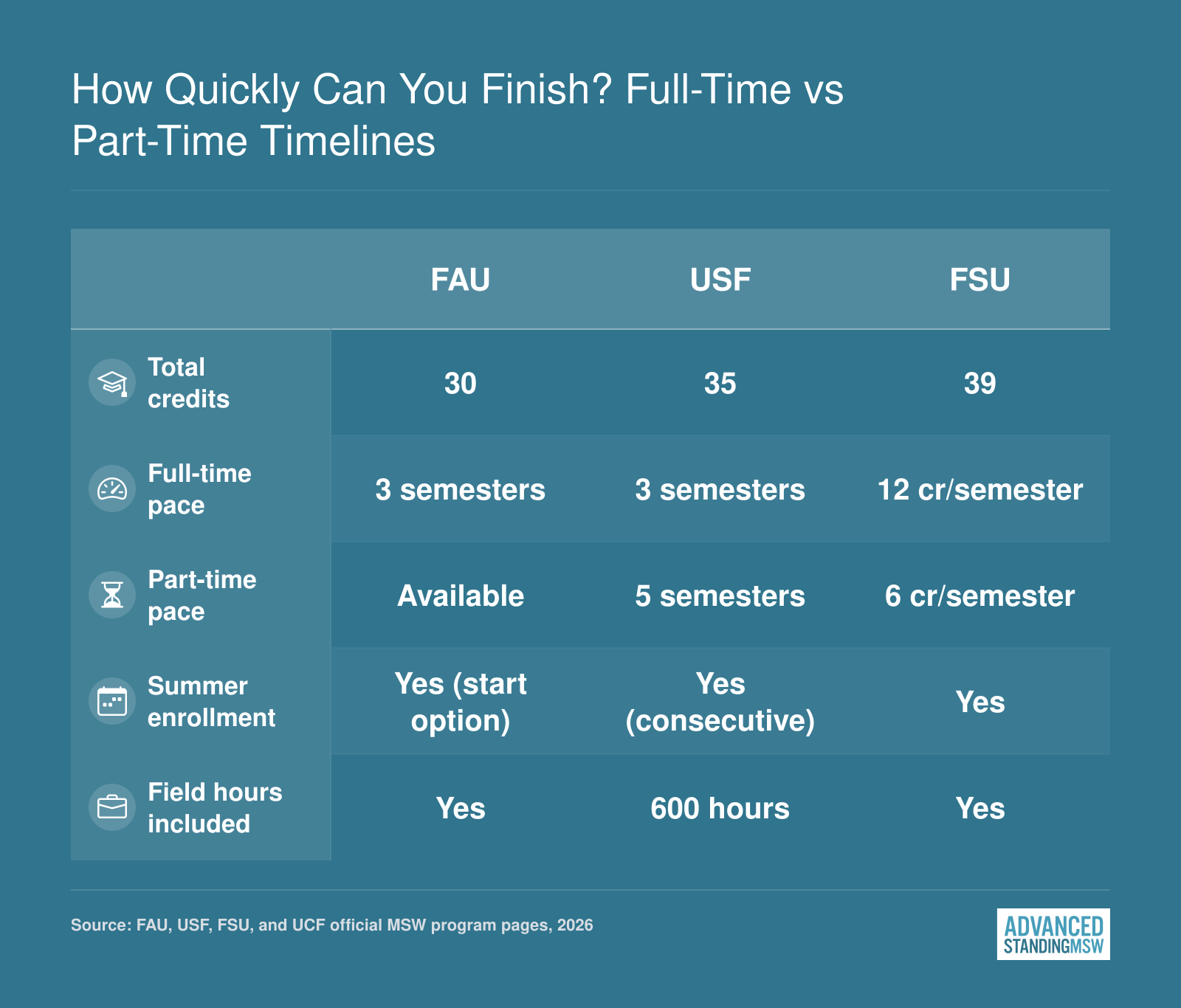
How Quickly Can You Finish? Full-Time vs Part-Time Timelines
Advanced standing MSW programs in Florida typically require 30 to 39 credits, roughly half the 60-plus credits expected in a traditional MSW. That credit reduction translates directly into a shorter runway to your degree, but how short depends on whether you enroll full-time or part-time and whether your program includes mandatory summer terms. Below is a side-by-side look at four representative Florida programs.
Tuition Breakdown: Most Affordable Advanced Standing MSW Programs in Florida
Cost is one of the most important factors when choosing an advanced standing MSW program, and the range across Florida is dramatic. The table below ranks all 11 CSWE-accredited advanced standing MSW options in the state by estimated net price, from lowest to highest. Note that the net price column reflects an institution-wide average after financial aid (not a program-specific figure), so your actual MSW cost will vary based on the aid package you receive. Published tuition rates are program-specific where available. Public universities dominate the affordable end, while private institutions can cost roughly two to three times more after aid.
| School | Sector | Published In-State Tuition (Program) | Published Out-of-State Tuition (Program) | Avg. Net Price After Aid (Institution-Wide) |
|---|---|---|---|---|
| Florida Atlantic University | Public | $6,693 | $18,482 | $8,752 |
| Florida International University | Public | $11,334 | $24,439 | $9,288 |
| University of West Florida | Public | $9,062 | $24,894 | $9,364 |
| University of South Florida | Public | $10,428 | $21,126 | $9,812 |
| University of North Florida | Public | $10,364 | $21,930 | $10,154 |
| University of Central Florida | Public | $8,872 | $28,657 | $10,411 |
| Florida State University | Public | $10,553 | $26,707 | $11,297 |
| Florida Gulf Coast University | Public | $8,961 | $31,216 | $12,568 |
| Saint Leo University | Private | $12,870 | $12,870 | $21,293 |
| Barry University | Private | $19,650 | $19,650 | $22,613 |
| Southeastern University | Private | $10,659 | $10,659 | $31,942 |
Field Placement Hours and LCSW Licensure Readiness in Florida
A common point of confusion for advanced standing applicants is mistaking MSW field placement hours for the supervised clinical experience Florida requires for LCSW licensure. These are separate requirements with vastly different hour totals and timelines. Understanding the distinction early prevents surprises when you start planning your post-graduation path.
Florida's LCSW Requirements at a Glance
To become a licensed clinical social worker in Florida, you must hold a CSWE-accredited MSW, complete no less than 1,500 hours of post-master's supervised clinical experience, and pass the Association of Social Work Boards (ASWB) clinical exam. The supervised hours must be completed after the degree is awarded, under a qualified LCSW supervisor in a setting where you provide clinical services. This requirement sits entirely outside your MSW coursework and field placement.
Field Placement Hours by Program
Advanced standing MSW programs in Florida require between 500 and 600 hours of supervised field placement during the degree. Because advanced standing students already completed a BSW field placement, these programs reduce the total hours compared to traditional MSW tracks, which often demand 900 or more hours. Here is how the fieldwork requirement breaks down for advanced standing students at major Florida public universities:
- Florida Atlantic University: 600 hours
- Florida State University: 512 hours
- University of Central Florida: 600 hours
- University of North Florida: 500 hours
- University of South Florida: 600 hours
- University of West Florida: 600 hours
Most programs spread these hours across two semesters, placing students in agencies that align with their concentration. The hour totals above are for the advanced standing track specifically; traditional MSW students complete a longer field sequence.
Field Hours vs. Post-MSW Supervised Hours
Field placement hours completed during the MSW do not count toward the 1,500 post-degree hours required for LCSW licensure. These are distinct requirements governed by separate policies. MSW field hours satisfy your degree's practical education component and allow you to apply classroom learning under supervision. The 1,500 post-MSW hours, on the other hand, constitute a full-time supervised clinical practice that deepens your competency after you have earned the master's. Thinking of the two as cumulative, as if your MSW field hours chip away at the 1,500, is a common error that can delay your licensure timeline.
Clinical Preparation in Advanced Standing Programs
While all CSWE-accredited programs meet the educational foundation for licensure, some Florida schools explicitly structure their advanced standing tracks to strengthen clinical readiness. Florida State, UCF, and USF, for instance, offer a clinical concentration that includes specialized coursework and field placements in mental health or medical settings. Field coordinators at these programs work to match students with sites that provide relevant clinical experience, which can build a strong case for obtaining a qualified LCSW supervisor position after graduation. Even though those program-level field hours are not counted toward the LCSW requirement, choosing a program with an intentional clinical footprint can smooth the transition to post-master's supervised practice.
What Florida MSW Graduates Earn: Program-Level Salary and ROI Data
Comparing program-specific earnings figures against a university's broad institutional numbers reveals two very different pictures of return on investment. One zooms in on the professional outcomes of MSW graduates from a particular school; the other pools every graduate, from business majors to engineers, into a single median. For someone evaluating advanced standing MSW programs in Florida, understanding that distinction is essential before making a financial commitment.
Why Program-Level Earnings Data Matters
As of 2026, federal program-level earnings data for individual master's degrees in social work is still incomplete. When fully published, it will let prospective students compare what graduates of University of Central Florida's advanced standing MSW actually earned one, two, and four years after completion, side by side with graduates of Florida State, Florida Atlantic, or online programs headquartered elsewhere. The same dataset will show what share of each program's alumni are working and not still enrolled in further education within a year after finishing. Those two numbers, early-career pay and immediate workforce entry, are the raw ingredients of a credible ROI calculation.
Until that data is released, applicants need to interpret the available figures carefully. An institution's overall 10-year median earnings number, the figure that College Scorecard often highlights for a school, includes graduates from dozens of disciplines. A university with a strong engineering or nursing pipeline will report a high institution-wide median that has little bearing on social work pay. Relying on that number alone can overstate the financial return of an MSW from that school.
What We Can Infer from Florida's Social Work Job Market
Even without exhaustive program-level details, several patterns hold for social workers in Florida. Earnings vary substantially by specialization: clinical and healthcare social workers tend to out-earn those in child, family, or school settings. Geographic region within the state also creates a wide spread, with Miami, Orlando, and Tampa metro areas generally offering higher salaries than rural Panhandle counties, though cost-of-living differences complicate a direct comparison. Employer type is another lever: a VA hospital, private practice group, or large nonprofit often pays differently than a small community agency.
Advanced standing graduates who complete their MSW faster also enter the workforce sooner, which shifts the repayment timeline. When tuition debt is moderate and the degree shortens the total study period, the effective annualized return improves even if the first post-MSW salary looks similar to a traditional track graduate's. Prospective students can approximate this by dividing projected total debt by expected starting salary; ratios below 1.0 are generally manageable, while ratios above 1.5 warrant a closer look at income-based repayment options.
Reading Future Data with a Critical Eye
Once program-level metrics are available, the most telling single indicator will be the employment share within one year. A high employment share paired with median earnings that exceed Florida's statewide average for bachelor's degree holders suggests a program is placing its graduates efficiently. Programs where a large chunk of alumni remain enrolled in another degree may be sending graduates into further study rather than into social work jobs, which diminishes the immediate ROI. The 10-year institutional figure will remain a helpful secondary reference, but it should never be mistaken for what an MSW alone delivers.
Application Deadlines and Start Dates for 2026–2027
Application deadlines and start dates are the calendar dates by which your completed application must arrive, paired with the term (summer, fall, or spring) in which you would actually begin coursework. For advanced standing applicants in Florida, these two pieces of information often diverge from the traditional MSW timeline at the same school, so treating them as interchangeable is a common and costly mistake.
Fixed Deadlines by Program
- Florida Atlantic University (FAU): Fixed deadlines of February 1 for summer, May 1 for fall, and October 1 for spring. The advanced standing pathway runs summer-to-fall, meaning you begin electives in summer and enter specialization coursework in fall.
- FSU Tallahassee: May 1, 2026 for Fall 2026 entry and October 1, 2026 for Spring 2027 entry.
- FSU Panama City: A single July 1, 2026 deadline for fall-only entry.3
- FSU Online: March 1 (summer), May 1 (fall), and October 1 (spring), 2026, offering three annual entry points.
- USF Online Advanced Standing: February 15 for a summer entry only. The traditional track starts in fall, but advanced standing does not.
Rolling and Hybrid Timelines
Florida International University (FIU) reviews applications on a rolling basis, though term-specific submission windows still apply, so earlier is better. The University of North Florida (UNF) admits its advanced standing cohort for summer entry using an early decision date of February 1 and a final deadline of March 1, with interviews and decisions issued on a rolling basis within about two weeks of submission.6
Advanced standing cohorts frequently close earlier than the traditional MSW cohorts at the same institution, particularly where summer entry is involved. Confirm the advanced standing calendar directly with each program before you plan around a general MSW deadline you saw elsewhere on the school's site.
Selecting the Right Advanced Standing MSW in Florida for Your Career Goals
The demand for licensed clinical social workers in Florida has never been stronger, but the pipeline from BSW to LCSW is growing more competitive each year. The advanced standing MSW program you choose will shape your clinical training, licensure timeline, and earning potential, so making a deliberate choice matters more than ever.
Accreditation: The Non-Negotiable First Filter
Before comparing curricula or tuition, confirm that each program holds current CSWE accreditation. Florida's LCSW board requires a degree from a CSWE-accredited program, and without it, you cannot sit for the ASWB clinical exam. This requirement is non-negotiable, and no amount of field experience or post-graduate training can substitute.
Clarify Your Track: Clinical, Macro, or Somewhere Between
Advanced standing programs in Florida typically offer two primary paths. Clinical tracks prepare you for direct practice, psychotherapy, and LCSW licensure, while macro tracks focus on community organizing, policy, and administration. If you plan to pursue clinical licensure, select a program that embeds clinical coursework and supervised field hours aligned with Florida's LCSW requirements. Note that some online programs serve all tracks but may limit practicum options for macro students.
Field Placement Geography Matters
Do not wait until after admission to ask about field placement sites. Contact the field placement office directly to confirm availability of sites in your county, especially if you are enrolled in an online or out-of-area program. Some Florida schools have strong relationships with local hospitals and agencies, while others may require you to identify your own placement. Clarifying this early prevents delays in completing required hours.
Cost: Look Beyond the Sticker Price
Tuition rates among Florida's advanced standing MSW programs vary widely, but sticker price rarely tells the full story. Use each program's net price calculator, ask about graduate assistantships, and compare financial aid packages. A program with higher listed tuition may become more affordable than a less expensive program after factoring in institutional grants or employer reimbursement programs. Focus on net price after aid, not the published rate.
Next Step: Build a Shortlist and Compare
Request information from two to three programs that align with your career goals and regional preferences. Lay their admission requirements, projected timelines, and net cost estimates side by side. This side-by-side comparison, grounded in verified accreditation and field placement feasibility, turns an overwhelming decision into a reasoned next step toward your MSW.