What you’ll learn in this article…
- Five CSWE-accredited Washington programs offer advanced standing MSW tracks in 2026.
- Washington social workers earn mean wages from roughly $62,000 to $92,000 by specialty.
- BSW recency rules vary, with most programs requiring graduation within five to seven years.
Advanced standing MSW programs in Washington trim roughly 30 credits and an entire academic year from the standard two-year curriculum. For BSW graduates, that means one fewer year of graduate tuition, fees, and living expenses, and one extra year of licensed earnings.
Washington’s CSWE-accredited advanced standing options, though limited in number, now span fully on-campus, fully online, and hybrid delivery models, covering the Seattle metro, Spokane, and beyond. In a state with a well-documented behavioral health workforce shortage, the accelerated pathway is more than a time-saver; it is a direct line to filling urgent employer demand.
That scarcity of seats, however, means you’ll need to weigh program cost, format, and licensure alignment carefully before applying.
What Is an Advanced Standing MSW, and How Is It Different From a Traditional MSW?
A traditional MSW requires two full academic years of study, while an advanced standing MSW compresses that timeline to approximately one year for students who already hold a BSW. Understanding this distinction helps you evaluate whether the accelerated route aligns with your credentials and career timeline.
The Foundation You Already Built
Advanced standing programs recognize that BSW graduates have already completed foundational social work education: human behavior theory, introductory policy analysis, generalist practice methods, and an undergraduate field placement. Rather than repeating this content, advanced standing students enter directly into concentration-year coursework, focusing on specialized clinical skills, advanced practice methods, or macro-level intervention strategies.
This structure typically translates to 30 to 40 credit hours for advanced standing students compared to 60 or more credits for traditional MSW candidates. The time savings is real: you can earn your MSW in 9 to 12 months of full-time study, or 18 to 24 months at a part-time pace, depending on program structure.
Field Practicum Requirements
Advanced standing students still complete a graduate-level field practicum, but the total hour requirement is usually lower than what traditional students accumulate across two years. Most Washington programs require between 450 and 600 field hours for advanced standing candidates, compared to 900 or more for students completing both foundation and concentration placements. Your undergraduate field experience counts toward your overall development as a practitioner, so graduate placements build on that base rather than starting from scratch.
The Eligibility Gate
The key requirement is straightforward: your BSW must come from a program accredited by the Council on Social Work Education (CSWE). Programs also impose a recency window, typically requiring that you earned your BSW within the past five to seven years. If your degree is older, some programs offer bridge coursework to refresh foundational knowledge before you begin concentration-level study. Each Washington program sets its own recency policy, so verifying your eligibility early prevents application surprises.
Questions to Ask Yourself
Tuition, Credits, and Field Hours Compared Across Washington Programs
Published tuition figures represent sticker prices before institutional aid, scholarships, stipends, or employer reimbursement. Net cost after aid can differ substantially, so contact each program's financial aid office for a personalized estimate. Where official data on specific fields (such as total field hours or exact program length) was not available from verified sources, cells are marked N/A.
| School | Format | Total Credits | Estimated Tuition (In-State) | Estimated Tuition (Out-of-State) | Required Field/Clinical Hours | Program Length |
|---|---|---|---|---|---|---|
| University of Washington, Seattle | Campus | 48 | $18,792 | $32,811 | 680 | 5 quarters (about 15 months) |
| Heritage University, Toppenish | Hybrid (online with in-person Saturdays) | N/A | $10,620 | $10,620 | N/A | Approximately 1 year |
| Pacific Lutheran University, Tacoma | Hybrid (synchronous and asynchronous) | N/A | $30,535 | $30,535 | 900 clinical hours | 14 months |
| Walla Walla University, College Place | Online (synchronous and asynchronous) | 45 | $28,446 | $28,446 | 900 clinical hours | 4 quarters (12 months) |
| Seattle University, Seattle | Campus | 39 | $24,216 | $24,216 | 600 | 10 months |
| Eastern Washington University | Campus | 51 | N/A | N/A | N/A | 6 quarters (approximately 2 years) |
Online, Campus, or Hybrid: Format Options for Washington BSW Graduates
Choosing the right delivery format can make or break your advanced standing MSW experience, especially if you are balancing work, family, or geography. Washington programs span four distinct models: fully on campus, hybrid with scheduled in-person days, hybrid with low-residency requirements, and fully online. Below is a side-by-side look at scheduling flexibility, synchronous expectations, field placement logistics, and part-time availability across the state's options.
| Program | Delivery Format | Synchronous Component | Part-Time Option | Typical Timeline | Field Placement Notes |
|---|---|---|---|---|---|
| University of Washington, Seattle | Fully on campus | Yes, in-person class sessions on the Seattle campus | Part-time advanced standing admission was suspended as of June 2025; availability for 2026 entry should be confirmed directly with the school | 12 months (full time) | 680 hours of integrated field practicum required; the program has not published guidance indicating placements may be completed outside Washington |
| Seattle University | On campus | Yes, in-person sessions in Seattle with small class sizes | Not confirmed in available program materials | Approximately 10 months | 600 clinical field hours required |
| Eastern Washington University | Hybrid (online coursework plus in-person components) | Yes, includes required on-site sessions at the Spokane or Everett location | Yes. Part-time students complete the program across 6 quarters plus a summer seminar | Full time: 3 quarters plus summer seminar; Part time: 6 quarters plus summer seminar | Field education required; the program serves students in Washington and the Idaho panhandle, though an explicit geographic restriction on placement sites is not stated in published materials |
| Pacific Lutheran University, Tacoma | Low-residency hybrid | Yes, the program uses both synchronous and asynchronous components in a cohort-based structure | Not confirmed in available program materials | 14 months | 900 clinical hours required; the low-residency model may allow greater geographic flexibility, but confirm placement rules with the program |
| Walla Walla University | Fully online | Classes are delivered online in the evenings with both synchronous and asynchronous elements | Not confirmed in available program materials | 12 months (4 quarters) | 900 clinical hours required; the online format and practicum placement support suggest students may arrange local sites, but verify directly with the program |
| Heritage University, Toppenish | Hybrid (asynchronous online coursework with in-person Saturday sessions) | Saturday on-campus meetings are required | Not confirmed in available program materials | Approximately 1 year | Field education required; the program emphasizes service to rural and diverse communities in the Yakima Valley region |
Related Articles
Admission Requirements and BSW Recency Rules by Program
Standard admission versus advanced standing: one path asks for broad readiness, the other demands proof that your BSW is recent and rigorous. While a traditional MSW applicant can bring a degree in psychology, sociology, or even an unrelated field, advanced standing candidates must show that their undergraduate social work education is still fresh and their academic record signals graduate-level capability. Washington programs generally uphold similar guardrails, but key details (GPA floors, recency cutoffs, and GRE expectations) vary enough to shape where you should apply.
GPA Minimums: The 3.0 Baseline and Exceptions
Most Washington advanced standing MSW programs set a minimum cumulative GPA of 3.0 on a 4.0 scale for the last 60 credit hours or for the entire undergraduate degree. Eastern Washington University’s MSW program, for instance, expects BSW or BASW graduates from CSWE-accredited programs to meet that threshold, though the university may consider qualifying petitions if the GPA is slightly below.1 The University of Washington’s advanced standing track is highly competitive and typically looks for a GPA well above the minimum, although an exact published floor was not available in recent admission materials. For Seattle University, Pacific Lutheran University, Walla Walla University, and Heritage University, program-specific GPA requirements were not part of our 2026 research snapshot. Before committing to an application, confirm each school’s current GPA expectation directly on its admissions page, because thresholds can shift year to year.
BSW Recency Windows: When Your Degree Still Counts
A defining feature of advanced standing admission is the recency window: schools require that your BSW was awarded within a certain number of years to guarantee that your foundational knowledge is current. In Washington, the typical window ranges from five to seven years after BSW graduation. If your degree falls outside that period, you are not necessarily locked out. Many programs offer bridge options, such as completing a foundational practice course, passing a competency exam, or adding extra field hours, to refresh your skills before beginning the advanced curriculum. Eastern Washington University and the University of Washington did not publish specific recency rules in the 2026-2027 materials we reviewed; however, both emphasize that applicants must hold a BSW or BASW from a CSWE-accredited institution.1 Because recency policies can differ sharply between schools and sometimes vary by concentration, reach out to admission coordinators early if your BSW is older than five years.
GRE Policies: Mostly Optional, but Verify
Post-pandemic, the vast majority of MSW programs nationally and in Washington have eliminated the GRE requirement or made it optional. Neither Eastern Washington University nor the University of Washington lists a GRE mandate for advanced standing applicants in the 2026-2027 cycle.1 The trend holds broadly across the state, but always verify the latest policy on the program website, particularly if you hope to use a strong GRE score to offset a lower GPA. Do not assume every school has abandoned the test; a handful of programs may still request scores for certain applicants.
Application Deadlines and the Advanced Standing Advantage
Advanced standing cohorts often operate on a tighter calendar than traditional MSW tracks, so missing a deadline can sideline your accelerated plan by a full year. For the 2026-2027 cycle, the University of Washington’s advanced standing deadline is January 15, 2026.2 Eastern Washington University opens its MSW application on October 1 each year,1 but no closing date was public in our review. Other Washington programs, including Seattle University, Pacific Lutheran University, Walla Walla University, and Heritage University, did not have 2026-2027 deadlines available at the time of writing. Because advanced standing is an expedited pathway, programs often review applications earlier and make decisions sooner. Mark your calendar with each school’s date, and aim to submit well before the cutoff to allow time for transcript processing and reference letters.
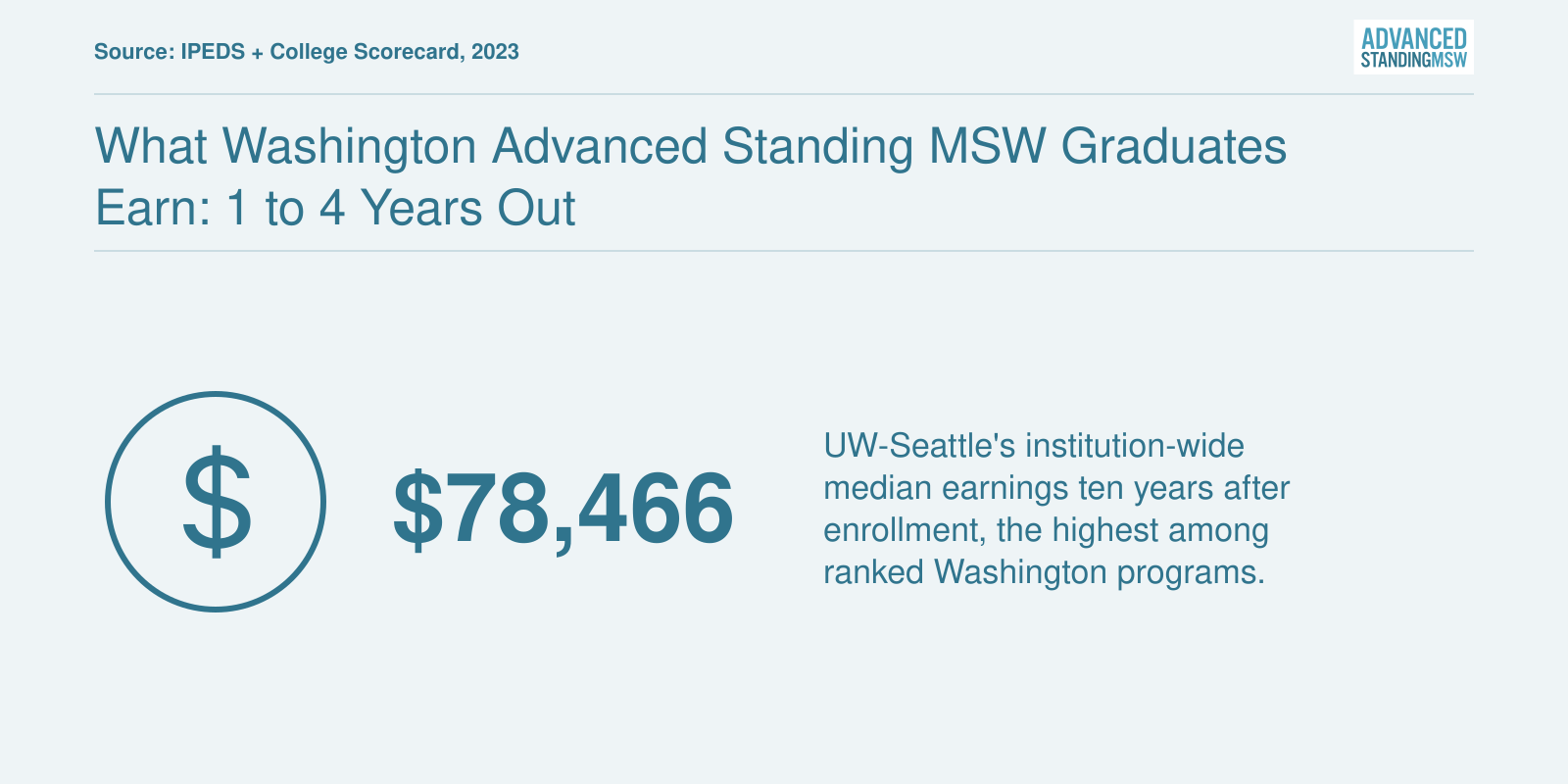
What Washington Advanced Standing MSW Graduates Earn: 1 to 4 Years Out
Program-level earnings data from the College Scorecard, which tracks actual wages reported by program completers one, two, and four years after graduation, are not yet published for the advanced standing MSW programs at any of the five ranked Washington schools. Because these figures are released on a rolling basis and depend on sufficient completer counts for privacy thresholds, they may appear in future Scorecard updates. For now, the best earnings reference point is the institution-level median: UW-Seattle graduates across all programs report a median of $78,466 at ten years out, the highest among these five schools.
Social Worker Salaries in Washington State: Occupation-Level Context
What can I realistically earn as a social worker in Washington after an advanced standing MSW?
Washington’s employment data from the Bureau of Labor Statistics (May 2023) breaks social work into three key specialties. Mean annual wages across the state show a tight band:
- Child, family, and school social workers: $64,860 per year
- Mental health and substance abuse social workers: $67,280 per year
- Healthcare social workers: $70,390 per year
These are averages; experienced clinicians and those in high-demand niches often climb higher. National percentile estimates give a sense of the spread, though they aren’t state-specific. For child, family, and school social workers nationwide, the 10th percentile earns $42,280 while the 90th percentile reaches $95,530. Healthcare social workers show a similar range, from $45,030 at the 10th percentile to $100,870 at the 90th. Washington’s wages tend to sit above the national median, reflecting the state’s higher cost of living and strong demand.
Where you work affects your paycheck
Metro-level data for specific social work subspecialties isn’t published by BLS, but broader social worker salary summaries from 2026 give a useful benchmark for urban Washington:
- Seattle: $80,250 median
- Spokane: $76,650 median
- Tacoma: $74,450 median
- Vancouver: $69,400 median
These figures encompass all social worker roles and likely include both bachelors-level and masters-level practitioners. Clinical social workers, who hold an LICSW and can independently diagnose and treat mental health conditions, typically command the highest salaries. That’s where an advanced standing MSW becomes a strategic accelerant. By shaving a full year off the traditional MSW timeline, you enter the supervised experience phase sooner and unlock LICSW eligibility faster.
Advanced standing puts licensure and higher earnings within reach
Washington’s licensure ladder is cumulative: the LSWAIC allows you to begin clinical work under supervision; the LASW marks independent non-clinical practice; the LICSW permits independent clinical practice. Each step generally opens doors to higher-paying roles. Advanced standing students often start their post-MSW supervision while classmates in traditional programs are still completing foundation courses. Over a career, that head start translates to an extra year of LICSW-level income, and for someone in the top quartile of earners, that difference can be substantial.
Did you know social work employment nationwide is projected to grow 6 percent from 2024 to 2034, according to the Bureau of Labor Statistics Occupational Outlook Handbook? That pace outstrips many other occupations, and Washington's aging population, behavioral health needs, and expanding integrated care settings suggest demand for MSW-credentialed clinicians here will track right along with, or even exceed, that national trend.
Washington Social Work Licensure: How Your MSW Maps to LSWAIC, LASW, and LICSW
Washington State structures social work practice around three graduate-level licenses, each unlocking different scopes of responsibility and clinical independence. The Washington State Department of Health administers this tiered system,1 and your MSW from any CSWE-accredited program, whether completed through advanced standing or a traditional track, meets the educational threshold for all three credentials.
The Three Graduate-Level Licenses
- LSWAIC (Licensed Social Work Associate, Independent Clinical): This entry-level clinical credential requires an MSW or social work doctorate.1 No supervised hours are prerequisites to obtain it. Instead, the LSWAIC functions as a working license that allows you to accumulate supervised clinical experience toward full independent licensure.
- LASW (Licensed Advanced Social Worker): Also requiring an MSW or doctorate, this license centers on advanced generalist practice. You must pass the ASWB Advanced Generalist exam to qualify.1 The LASW suits practitioners focused on macro-level work, program administration, or community practice rather than clinical therapy.
- LICSW (Licensed Independent Clinical Social Worker): This is the highest clinical credential in Washington. Beyond your MSW, you need 3,000 hours of postgraduate supervised experience, including at least 800 direct client-contact hours. You must also complete 90 hours of supervision under a LICSW or an LASW who has held their license for at least two years. The final step is passing the ASWB Clinical exam.1
Which License Can You Pursue Immediately?
As a new advanced standing MSW graduate, you are immediately eligible to apply for either the LSWAIC or LASW, depending on your career direction. If your goal is clinical practice and eventual independent licensure, most graduates start with the LSWAIC, which authorizes you to begin accruing supervised hours right away. If you are drawn to policy, administration, or community-based roles, the LASW may be the more fitting path.
The Road to LICSW
Most clinically focused graduates want to reach LICSW status, and the timeline depends on your employment setting. At a full-time clinical position, accumulating 3,000 supervised hours typically takes two to three years. Your supervisor must be a licensed LICSW or a qualifying LASW, and you will need documentation of those 90 supervision hours along with 800 direct client-contact hours before sitting for the ASWB Clinical exam.
Advanced Standing Does Not Affect Eligibility
The Department of Health does not distinguish between advanced standing and traditional MSW graduates. Both pathways produce the same CSWE-accredited degree, and both satisfy the educational requirements for LSWAIC, LASW, and LICSW. The condensed timeline of your program has no bearing on your licensure eligibility or the hours required for independent practice.
Selecting the Right Advanced Standing MSW Program for Your Goals
Washington's behavioral health workforce shortage has accelerated program innovation, giving BSW graduates more accelerated-pathway options than ever. The right choice hinges on your intended career direction, financial situation, and personal schedule, not just a school's overall reputation.
For Clinical-Track Students
If you aim to become a Licensed Independent Clinical Social Worker (LICSW), look for advanced standing curricula that embed clinical theory, DSM-based assessment, and psychotherapeutic modalities. Strong practicum partnerships matter: programs that place students in community mental health centers, hospital behavioral health units, or integrated primary care settings give you supervised hours that align with licensure requirements. Verify that the concentration explicitly says "clinical" or "mental health," because some programs lean toward generalist practice even in the advanced year.
For Macro-Oriented Students
Community practice, policy, and administration tracks are less common in Washington but available at select schools. If your goal is program management, advocacy, or systems-level change, search for concentrations labeled "community-centered practice," "organizational leadership," or "policy practice." Inspect the field placement catalog for rotations in legislative offices, nonprofit headquarters, or public health departments. A macro track should replace some clinical fieldwork with project-based learning and grant-writing experiences.
For Budget-Conscious Students
Tuition differences between public and private institutions can be significant. The comparison table earlier in this article breaks down per-credit costs and total program fees. Look beyond sticker price: ask about graduate assistantships, Title IV-E stipends for child welfare, and need-based institutional aid. In-state residency at a public university often cuts the cost by half or more. Revisit that table after identifying programs with your desired concentration to weigh net price against career payoff.
For Working Professionals
Part-time, evening, and fully online formats are now available at several Washington schools, including programs designed specifically for BSW holders employed in social services. Confirm whether synchronous class times conflict with your work schedule and whether field placements can be arranged at your current employer. A hybrid model that combines occasional weekend intensives with asynchronous coursework may offer the most flexibility without sacrificing cohort connection.
Accreditation and BSW Recency
Before applying, verify that the program holds current CSWE accreditation, which is essential for licensure in Washington. Also confirm that your BSW falls within the program's recency window. Most schools require the BSW to have been earned within the last five to seven years; some will accept an older degree if you have recent practice experience. Contact the admissions office if you are near the cutoff so you do not waste an application fee.